Basic 6 · Physical Education · Rhythmic Skills
Changing Direction While Running with an Object
In this topic you will change direction quickly while running with an object through obstacles, keeping your balance.
By the end of these notes you should be able to:
- Use dodging, pivoting and sidestepping
- Run with an object through an obstacle course
- Maintain balance when changing direction quickly
What you already know
- Changing direction while walking with an object (Basic 5)
Copy everything that has a blue line on its left into your notebook. The other parts are for reading.
- Strand
- Motor Skill And Movement Patterns
- Sub-strand
- Rhythmic Skills
- Indicator
- B6.1.5.1.6 – Change direction quickly to maintain ones’ balance whiles running with an object through obstacles
Introduction
A footballer dribbling past defenders and a netballer pivoting to pass both change direction quickly while controlling the ball. This skill is called agility.
1. Techniques for Changing Direction
| Technique | How |
|---|---|
| sidestep | plant one foot and push off sideways in the opposite direction |
| pivot | keep one foot on the ground and turn on it (as in netball) |
| dodge | fake one way with the head and shoulders, then go the other way |
| cutting | sharp change of direction at an angle while running |
2. Keys to Balance
- Lower your centre of gravity by bending your knees before turning.
- Take short, quick steps before the turn.
- Plant the outside foot firmly and push off.
- Keep your head up and eyes forward.
- Hold or control the object close to your body.
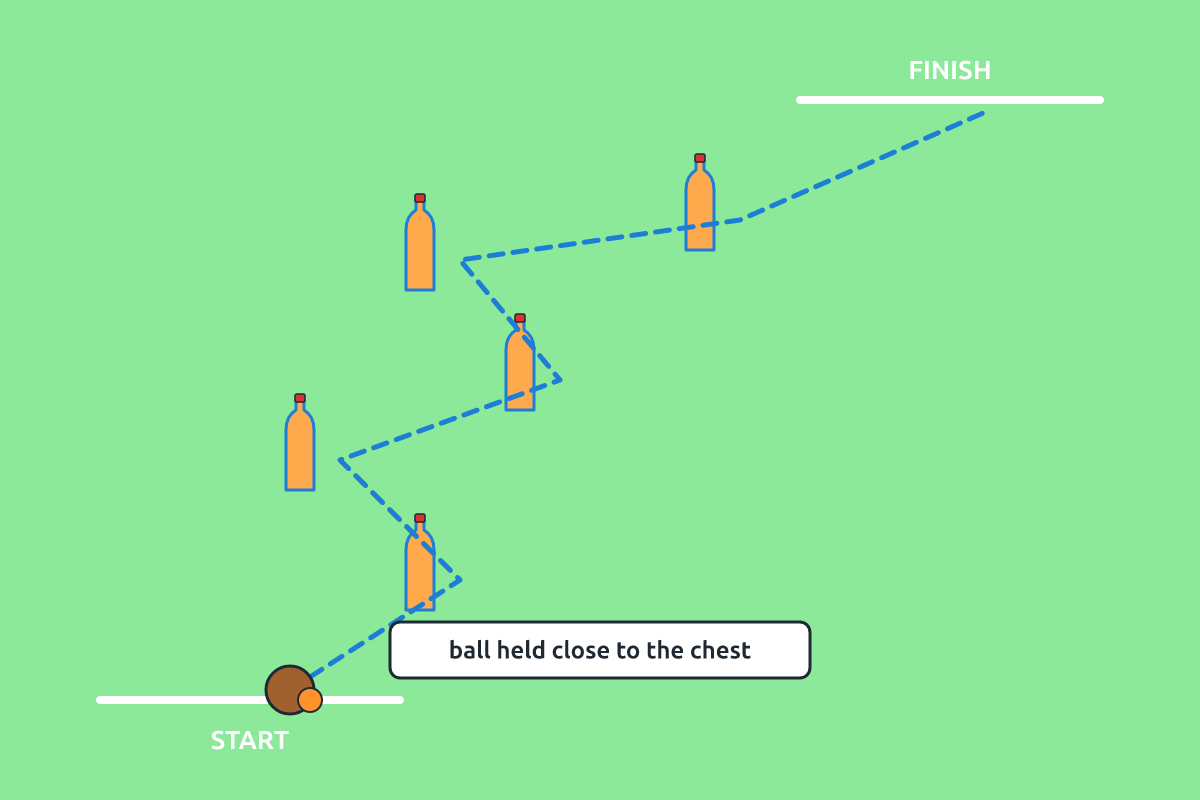
3. Obstacle Course
| Station | Task |
|---|---|
| 1 | sprint 10 m carrying a ball |
| 2 | zigzag through 6 cones 2 m apart |
| 3 | sidestep along a 5 m line |
| 4 | dodge around a stationary "defender" (a pole) |
| 5 | pivot and pass the ball to a teammate |
| 6 | sprint back to the finish |
Time each runner. Penalties of 2 seconds are added for each knocked cone or dropped ball. Try to improve your time over three attempts while keeping control.
4. Agility in Sports
Agility is used in football, basketball, netball, handball and rugby. Strong leg muscles, good balance and quick reactions improve agility. Practise ladder drills, shuttle runs and cone drills to develop it.
Safety: Warm up and stretch the ankles and knees. Use flat, non-slippery ground. Keep a safe distance from other runners.
New words
- agility
- The ability to change direction quickly with control.
- pivot
- To turn on one foot.
- sidestep
- To step sideways quickly.
- dodge
- To avoid by moving quickly.
- shuttle run
- Running back and forth between two lines.
- penalty
- A disadvantage for breaking a rule.
Summary
- Use sidesteps, pivots, dodges and cuts to change direction.
- Bend the knees and take short steps to stay balanced.
- Keep the object close to your body.
- Agility is important in many team sports.
Class activity: Agility Challenge
- Set up the six-station obstacle course.
- Time each member over three attempts.
- Record and discuss which techniques helped most.
You need: Plastic-bottle cones, Sticks of chalk, Whistle
Exercises
Answer in your exercise book first, then check your answers.
1. The ability to change direction quickly is…
- A. agility
- B. strength
- C. endurance
- D. flexibility
Show answer
Answer: agilityWith control.2. Turning on one foot is a…
- A. pivot
- B. sprint
- C. jump
- D. roll
Show answer
Answer: pivotUsed in netball.3. To keep balance when turning, you should…
- A. bend your knees
- B. stand straight
- C. close your eyes
- D. take long steps
Show answer
Answer: bend your kneesLowers centre of gravity.4. Keeping your head up helps balance.
- A. True
- B. False
Show answer
Answer: TrueAnd awareness.5. Long steps are best before a sharp turn.
- A. True
- B. False
Show answer
Answer: FalseShort, quick steps.6. Running back and forth between two lines is a ______ run.
Show answer
Answer: shuttleAgility drill.7. List three agility techniques.
Show answer
Answer: Sidestep, pivot, dodge (or cutting).Any three.8. Why should the object be kept close to the body when changing direction?
Show answer
Answer: It is easier to control, less likely to be dropped and keeps the body balanced.Control.
Homework
- Do shuttle runs between two marks 5 m apart for 3 sets of 30 seconds.