Basic 6 · History · Political Development
The Road to Independence, 1946–1957
In this topic you will describe the constitutional changes and events that ended British colonial rule and led to Ghana's independence in 1957.
By the end of these notes you should be able to:
- Describe the key constitutional changes from 1946 to 1957
- Explain the events of 1948 and their effects
- Explain how Ghana gained independence
What you already know
- Guggisberg and colonial development
Copy everything that has a blue line on its left into your notebook. The other parts are for reading.
- Strand
- Colonization & Development
- Sub-strand
- Political Development
- Indicator
- B6.4.4.1.1 – Describe the features of British colonial rule in Ghana including direct and indirect rule, 1874–1957
Introduction
In just eleven years, from 1946 to 1957, the Gold Coast moved from colonial rule to full independence. Brave leaders and ordinary citizens made this possible.
1. The Burns Constitution (1946)
The Burns Constitution, named after Governor Sir Alan Burns, gave Africans a majority in the Legislative Council for the first time. However, most African members were still chosen indirectly, and the Governor kept real power. Many Ghanaians felt it was not enough.
2. The Events of 1948
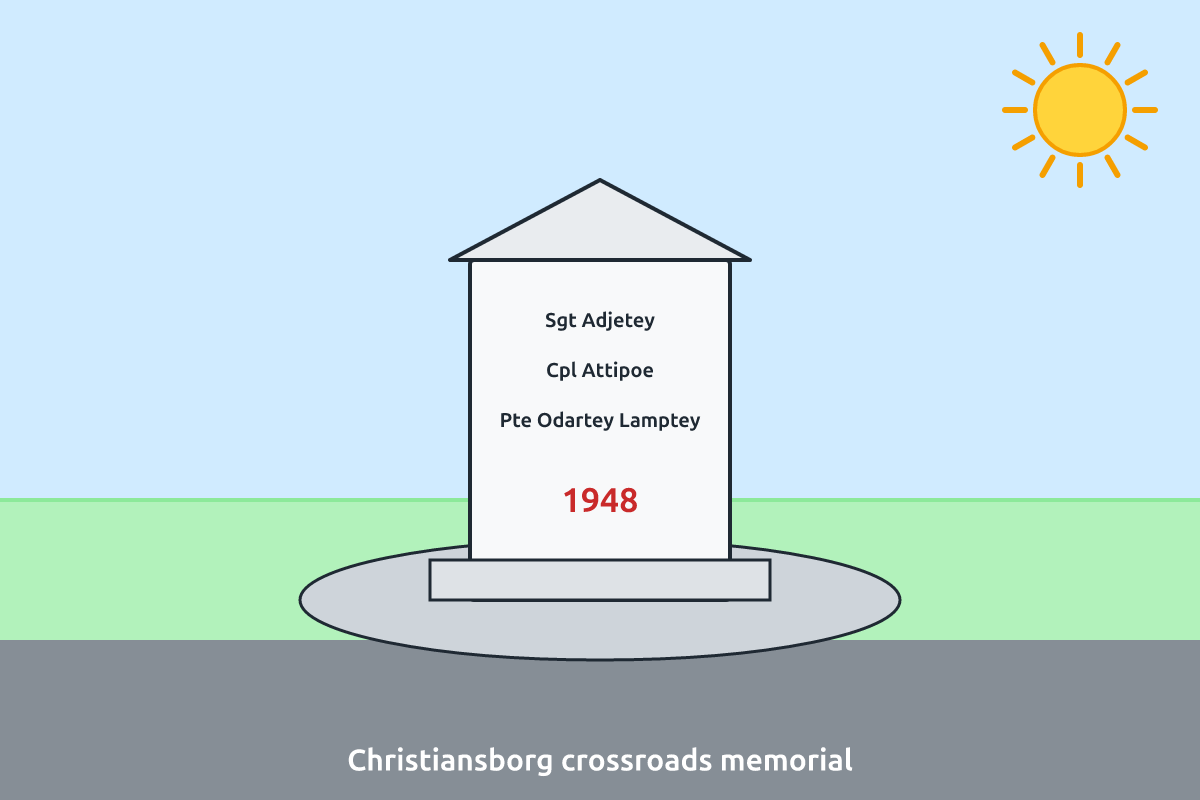
In 1947, the United Gold Coast Convention (UGCC) was formed, and Kwame Nkrumah became its general secretary. On 28th February 1948, ex-servicemen who had fought for Britain in the Second World War marched peacefully to Christiansborg Castle to present a petition about their unpaid benefits. At the Christiansborg crossroads, police opened fire, killing Sergeant Adjetey, Corporal Attipoe and Private Odartey Lamptey. Riots spread to other towns. The Big Six leaders of the UGCC were arrested.
3. Towards Self-Government
| Year | Event |
|---|---|
| 1948 | Watson Commission investigates the riots and recommends a new constitution |
| 1949 | Coussey Committee drafts a new constitution; Nkrumah forms the CPP (12th June) |
| 1950 | "Positive Action" campaign; Nkrumah imprisoned |
| 1951 | Coussey Constitution; CPP wins the general election; Nkrumah becomes Leader of Government Business |
| 1952 | Nkrumah becomes Prime Minister |
| 1954 | new constitution; CPP wins another election; all-African cabinet |
| 1956 | CPP wins again; British Togoland votes to join the Gold Coast |
| 1957 | independence on 6th March; the Gold Coast becomes Ghana |
4. Independence Day
At midnight on 5th–6th March 1957, at the Old Polo Ground in Accra, Kwame Nkrumah declared: "At long last, the battle has ended! And thus Ghana, your beloved country, is free for ever!" Ghana became the first country in sub-Saharan Africa to gain independence from colonial rule, inspiring other African countries to fight for their freedom.
5. Why Independence Was Achieved
- Strong leadership by the UGCC and CPP.
- Mass support from workers, farmers, women, youth and ex-servicemen.
- The effects of the 1948 riots.
- Britain's weakened position after the Second World War.
- International pressure for the end of colonial rule.
New words
- independence
- Freedom from rule by another country.
- ex-servicemen
- Former soldiers.
- petition
- A formal written request.
- Positive Action
- Nkrumah's campaign of strikes and non-violent protest in 1950.
- cabinet
- A group of ministers who lead the government.
- general election
- A national vote to choose leaders.
Summary
- The Burns Constitution (1946) gave Africans a majority but little real power.
- The 1948 shooting of ex-servicemen sparked riots and change.
- The CPP won elections in 1951, 1954 and 1956.
- Ghana became independent on 6th March 1957.
Class activity: Independence Timeline
- Create a large timeline from 1946 to 1957.
- Add each event with a picture.
- Act out Nkrumah's independence speech.
You need: Ghana map, Locally made colonial timeline cards, Printed photographs of Ghanaian chiefs, Colonial officials
Exercises
Answer in your exercise book first, then check your answers.
1. Ghana became independent on…
- A. 6th March 1957
- B. 1st July 1960
- C. 24th July 1874
- D. 28th February 1948
Show answer
Answer: 6th March 1957Independence Day.2. Which event happened on 28th February 1948?
- A. Shooting of ex-servicemen at Christiansborg crossroads
- B. Independence
- C. Formation of the CPP
- D. Bond of 1844
Show answer
Answer: Shooting of ex-servicemen at Christiansborg crossroadsIt led to riots.3. Nkrumah formed the CPP in…
- A. 1949
- B. 1947
- C. 1957
- D. 1966
Show answer
Answer: 1949On 12th June.4. Sergeant Adjetey was killed in 1948.
- A. True
- B. False
Show answer
Answer: TrueAt the crossroads.5. Ghana was the last African country to gain independence.
- A. True
- B. False
Show answer
Answer: FalseIt was the first in sub-Saharan Africa.6. Nkrumah's 1950 campaign of strikes was called Positive ______.
Show answer
Answer: ActionNon-violent protest.7. Name three steps towards independence after 1948.
Show answer
Answer: Coussey Committee (1949), CPP wins 1951 election, Nkrumah becomes Prime Minister (1952).Any three.8. Explain why the 1948 riots were important for independence.
Show answer
Answer: They showed strong anger against colonial rule, led to the Watson Commission and the Coussey Constitution, and sped up self-government.Turning point.
Homework
- Learn part of Nkrumah's independence speech and explain what it means.