Basic 6 · History · Impact of European Presence
Assessing the European Presence: Costs and Benefits
In this topic you will weigh the positive and negative effects of the European presence in Ghana and form a balanced judgement.
By the end of these notes you should be able to:
- Summarise the positive and negative effects of European presence
- Explain the negative effects such as wars and loss of sovereignty
- Make and support a balanced judgement
What you already know
- European impact
Copy everything that has a blue line on its left into your notebook. The other parts are for reading.
- Strand
- Europeans In Ghana
- Sub-strand
- Impact of European Presence
- Indicator
- B6.3.4.1.1 – Assess the changes that the European presence brought to Ghana
Introduction
Historians do not just list facts. They weigh evidence and make judgements. Was the European presence good or bad for Ghana? The answer is not simple.
1. The Negative Side
| Effect | Explanation |
|---|---|
| the slave trade | millions of people were taken away; communities were destroyed |
| wars | European rivalry and the Anglo-Asante wars (1824–1900) caused death and destruction |
| loss of sovereignty | Ghanaians lost control of their own government to the British |
| exploitation | gold, timber and cocoa profits mostly went to Europe |
| cultural damage | traditional religion and customs were sometimes condemned |
| unequal development | the south developed more than the north |
2. The Anglo-Asante Wars
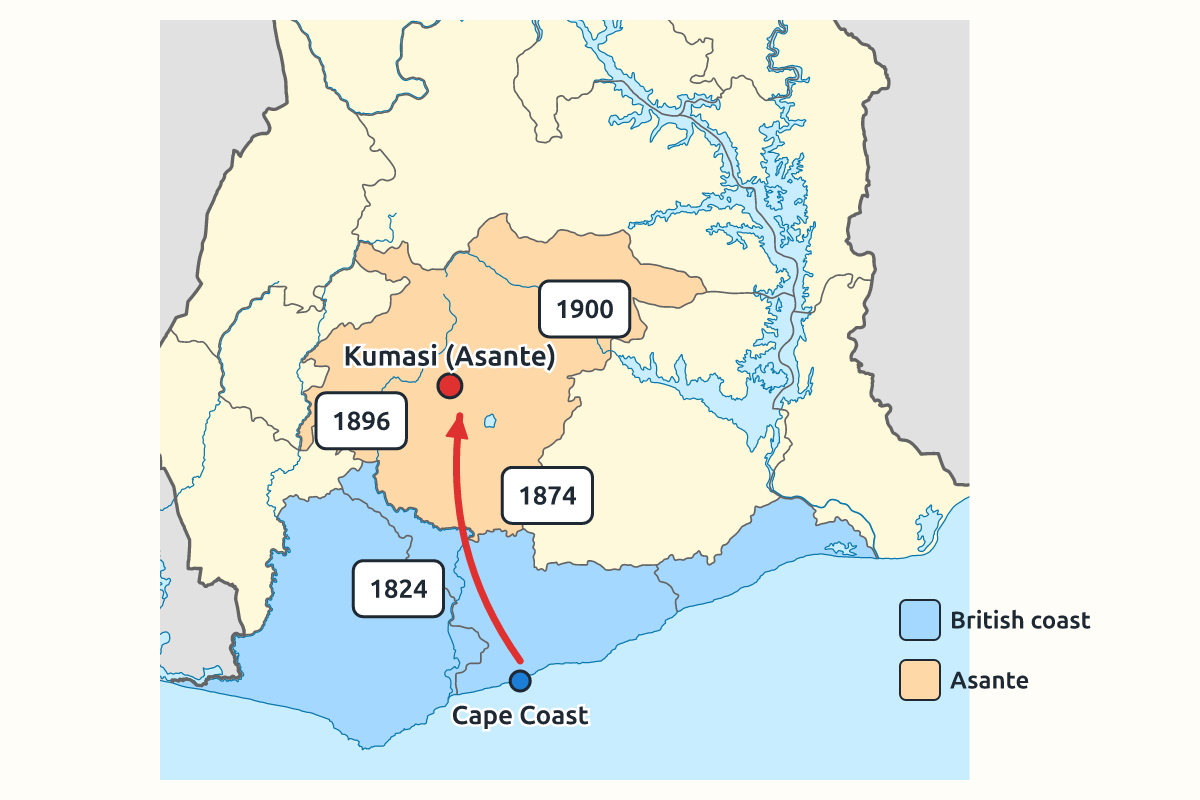
Between 1824 and 1900, Asante and Britain fought several wars over control of trade and the coast. In 1874, British troops burnt Kumasi. In 1896, the British exiled the Asantehene, Nana Agyeman Prempeh I, to the Seychelles. In 1900, the Yaa Asantewaa War broke out when the British governor demanded the Golden Stool. After this war, Asante was made part of the British colony in 1901.
3. The Positive Side (Summary)
- Formal education and literacy.
- Hospitals and modern medicine.
- Railways, roads and harbours.
- New crops such as cocoa, maize and cassava.
- A common official language and a modern legal and banking system.
4. Making a Balanced Judgement
A balanced judgement looks at both sides, gives evidence, and then states a conclusion with reasons. For example: "The European presence brought schools, hospitals and railways that are still useful today. However, it also brought the slave trade, wars and the loss of Ghanaian independence, and much of the wealth went to Europe. Overall, the benefits came at a very high human cost, and many were designed to serve European interests."
Tip: Use words such as however, on the other hand, overall and in conclusion to show balance.
Different people may reach different judgements from the same evidence. What matters is that your judgement is supported by facts and that you consider the views of those who suffered as well as those who benefited.
New words
- sovereignty
- The right of a people to govern themselves.
- exploitation
- Using people or resources unfairly for profit.
- exile
- Being forced to live outside one's country.
- judgement
- A decision based on evidence.
- evidence
- Facts that support a statement.
- balanced
- Considering both sides fairly.
Summary
- The European presence had both positive and negative effects.
- Negative effects include the slave trade, wars and loss of sovereignty.
- Positive effects include schools, hospitals and infrastructure.
- A balanced judgement weighs evidence on both sides.
Class activity: Class Debate
- Divide into two sides: "European presence did more good" and "European presence did more harm".
- Each side presents three points with evidence.
- The class writes a balanced conclusion together.
You need: Ghana map, Printed photographs of forts, Early mission schools, Cowrie shells, Trade beads
Exercises
Answer in your exercise book first, then check your answers.
1. Which is a negative effect of European presence?
- A. The slave trade
- B. Formal schools
- C. Hospitals
- D. New crops
Show answer
Answer: The slave tradeMillions were taken.2. Which Asantehene was exiled in 1896?
- A. Prempeh I
- B. Osei Tutu
- C. Opoku Ware
- D. Yaa Asantewaa
Show answer
Answer: Prempeh ISent to the Seychelles.3. Asante became part of the British colony in…
- A. 1901
- B. 1874
- C. 1957
- D. 1807
Show answer
Answer: 1901After the 1900 war.4. A balanced judgement considers both sides.
- A. True
- B. False
Show answer
Answer: TrueFairly.5. All the wealth from Ghana's resources stayed in Ghana.
- A. True
- B. False
Show answer
Answer: FalseMuch went to Europe.6. The right of a people to govern themselves is ______.
Show answer
Answer: sovereigntyLost under colonial rule.7. Give two positive and two negative effects of European presence.
Show answer
Answer: Positive: schools, hospitals. Negative: slave trade, loss of sovereignty.Balanced.8. Write a one-sentence balanced judgement on the European presence.
Show answer
Answer: E.g. It brought useful schools and infrastructure, but at a high cost of slavery, wars and lost independence.Both sides with conclusion.
Homework
- Write a short essay: "The European presence in Ghana: blessing or curse?"