Basic 6 · Ghanaian Language · Use of Capitalization
Capital Letters after Colons and Question Marks
In this topic you will use upper case (capital) letters correctly after colons and question marks.
By the end of these notes you should be able to:
- State when to use a capital letter after a colon
- Use capital letters after question marks
- Correct capitalisation errors in passages
What you already know
- Capital letters (Basic 5)
Copy everything that has a blue line on its left into your notebook. The other parts are for reading.
- Strand
- Writing Convention
- Sub-strand
- Use of Capitalization
- Indicator
- B6.5.1.1.1-2 – Use the upper case letters after colons and question marks
Introduction
Capital letters show the start of a sentence and special names. After a colon or a question mark, writers must decide whether to use a capital letter.
1. Capital Letters after Question Marks
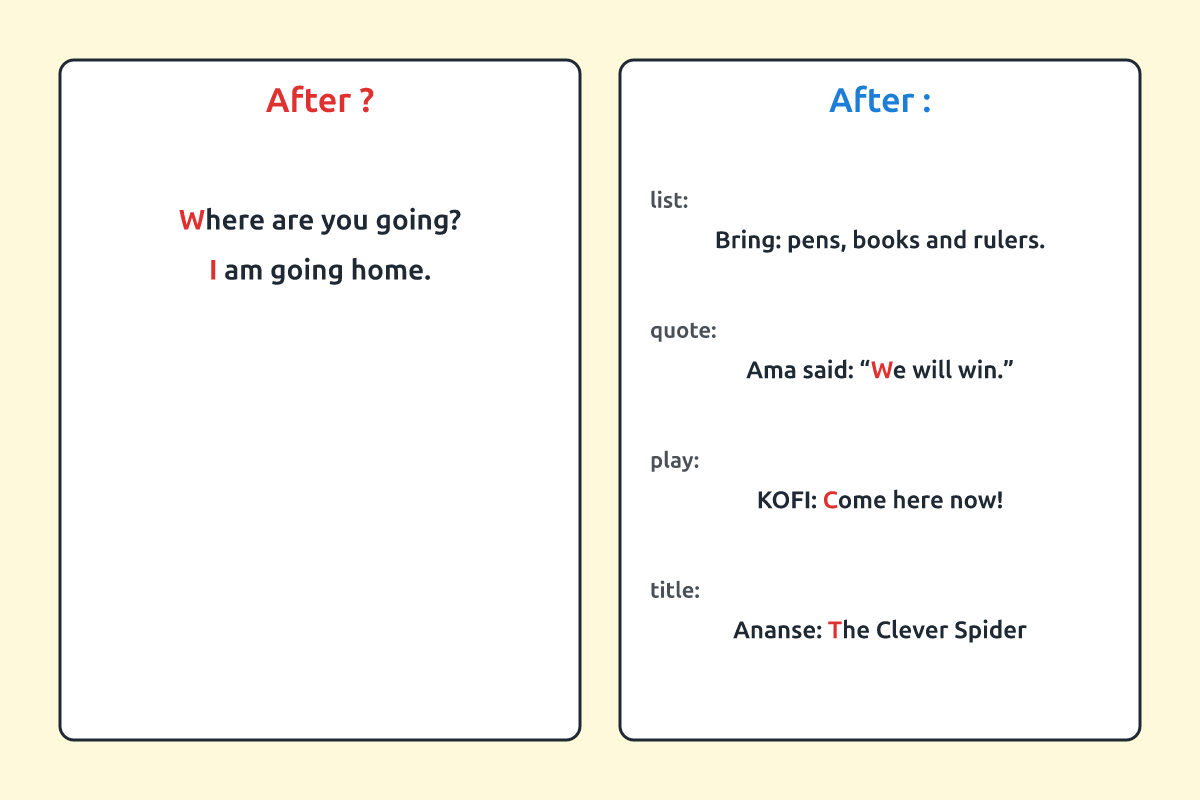
A question mark usually ends a sentence, so the next word begins a new sentence and takes a capital letter.
Example: "Where are you going? I am going to the market."
In direct speech, the question ends inside the quotation marks and the reporting words may continue in small letters: "Where are you going?" asked Mother.
2. Capital Letters after Colons
| Situation | Capital or small? | Example |
|---|---|---|
| a list | small (unless a proper noun) | Bring these: a broom, a bucket and soap. |
| an explanation that is not a full sentence | small | He had one wish: to visit Kumasi. |
| a full quotation | capital | The headteacher said: "Be punctual." |
| a speaker's words in a play | capital | Kofi: Where is my book? |
| a proper noun | capital | The winner was: Abena Asante. |
| a title and subtitle | capital | Ghana: Our Beautiful Country |
3. Correcting Errors
Example
Correct: "Are you ready? we leave at noon. Bring three things: Water, Food and a Torch. Mother said: "come back early.""
- After "ready?" a new sentence begins: We
- After the colon, a list takes small letters: water, food and a torch
- A full quotation after a colon takes a capital: "Come back early."
Answer: Are you ready? We leave at noon. Bring three things: water, food and a torch. Mother said: "Come back early."
4. Practice in Your Ghanaian Language
These rules also apply when writing Ghanaian languages. Your teacher will give you a passage in your language with errors in capitalisation after colons and question marks. Correct them and explain each rule.
New words
- upper case
- Capital letters.
- lower case
- Small letters.
- colon
- The punctuation mark (:).
- question mark
- The punctuation mark (?).
- quotation
- Someone's exact words.
- proper noun
- The special name of a person, place or thing.
Summary
- After a question mark that ends a sentence, start the next sentence with a capital.
- After a colon, use small letters for lists and phrases.
- Use capitals after a colon for full quotations, play script speech, proper nouns and titles.
- Apply these rules in your Ghanaian language too.
Class activity: Capital Corrections
- Correct a passage with capitalisation errors after colons and question marks.
- Explain each correction to your partner.
- Write three examples of your own.
You need: Printed cards of Ghanaian names, Place names, Chalkboard, Chalk, Exercise books, Pencils
Exercises
Answer in your exercise book first, then check your answers.
1. After a question mark that ends a sentence, the next word begins with…
- A. a capital letter
- B. a small letter
- C. a number
- D. a comma
Show answer
Answer: a capital letterNew sentence.2. Which is correct?
- A. Bring these: a cup, a plate and a spoon.
- B. Bring these: A Cup, A Plate and A Spoon.
- C. bring these: a cup.
- D. Bring these, a cup
Show answer
Answer: Bring these: a cup, a plate and a spoon.Small letters for a list.3. In a play script, after the speaker's name and colon, use…
- A. a capital letter
- B. a small letter
- C. a number
- D. nothing
Show answer
Answer: a capital letterSpeaker's words.4. Upper case means capital letters.
- A. True
- B. False
Show answer
Answer: TrueA, B, C.5. Lists after a colon always begin with capital letters.
- A. True
- B. False
Show answer
Answer: FalseSmall letters unless proper nouns.6. Small letters are also called ______ case.
Show answer
Answer: lowera, b, c.7. Correct: "What is your name? my name is Esi."
Show answer
Answer: What is your name? My name is Esi.Capital after ?8. When should a capital letter follow a colon?
Show answer
Answer: For a full quotation, a speaker's words in a play, a proper noun or a title/subtitle.Colon rules.
Homework
- Write a short play script of six lines in your Ghanaian language using colons correctly.