Basic 6 · Ghanaian Language · Use of Action Words
Perfect Tense Action Words
In this topic you will recognise and use perfect tense action words (verbs) in sentences.
By the end of these notes you should be able to:
- Explain the present perfect and past perfect tenses
- Form perfect tense verbs in English and your Ghanaian language
- Use perfect tense verbs in sentences
What you already know
- Present and past tense (Basic 5)
Copy everything that has a blue line on its left into your notebook. The other parts are for reading.
- Strand
- Writing Convention
- Sub-strand
- Use of Action Words
- Indicator
- B6.5.3.1.1-3 – Recognize and use perfect tense action words in sentences
Introduction
When Mother asks, "Have you swept the compound?", she wants to know if the action is complete now. The perfect tense shows that an action has been completed.
1. The Present Perfect Tense
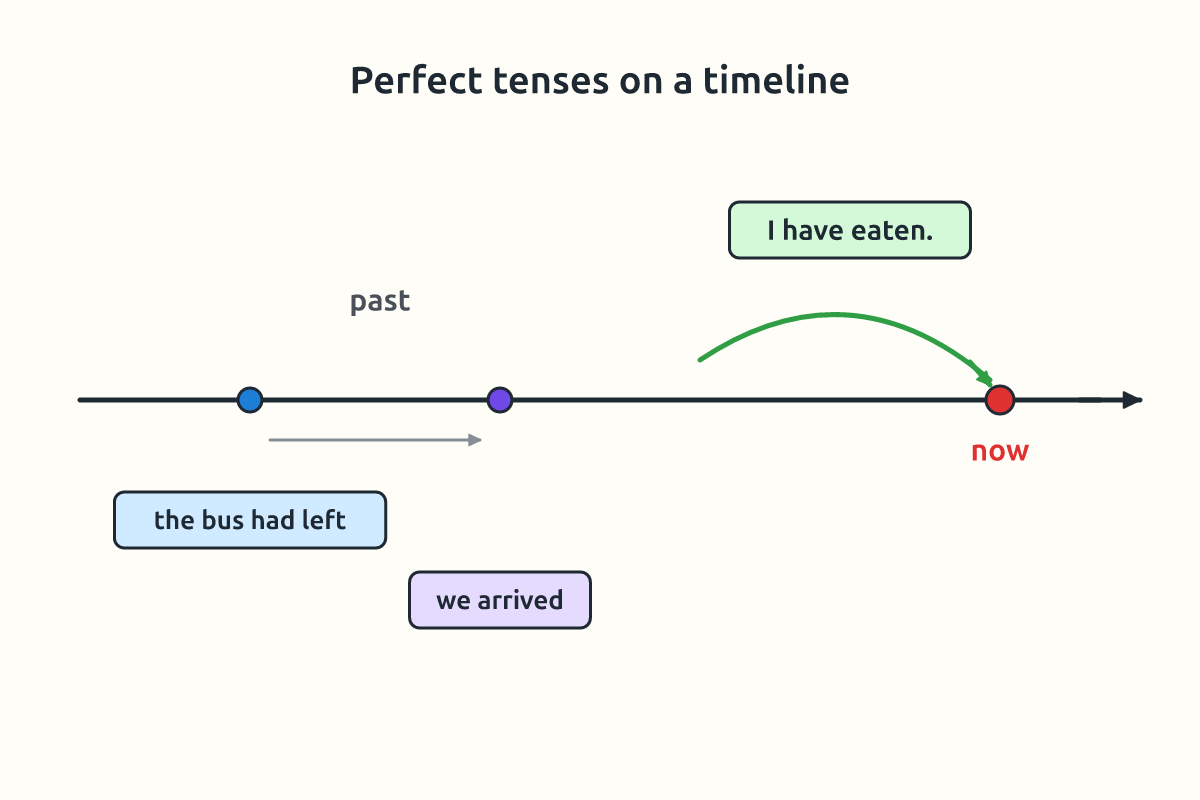
The present perfect shows an action completed at an unstated time before now, or an action whose result is important now. In English it is formed with has/have + past participle.
| Subject | Form | Example |
|---|---|---|
| I, you, we, they | have + past participle | I have finished my homework. |
| he, she, it | has + past participle | She has eaten her food. |
2. The Past Perfect Tense
The past perfect shows an action completed before another past action. It is formed with had + past participle.
Example: "When we arrived, the bus had left." (The bus left first, then we arrived.)
| Tense | Example | Meaning |
|---|---|---|
| simple past | I ate rice. | finished at a past time |
| present perfect | I have eaten rice. | completed; I am not hungry now |
| past perfect | I had eaten rice before he came. | completed before another past event |
3. The Perfect in Ghanaian Languages
Ghanaian languages show completed actions in their own ways. In Twi, the perfect is often shown by the prefix "a-" on the verb: "Mawie" (I have finished), "Wadidi" (he/she has eaten), "Yɛakɔ" (we have gone). Your teacher will show you how the perfect is formed in your Ghanaian language.
4. Practice
Example
Change to the present perfect: "Kofi washes the plates."
- The subject is Kofi (he), so use "has".
- The past participle of "wash" is "washed".
Answer: Kofi has washed the plates.
| Verb | Past participle |
|---|---|
| go | gone |
| eat | eaten |
| write | written |
| see | seen |
| take | taken |
Common mistake: Do not use the present perfect with a definite past time: say "I saw him yesterday", not "I have seen him yesterday".
New words
- perfect tense
- A tense showing a completed action.
- present perfect
- has/have + past participle.
- past perfect
- had + past participle.
- past participle
- The verb form used in perfect tenses, e.g. eaten.
- prefix
- Letters added to the beginning of a word.
- irregular verb
- A verb that does not follow the usual -ed pattern.
Summary
- The present perfect (has/have + participle) shows completed actions linked to now.
- The past perfect (had + participle) shows an action before another past action.
- Twi often uses the prefix "a-" for the perfect.
- Learn irregular past participles.
Class activity: Perfect Sentences
- Write five sentences in the present perfect about things you have done this week.
- Write two sentences in the past perfect.
- Translate them into your Ghanaian language.
You need: Printed action-picture cards of farming, Fishing, Locally made verb cards, Exercise books, Pencils
Exercises
Answer in your exercise book first, then check your answers.
1. Which is present perfect?
- A. She has finished
- B. She finishes
- C. She will finish
- D. She finishing
Show answer
Answer: She has finishedhas + participle.2. The past participle of "write" is…
- A. written
- B. wrote
- C. writed
- D. writing
Show answer
Answer: writtenIrregular.3. "When we arrived, the bus ___ left."
- A. had
- B. has
- C. have
- D. is
Show answer
Answer: hadPast perfect.4. The present perfect uses has or have.
- A. True
- B. False
Show answer
Answer: TruePlus past participle.5. "I have seen him yesterday" is correct.
- A. True
- B. False
Show answer
Answer: FalseUse "I saw him yesterday".6. In Twi, "Mawie" means "I have ______".
Show answer
Answer: finishedPerfect form.7. Change to the present perfect: "They eat the mangoes."
Show answer
Answer: They have eaten the mangoes.have + eaten.8. Explain the difference between "I ate" and "I had eaten before she came".
Show answer
Answer: "I ate" is a simple past action; "I had eaten before she came" shows eating finished before another past event.Sequence of past events.
Homework
- Write ten sentences in your Ghanaian language about things you have done this term.