Basic 6 · English Language
Dramatisation, Skimming and Scanning, Conjunctions of Contrast and Condition, Persuasive Conclusions and Complex Sentences
In this topic you will dramatise stories, skim and scan texts, use conjunctions of contrast and condition, write persuasive conclusions with rhetorical questions and identify subjects and verbs in complex sentences.
By the end of these notes you should be able to:
- Dramatise a story using a script
- Skim and scan a text for main ideas and details
- Use conjunctions of contrast and condition
- Write a persuasive conclusion with a rhetorical question
- Identify subjects and verbs in complex sentences
What you already know
- Pace, Stress and Tone, Silent Reading, Conjunctions, Supporting Opinions and Correlative Conjunctions
Copy everything that has a blue line on its left into your notebook. The other parts are for reading.
Lesson 1
- Strand
- Oral Language
- Sub-strand
- Dramatization and Role Play
- Indicator
- B6.1.5.2.1 – Dramatise or role-play whole or parts of stories or scenes
Introduction
Turning a story into a play script helps actors know what to say and do.
Writing and Performing a Script
| Feature | Example |
|---|---|
| title | "The Lost Purse" |
| list of characters | Esi, Trader, Esi's Mother |
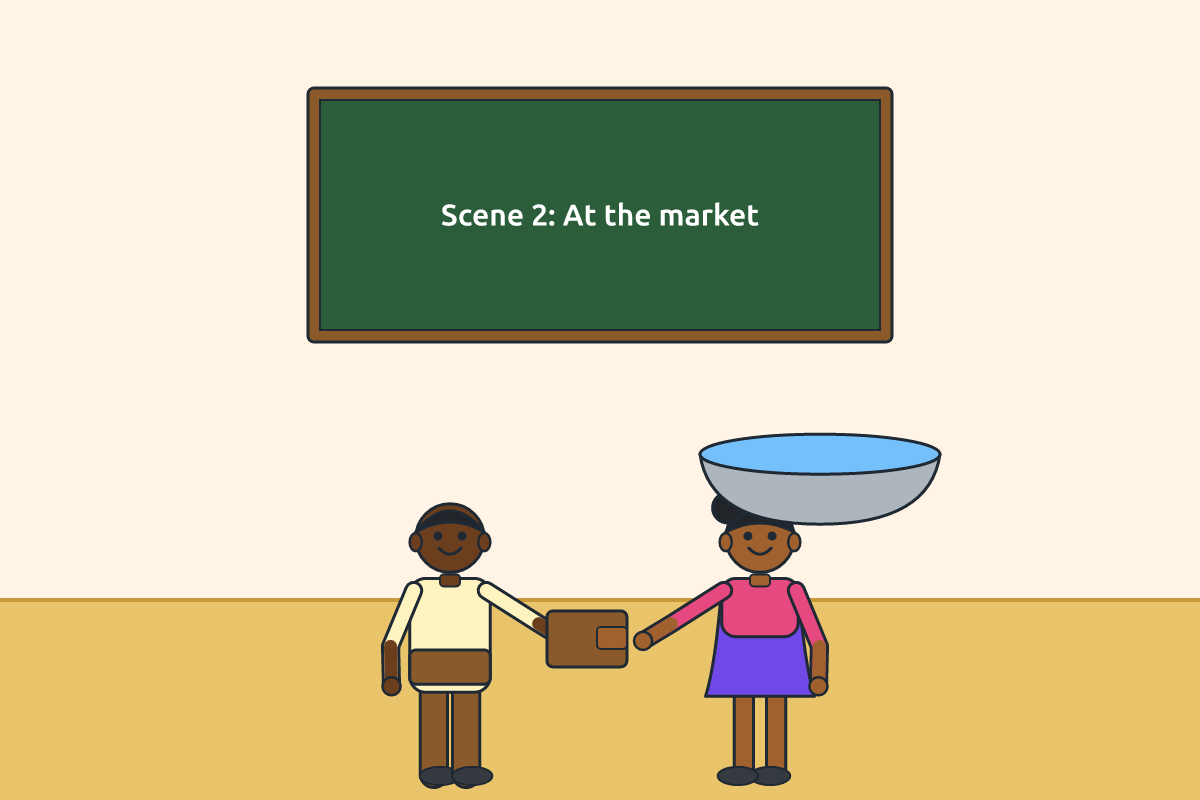
| scene heading | Scene 1: A busy market, morning |
| stage directions in brackets | (Esi picks up the purse and looks around.) |
| speaker's name and colon | ESI: Whose purse is this? |
| dialogue | the words each character says |
Sample script:
"Scene 1: A busy market. (Esi sees a purse on the ground.)
ESI: (to herself) Someone has lost this. I must find the owner.
TRADER: (searching anxiously) My purse! My purse is gone!
ESI: Madam, is this yours?
TRADER: (relieved) Oh, thank you, my child! You are very honest."
New words
- script
- The written text of a play.
- stage direction
- An instruction about actions, written in brackets.
- scene
- A part of a play in one place and time.
Summary
- A script has a title, characters, scenes, stage directions and dialogue.
- Rehearse and perform with expression.
Exercises
Answer in your exercise book first, then check your answers.
1. Instructions about actions in a script are…
- A. stage directions
- B. dialogue
- C. titles
- D. scenes
Show answer
Answer: stage directionsIn brackets.2. In a script, the speaker's name comes before the words.
- A. True
- B. False
Show answer
Answer: TrueNAME: words.3. A part of a play in one place and time is a ______.
Show answer
Answer: sceneScene 1.4. Write one line of script with a stage direction.
Show answer
Answer: E.g. MOTHER: (smiling) Well done, Esi.Format.
Lesson 2
- Strand
- Reading
- Sub-strand
- Comprehension
- Indicator
- B6.2.7.1.3 – Scan/skim for details and read level- appropriate texts silently and closely for comprehension
Introduction
Skimming means reading quickly for the general idea. Scanning means searching quickly for specific details.
Reading Passage: Kente – The Cloth of Kings
"Kente is one of Ghana's most famous cloths. It is woven in narrow strips on a horizontal loom and then sewn together to make large cloths. The main weaving centres are Bonwire in the Ashanti Region and Agotime-Kpetoe in the Volta Region.
According to Asante tradition, two brothers, Kurugu and Ameyaw, learnt to weave by watching a spider spin its web. The Ewe also have long traditions of weaving kente, with their own patterns and stories.
Every kente pattern has a name and meaning. 'Adweneasa' means 'my skill is exhausted', showing that the weaver used every design he knew. 'Sika Futuro' means 'gold dust' and shows wealth. Colours also carry meaning: gold for wealth and royalty, green for growth, red for sacrifice and struggle, and black for maturity and spiritual energy.
In the past, kente was worn mainly by kings and chiefs on important occasions. Today, people wear it at weddings, graduations, festivals and church services. Kente patterns appear on bags, shoes and even graduation stoles in other countries. The Agotime people celebrate a kente festival (Agbamevoza) every year."
| Task | Skim or scan? | Answer |
|---|---|---|
| What is the passage mainly about? | skim | the history, meaning and use of kente |
| Name the two weaving centres. | scan | Bonwire and Agotime-Kpetoe |
| What does "Sika Futuro" mean? | scan | gold dust |
| What does green represent? | scan | growth |
| Who wore kente in the past? | scan | kings and chiefs |

New words
- skim
- To read quickly for the main idea.
- scan
- To search quickly for specific details.
- loom
- A frame used for weaving.
Summary
- Skim for the main idea; scan for names, numbers and details.
- Kente patterns and colours carry meaning.
Exercises
Answer in your exercise book first, then check your answers.
1. Which town is a kente weaving centre?
- A. Bonwire
- B. Tamale
- C. Takoradi
- D. Bolgatanga
Show answer
Answer: BonwireAshanti Region.2. Scanning means looking for specific details.
- A. True
- B. False
Show answer
Answer: Truee.g. names.3. Gold in kente represents wealth and ______.
Show answer
Answer: royaltyParagraph 3.4. Why is one pattern called "Adweneasa"?
Show answer
Answer: It means "my skill is exhausted", showing the weaver used every design he knew.From the passage.
Lesson 3
- Strand
- Grammar
- Sub-strand
- Conjunctions
- Indicator
- B6.3.8.1.1 – Identify and use conjunctions of contrast and condition
Introduction
Some conjunctions show contrast (difference) and others show condition (what must happen first).
Conjunctions of Contrast and Condition
| Conjunction | Example |
|---|---|
| although / even though | Although he was ill, he came to school. |
| whereas | Ama likes rice, whereas Kofi prefers banku. |
| while | While some pupils read, others played. |
| however (adverb) | The road was long; however, we arrived on time. |
| Conjunction | Example |
|---|---|
| if | If it rains, the match will be postponed. |
| unless | You cannot enter unless you have a ticket. |
| provided that | You may go out provided that you finish your work. |
| as long as | You can borrow my bike as long as you return it. |
Passage: "Although the harmattan was harsh, the farmers kept working. Kwesi planted pepper, whereas his brother planted okra. 'We will have a good harvest as long as we water the plants,' said their father, 'unless the river dries up.'"
New words
- contrast
- A difference between two things.
- condition
- Something that must happen for another thing to happen.
- whereas
- While on the other hand.
Summary
- Although, whereas and while show contrast.
- If, unless, provided that and as long as show condition.
Exercises
Answer in your exercise book first, then check your answers.
1. Which shows condition?
- A. unless
- B. although
- C. whereas
- D. however
Show answer
Answer: unlessIf not.2. "Whereas" shows contrast.
- A. True
- B. False
Show answer
Answer: TrueComparing two things.3. You may go ______ you finish your work. (provided that/although)
Show answer
Answer: provided thatCondition.4. Join with "although": "It was raining. We played football."
Show answer
Answer: Although it was raining, we played football.Contrast.
Lesson 4
- Strand
- Writing
- Sub-strand
- Persuasive Writing
- Indicator
- B6.4.13.2.4 – Provide a concluding statement that follows from the argument and pose a rhetorical question
Introduction
A strong conclusion reminds readers of your argument and leaves them thinking.
Persuasive Conclusions
| Part | Example |
|---|---|
| restate the opinion | Clearly, galamsey must be stopped. |
| summarise key reasons | It poisons our rivers, destroys our farms and endangers lives. |
| call to action | Every citizen must report illegal mining and protect our land. |
| rhetorical question | If we do not act now, what will we leave for our children? |
A rhetorical question is not meant to be answered. It makes the reader think about the importance of the issue.
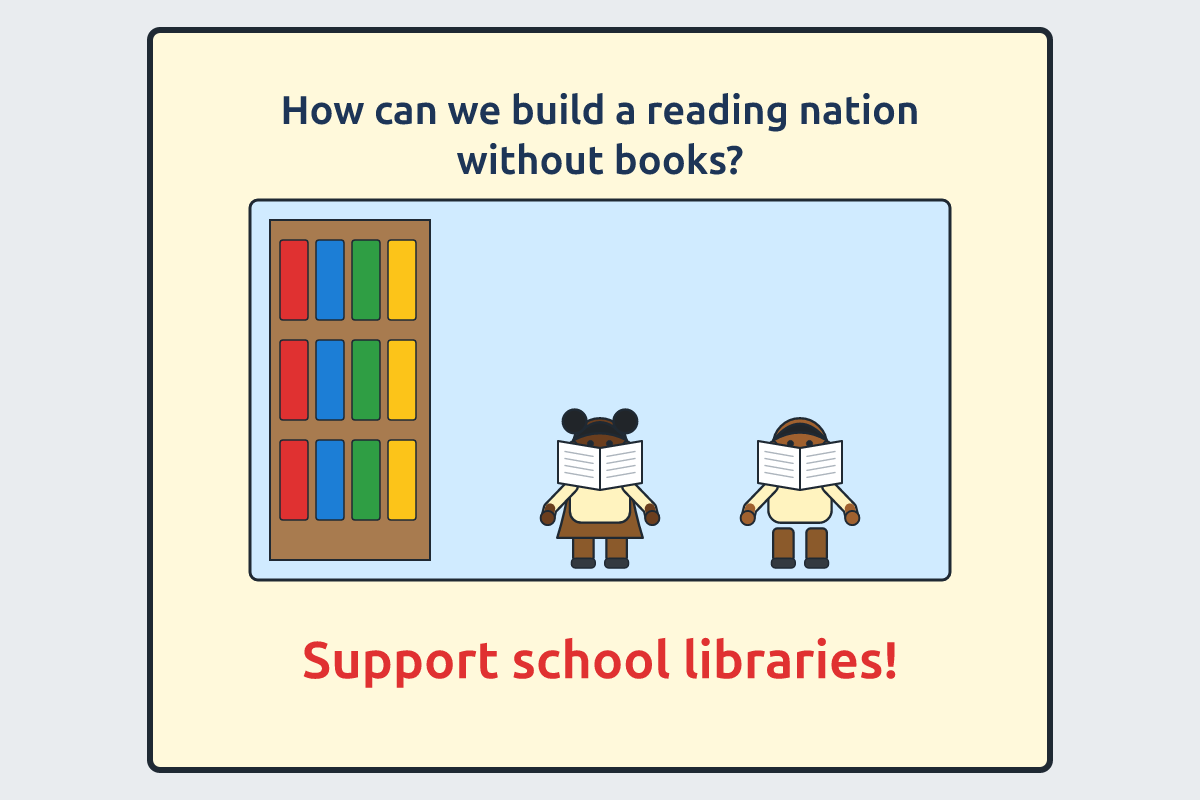
Sample conclusion: "In conclusion, every school in Ghana needs a library. Libraries improve reading, support all subjects and give pupils a safe place to learn. The government, parents and old students should work together to build and stock them. After all, how can we build a reading nation without books?"
New words
- conclusion
- The final part of an essay.
- call to action
- A request for readers to do something.
- rhetorical question
- A question asked for effect.
Summary
- Restate your opinion, summarise reasons and call for action.
- End with a rhetorical question to make readers think.
Exercises
Answer in your exercise book first, then check your answers.
1. A question asked for effect is a…
- A. rhetorical question
- B. direct question
- C. quiz
- D. riddle
Show answer
Answer: rhetorical questionNot answered.2. A conclusion should restate the opinion.
- A. True
- B. False
Show answer
Answer: TrueReminds readers.3. A request for readers to do something is a call to ______.
Show answer
Answer: actionPersuasion.4. Write a rhetorical question to end an essay on road safety.
Show answer
Answer: E.g. How many more lives must be lost before we change?Makes readers think.
Lesson 5
- Strand
- Writing Conventions/ Extensive Reading
- Sub-strand
- Using Simple and Compound Sentences, Building the Love and Culture of Reading
- Indicator
- B6.5.9.1.1 – Identify subjects and verbs in complex sentences
Introduction
A complex sentence has a main clause and at least one subordinate clause. Each clause has its own subject and verb.
Subjects and Verbs in Complex Sentences
| Sentence | Main clause (subject + verb) | Subordinate clause (subject + verb) |
|---|---|---|
| When the bell rang, the pupils ran out. | the pupils + ran | the bell + rang |
| Kofi stayed home because he was sick. | Kofi + stayed | he + was |
| Although Ama studied hard, she felt nervous. | she + felt | Ama + studied |
Steps: find the subordinating conjunction; it starts the subordinate clause. Find the subject and verb in that clause. Then find the subject and verb in the main clause.
Reading extract: "As the sun set over the lagoon, the fishermen pulled their canoes ashore. Their wives, who had waited since noon, carried the fish to the market while the children played on the sand."
New words
- complex sentence
- A sentence with a main clause and a subordinate clause.
- main clause
- A clause that can stand alone.
- subordinate clause
- A clause that depends on the main clause.
Summary
- A complex sentence has a main clause and a subordinate clause.
- Each clause has its own subject and verb.
Exercises
Answer in your exercise book first, then check your answers.
1. In "Kofi stayed home because he was sick", the main clause is…
- A. Kofi stayed home
- B. because he was sick
- C. he was sick
- D. stayed
Show answer
Answer: Kofi stayed homeIt can stand alone.2. A subordinate clause can stand alone.
- A. True
- B. False
Show answer
Answer: FalseIt depends on the main clause.3. In "When the bell rang", the subject is "the ______".
Show answer
Answer: bellSubject of the clause.4. Identify the subjects and verbs: "As the sun set, the fishermen pulled their canoes ashore."
Show answer
Answer: Subordinate: the sun + set. Main: the fishermen + pulled.Two clauses.
Homework
- Write a persuasive essay with a strong conclusion and a rhetorical question.