Basic 5 · Religious and Moral Education · The Environment
Caring for the Environment: Conserving Resources
In this topic you will demonstrate how to conserve water, energy and other resources, and learn how traditional practices protect the environment.
By the end of these notes you should be able to:
- Demonstrate ways to save water and electricity
- Explain how traditional practices protect resources
- Make a personal plan to care for the environment
What you already know
- Planting and cleaning
Copy everything that has a blue line on its left into your notebook. The other parts are for reading.
- Strand
- God’s Creation & Attributes
- Sub-strand
- The Environment
- Indicator
- B5.1.2.1.2 – Demonstrate ways to care for the environment
Introduction
Water and electricity cost money and take effort to provide. If we waste them, there may not be enough for everyone. Caring for the environment includes using resources wisely.
1. Conserving Water
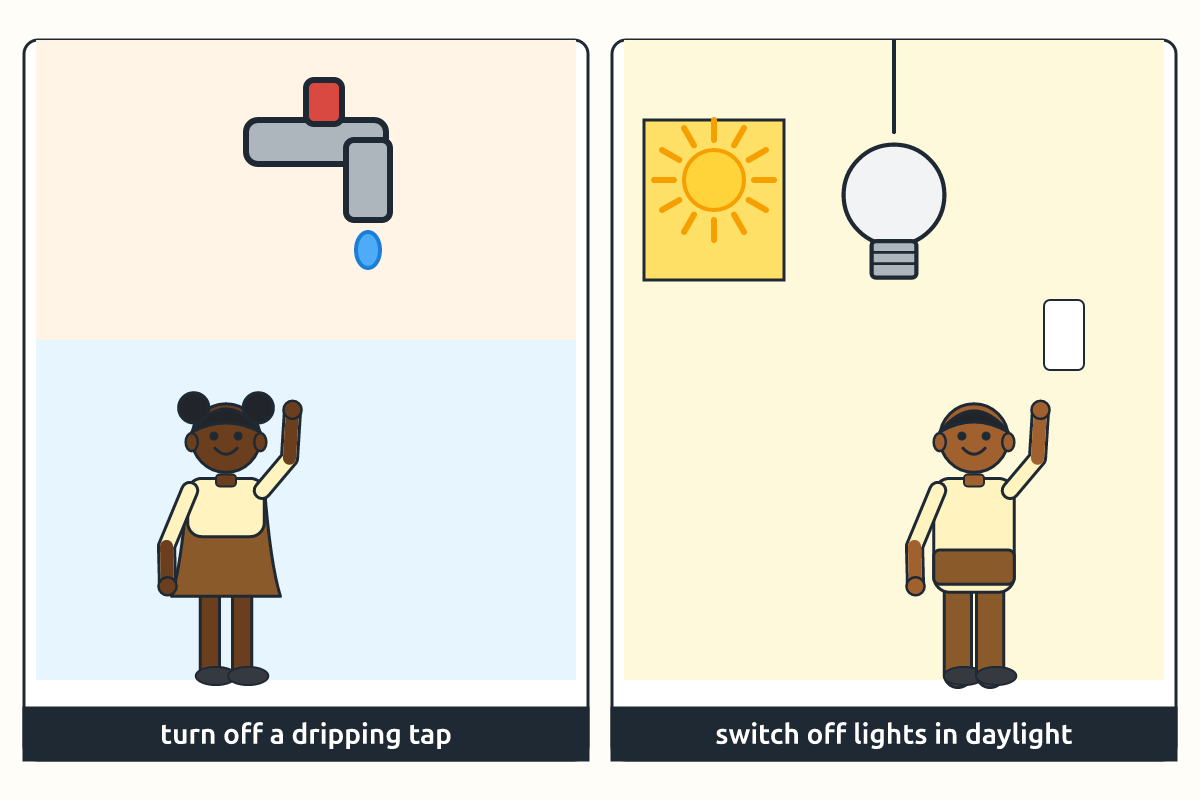
- Turn off taps after use and report leaking pipes.
- Use a cup when brushing your teeth instead of running water.
- Collect rainwater for washing and watering plants.
- Reuse water from washing vegetables to water plants.
- Do not pollute rivers, streams and wells.
2. Conserving Energy
- Switch off lights, fans and televisions when not in use.
- Unplug chargers when they are not charging.
- Use energy-saving bulbs and solar lamps.
- Open windows for light and air during the day.
- Use improved cookstoves or gas that need less charcoal and firewood.
3. Traditional Ways of Protecting Resources
| Practice | How it protects the environment |
|---|---|
| sacred groves (e.g. Boabeng-Fiema Monkey Sanctuary) | forests and animals are protected by taboos |
| rest days for rivers and land | fishing or farming is banned on certain days, allowing recovery |
| totems | clans do not kill or eat their totem animal |
| closed seasons | fishing or hunting is stopped at certain times of year |
| bans on cutting certain trees | trees near rivers and shrines are left standing |
At Boabeng-Fiema in the Bono East Region, monkeys are regarded as sacred and are protected by the community. Today the sanctuary attracts tourists and brings income. Ghana also has a closed season for fishing, when fishing stops for some weeks so that fish can breed.
4. Religious Motivation
The Bible says, "The earth is the Lord's, and everything in it" (Psalm 24:1). The Qur'an warns against waste: "Eat and drink, but do not waste" (Qur'an 7:31). Traditional teaching says that what we leave behind belongs to the children yet unborn. All three religions encourage people to use resources wisely and leave the earth in good condition for future generations.
New words
- conserve
- To use carefully so that it lasts.
- resource
- Something useful to people, such as water or forests.
- totem
- An animal or plant that represents a clan.
- closed season
- A time when fishing or hunting is banned.
- sanctuary
- A protected place for animals.
- future generations
- People who will live after us.
Summary
- Save water by closing taps and collecting rainwater.
- Save energy by switching off appliances.
- Taboos, totems and sacred groves protect resources.
- Religions teach us not to waste God's gifts.
Class activity: My Green Plan
- Write five things you will do to save water, energy and the environment.
- Share your plan with your family.
- Report what you did after one week.
You need: Local tree seedling, Broom, Waste basket
Exercises
Answer in your exercise book first, then check your answers.
1. Which saves electricity?
- A. Switching off lights
- B. Leaving the TV on
- C. Charging all night
- D. Lights on in daylight
Show answer
Answer: Switching off lightsIt reduces waste.2. Boabeng-Fiema is famous for protecting…
- A. monkeys
- B. elephants
- C. crocodiles
- D. lions
Show answer
Answer: monkeysThey are regarded as sacred.3. Which verse says "do not waste"?
- A. Qur'an 7:31
- B. Qur'an 1:1
- C. Genesis 1:1
- D. John 1:1
Show answer
Answer: Qur'an 7:31Eat and drink, but do not waste.4. Collecting rainwater conserves water.
- A. True
- B. False
Show answer
Answer: TrueIt reduces use of tap water.5. Totems encourage people to kill certain animals.
- A. True
- B. False
Show answer
Answer: FalseClans protect their totem animal.6. A time when fishing is banned so fish can breed is a closed ______.
Show answer
Answer: seasonFish numbers recover.7. State two ways to save water at school.
Show answer
Answer: Close taps after use; report leaks (or collect rainwater).Any two.8. How do taboos and totems help the environment?
Show answer
Answer: They stop people from killing certain animals or destroying certain forests and rivers, so these resources are protected.Traditional conservation.
Homework
- Check your home for wasted water or electricity and write what you did to stop it.