Basic 5 · Physical Education · Locomotive Skills
Walking on Lines and Edges
In this topic you will walk on straight lines and narrow edges with good balance and control.
By the end of these notes you should be able to:
- Explain balance and centre of gravity
- Walk forward, backward and sideways on a line
- Walk on a raised edge safely
What you already know
- Locomotor skills (Basic 4)
Copy everything that has a blue line on its left into your notebook. The other parts are for reading.
- Strand
- Motor Skill And Movement Patterns
- Sub-strand
- Locomotive Skills
- Indicator
- B5.1.2.1.1 – Walk on straight lines edges
Introduction
Tightrope walkers in a circus can cross a thin rope high in the air without falling. They have excellent balance. You can improve your balance by practising walking on lines and edges.
1. What Is Balance?
Balance: The ability to keep the body steady and in control without falling.
Every body has a centre of gravity, the point around which its weight is evenly spread. For a standing person, it is around the belly button. When the centre of gravity stays above your base (your feet), you stay balanced. When it moves outside, you fall.
2. Technique for Walking on a Line
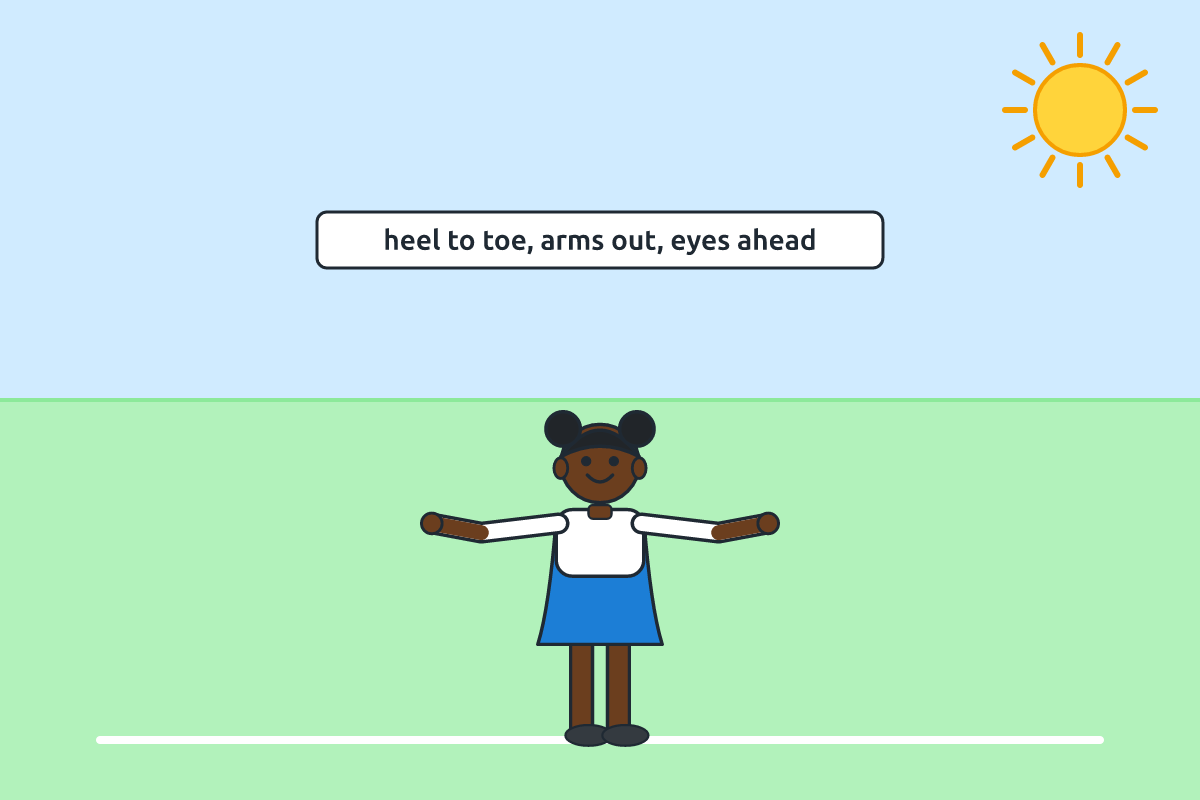
- Stand tall with your head up and eyes looking forward at the end of the line, not at your feet.
- Stretch your arms out sideways to help you balance.
- Place one foot directly in front of the other, heel touching toe.
- Move slowly and smoothly; tighten your stomach muscles.
- If you wobble, pause, bend your knees slightly and steady yourself.
3. Progressions
| Level | Task |
|---|---|
| 1 | walk forward on a chalk line |
| 2 | walk backward on the line |
| 3 | walk sideways with crossover steps |
| 4 | walk on the line carrying a beanbag on your head |
| 5 | walk on a low bench or kerb edge |
| 6 | walk on the bench, turn around in the middle and walk back |
4. Why Balance Is Important
Good balance helps in many sports, such as football (dribbling past players), gymnastics, netball and athletics. It also helps in daily life: carrying water on the head, climbing stairs and walking on uneven paths without falling.
Safety: Practise on low edges first. Have a partner walk beside you to give a hand if needed. Do not push anyone off.
New words
- balance
- Keeping the body steady.
- centre of gravity
- The point where the body's weight is centred.
- base of support
- The area under the body that supports it.
- heel-to-toe
- Placing the heel of one foot against the toe of the other.
- progression
- Moving from easier to harder tasks.
- stability
- Being steady and not easily moved.
Summary
- Balance means staying steady without falling.
- Keep your centre of gravity above your base.
- Look ahead, stretch your arms and walk heel to toe.
- Progress from lines on the ground to raised edges.
Class activity: Balance Trail
- Draw lines and curves on the ground with chalk.
- Walk the trail forward, backward and sideways.
- Try it with a beanbag on your head.
You need: Plastic-bottle cones, Rope, Sticks of chalk
Exercises
Answer in your exercise book first, then check your answers.
1. Where should you look when walking on a line?
- A. Ahead at the end of the line
- B. At your feet
- C. At the sky
- D. Behind you
Show answer
Answer: Ahead at the end of the lineIt keeps you steady.2. Stretching the arms sideways helps you…
- A. balance
- B. run faster
- C. jump higher
- D. throw
Show answer
Answer: balanceArms help control the body.3. The point where the body's weight is centred is the…
- A. centre of gravity
- B. base
- C. heel
- D. elbow
Show answer
Answer: centre of gravityAround the belly button.4. Walking heel-to-toe helps balance on a line.
- A. True
- B. False
Show answer
Answer: TrueFeet stay on the line.5. You should start on a high bench before a chalk line.
- A. True
- B. False
Show answer
Answer: FalseProgress from easy to hard.6. Keeping the body steady without falling is ______.
Show answer
Answer: balanceIt is a key skill.7. List three tips for walking on a line.
Show answer
Answer: Look ahead, stretch arms out, walk heel to toe (or move slowly).Any three.8. Explain why a wide base makes balancing easier.
Show answer
Answer: The centre of gravity stays above the base more easily, so the body is more stable.Bigger base, more stability.
Homework
- Practise walking along a straight line at home for five minutes each day.