Basic 5 · Physical Education · Locomotive Skills
Skipping and Leaping Continuously
In this topic you will skip and leap continuously with good rhythm and control.
By the end of these notes you should be able to:
- Describe the skip and the leap
- Skip continuously with rhythm
- Leap over low obstacles in a sequence
What you already know
- Walking on lines
Copy everything that has a blue line on its left into your notebook. The other parts are for reading.
- Strand
- Motor Skill And Movement Patterns
- Sub-strand
- Locomotive Skills
- Indicator
- B5.1.3.1.2 – Skip and leap continuously
Introduction
Skipping and leaping are locomotor skills used in games, dance and athletics. Hurdlers leap over barriers, and dancers skip lightly across the stage.
1. The Skip
A skip is a step followed by a hop on the same foot, then the same on the other foot: step-hop, step-hop. Swing your arms in opposition (right arm forward with left leg). Stay on the balls of your feet and keep a steady rhythm.
2. The Leap
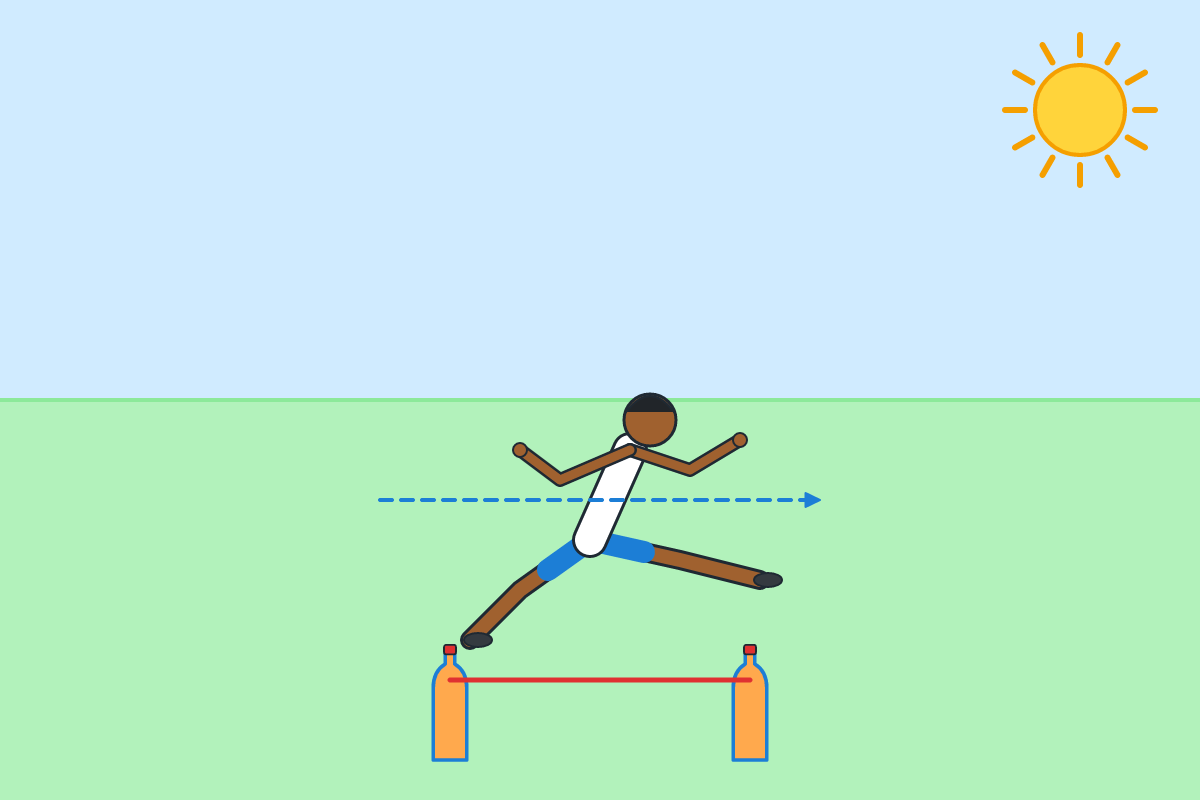
A leap is a long, high step from one foot to the other foot, with the body flying through the air. Push off strongly from the back foot, stretch the front leg forward, and land softly on the front foot with the knee bent.
| Feature | Skip | Leap |
|---|---|---|
| take-off foot | same foot (step-hop) | one foot |
| landing foot | same foot | opposite foot |
| height and distance | small, light | long and high |
| rhythm | uneven (long-short) | one big movement |
3. Continuous Skipping and Leaping
- Skip in a straight line for 20 metres with a steady rhythm.
- Skip in a circle, then change direction.
- Leap over a line, then over a low rope or stick.
- Set out four low obstacles 2 metres apart and leap over each without stopping.
- Combine: skip three times, leap once, and repeat.
4. Skipping with a Rope
Rope skipping also builds fitness. Hold the rope handles at hip level, turn the rope with your wrists, and jump just high enough for the rope to pass under your feet. Count how many skips you can do in one minute and try to improve each week.
Safety: Keep obstacles low and light so they fall if touched. Land on soft ground, not concrete.
New words
- skip
- A step followed by a hop on the same foot.
- leap
- A long jump from one foot to the other.
- locomotor
- Moving from one place to another.
- rhythm
- A regular pattern of movement.
- opposition
- Moving the opposite arm and leg together.
- obstacle
- Something in the way that you go over or around.
Summary
- A skip is step-hop on the same foot, alternating feet.
- A leap goes from one foot to the other with flight.
- Keep a steady rhythm and land softly.
- Combine skips and leaps over low obstacles.
Class activity: Skip-Leap Course
- Set up a course with lines and low ropes.
- Skip between obstacles and leap over them.
- Time each member and try to improve.
You need: Plastic-bottle cones, Rope, Sticks of chalk
Exercises
Answer in your exercise book first, then check your answers.
1. A skip is a…
- A. step and hop
- B. jump on two feet
- C. roll
- D. crawl
Show answer
Answer: step and hopStep-hop on the same foot.2. In a leap, you land on…
- A. the opposite foot
- B. both feet
- C. the same foot
- D. your hands
Show answer
Answer: the opposite footTake off one, land on the other.3. Moving the right arm with the left leg is called…
- A. opposition
- B. balance
- C. rhythm
- D. leap
Show answer
Answer: oppositionIt helps coordination.4. You should land softly with bent knees.
- A. True
- B. False
Show answer
Answer: TrueIt protects joints.5. Obstacles for leaping should be heavy and fixed.
- A. True
- B. False
Show answer
Answer: FalseThey should fall if touched.6. Moving from one place to another is a ______ skill.
Show answer
Answer: locomotore.g. skipping.7. Describe the difference between a skip and a leap.
Show answer
Answer: A skip is step-hop on the same foot; a leap is a long jump from one foot to the other.Feet differ.8. Why is a steady rhythm important when skipping continuously?
Show answer
Answer: It saves energy, keeps control and helps you move smoothly without tripping.Rhythm aids control.
Homework
- Skip with a rope for one minute daily and record your count.