Basic 5 · Our World and Our People · The Environment and the Weather
Human Activities, Greenhouse Gases and Climate Change
In this topic you will record human activities that add too much greenhouse gas to the air and cause climate change.
By the end of these notes you should be able to:
- Explain the greenhouse effect
- Name greenhouse gases and their sources
- Record human activities that cause climate change and their effects
What you already know
- Weather and the environment (Basic 4)
Copy everything that has a blue line on its left into your notebook. The other parts are for reading.
- Strand
- All Around Us
- Sub-strand
- The Environment and the Weather
- Indicator
- B5.2.1.1.1 – Record human activities that cause over concentration of greenhouse gases and climate change
Introduction
Older people in Ghana say the rainy seasons are not as regular as they used to be. Some years there are floods, and other years there is drought. Scientists say this is caused by climate change.
1. The Greenhouse Effect
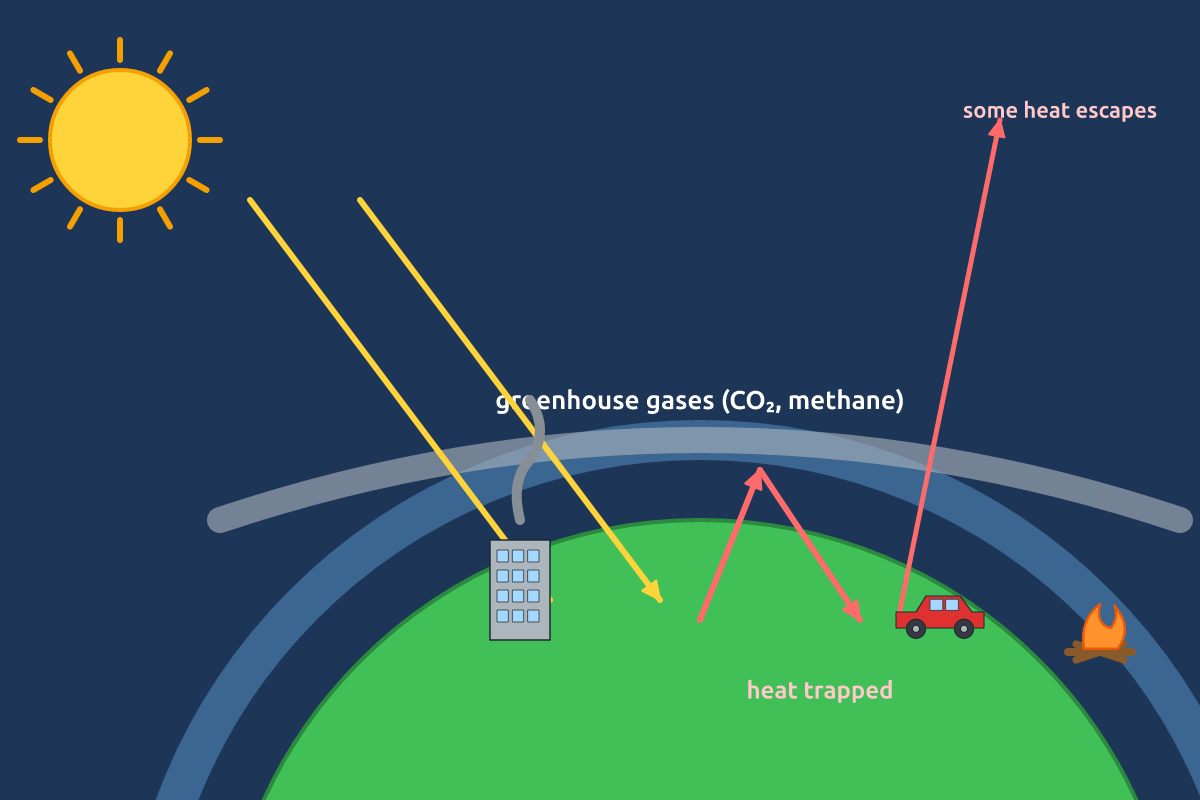
Some gases in the air, called greenhouse gases, trap heat from the sun, like the glass roof of a greenhouse. This natural greenhouse effect keeps the earth warm enough for life. But when people add too much of these gases, more heat is trapped and the earth becomes warmer. This is called global warming, and it leads to climate change.
2. Greenhouse Gases and Their Sources
| Gas | Human sources |
|---|---|
| carbon dioxide (CO₂) | burning fuel in vehicles and factories; burning charcoal, firewood and bush; deforestation |
| methane | rubbish dumps; cattle; flooded rice farms |
| nitrous oxide | chemical fertilisers |
| CFCs and similar gases | old fridges and air conditioners |
3. Recording Human Activities
| Activity seen | Gas released | Place |
|---|---|---|
| burning refuse | carbon dioxide | behind the market |
| vehicle smoke | carbon dioxide | main road |
| cutting trees for charcoal | carbon dioxide (fewer trees to absorb it) | farm area |
| rubbish dump | methane | refuse site |
Trees take in carbon dioxide. When forests are cut down, there are fewer trees to absorb it, and burning the wood releases even more. Ghana has lost much of its forest cover over the last century.
To record activities properly, write down what you saw, where and when you saw it, and which gas it releases. Use a tally to count how many times you see each activity in a week. Records like these help communities and the Environmental Protection Agency (EPA) know where the biggest problems are and plan solutions.
4. Effects of Climate Change in Ghana
- Irregular rainfall and longer dry seasons, causing poor harvests.
- Floods in cities such as Accra and Kumasi.
- Rising sea levels and coastal erosion at places such as Keta and Ada.
- Higher temperatures and heat stress.
- Drying up of rivers and streams.
- Spread of diseases such as malaria to new areas.
New words
- greenhouse gas
- A gas that traps heat in the atmosphere.
- greenhouse effect
- The trapping of heat by gases around the earth.
- global warming
- The rise in the earth's average temperature.
- climate change
- Long-term change in weather patterns.
- methane
- A greenhouse gas from rubbish and cattle.
- atmosphere
- The layer of air around the earth.
Summary
- Greenhouse gases trap heat around the earth.
- Burning fuels, bush burning and deforestation add carbon dioxide.
- Too much greenhouse gas causes global warming and climate change.
- Ghana faces floods, drought and coastal erosion.
Class activity: Community Record
- Walk around the community with your teacher.
- Record activities that release greenhouse gases in a table.
- Present your findings and suggest solutions.
You need: Printed photographs of Ghanaian weather conditions, Simple rain gauge, Locally made clay globe
Exercises
Answer in your exercise book first, then check your answers.
1. Which gas is released when charcoal burns?
- A. Carbon dioxide
- B. Oxygen
- C. Nitrogen
- D. Helium
Show answer
Answer: Carbon dioxideBurning releases CO₂.2. Methane comes from…
- A. rubbish dumps and cattle
- B. solar panels
- C. trees
- D. rain
Show answer
Answer: rubbish dumps and cattleDecomposing waste.3. Which is an effect of climate change in Ghana?
- A. Coastal erosion at Keta
- B. More snow
- C. Fewer floods
- D. Cooler weather
Show answer
Answer: Coastal erosion at KetaSea levels rise.4. Trees absorb carbon dioxide.
- A. True
- B. False
Show answer
Answer: TrueThey use it for photosynthesis.5. The greenhouse effect is always harmful.
- A. True
- B. False
Show answer
Answer: FalseA natural amount keeps the earth warm.6. The rise in the earth's temperature is called global ______.
Show answer
Answer: warmingIt causes climate change.7. Name two human activities that add greenhouse gases.
Show answer
Answer: Burning bush and vehicle smoke (or deforestation, rubbish dumps).Any two.8. Explain how deforestation adds to climate change.
Show answer
Answer: Fewer trees absorb carbon dioxide, and burning the wood releases more, so more heat is trapped.Double effect.
Homework
- Keep a one-week record of activities in your community that release greenhouse gases.