Basic 5 · History · Slave Trade
The Triangular Trade and the Middle Passage
In this topic you will describe the triangular trade and the terrible journey of enslaved Africans across the Atlantic.
By the end of these notes you should be able to:
- Describe the three stages of the triangular trade
- Describe conditions on the Middle Passage
- Explain the role of the forts and castles
What you already know
- Why Europeans traded in humans
Copy everything that has a blue line on its left into your notebook. The other parts are for reading.
- Strand
- Europeans in Ghana
- Sub-strand
- Slave Trade
- Indicator
- B5.3.2.1.1 – Investigate why the Europeans began trading in humans by the 16th century
Introduction
The trans-Atlantic slave trade followed a route shaped like a triangle, linking Europe, West Africa and the Americas. Each side of the triangle carried different cargo.
1. The Three Sides of the Triangle
| Stage | Route | Cargo |
|---|---|---|
| first | Europe → West Africa | cloth, guns, gunpowder, alcohol, beads, iron bars |
| second (the Middle Passage) | West Africa → the Americas | enslaved Africans |
| third | the Americas → Europe | sugar, cotton, tobacco, coffee, rum |
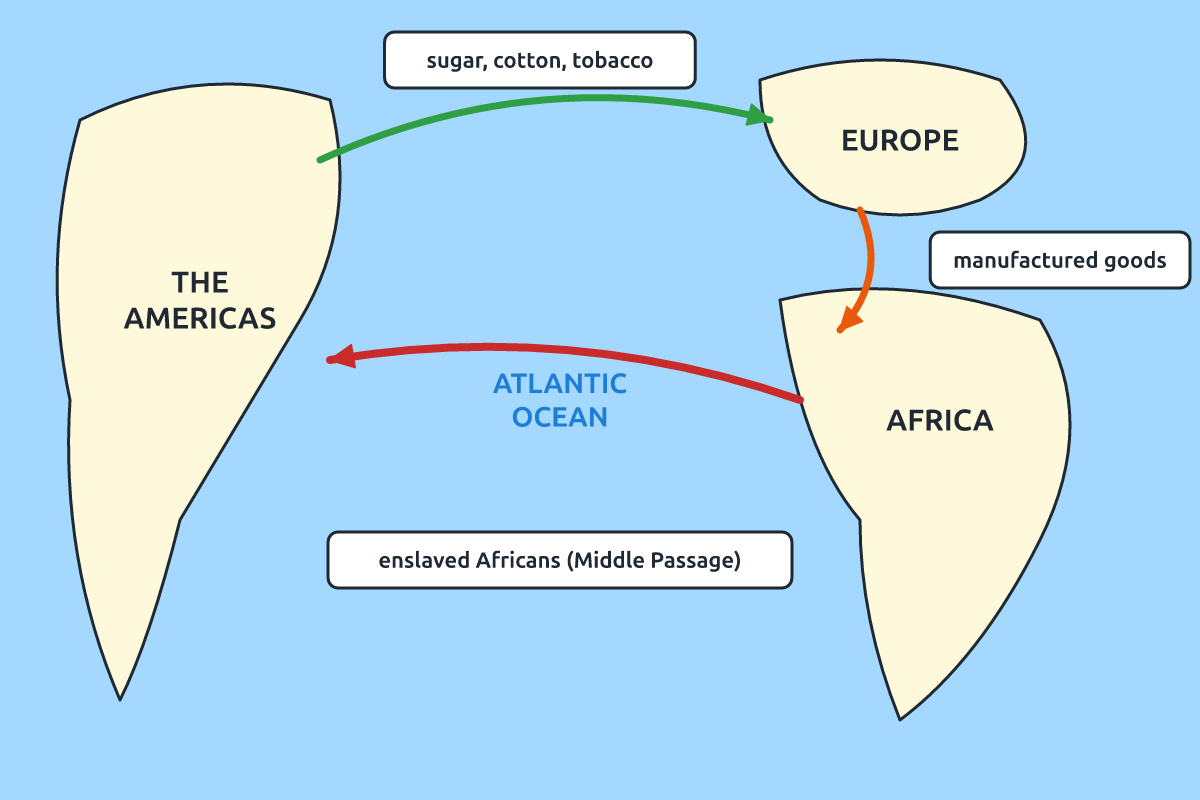
Ships made money on every side of the triangle. European merchants and plantation owners became very rich. Ports such as Liverpool, Bristol, Nantes and Amsterdam grew wealthy from this trade.
2. The Middle Passage
The journey from West Africa to the Americas was called the Middle Passage. It took about six to eight weeks. Enslaved Africans were chained together and packed tightly below deck, lying down with very little room to move. There was little air, little food and dirty water. Many fell sick with diseases such as dysentery and smallpox. Millions died on the way and their bodies were thrown into the sea. Some captives fought back in revolts or refused to eat.
3. The Forts and Castles
The forts and castles on the Gold Coast, such as Elmina and Cape Coast, were used to hold captives until ships arrived. The men's and women's dungeons were dark, hot and crowded. The captives left through a narrow passage known as the "Door of No Return", from which they boarded boats to the waiting ships. Today, these castles are World Heritage Sites. Visitors from around the world, including descendants of enslaved Africans, come to remember those who suffered.
Did you know?: In 2019, Ghana held the "Year of Return" to invite people of African descent in the diaspora to visit Ghana, 400 years after the first recorded enslaved Africans arrived in Virginia, USA, in 1619.
New words
- triangular trade
- Trade between Europe, Africa and the Americas.
- Middle Passage
- The sea voyage from Africa to the Americas.
- cargo
- Goods carried by a ship.
- Door of No Return
- The exit through which captives left the castles.
- diaspora
- People living far from their ancestors' homeland.
- revolt
- Fighting back against those in power.
Summary
- The triangular trade linked Europe, West Africa and the Americas.
- Enslaved Africans were carried on the Middle Passage.
- Conditions on the ships were terrible and many died.
- Forts and castles held captives; they are now memorial sites.
Class activity: Triangle Trade Role-Play
- Draw a large triangle on the floor with chalk.
- Groups stand at Europe, Africa and the Americas.
- Pass cards showing the cargo on each side and explain each stage.
You need: Ghana map, Printed photographs of Ghanaian coastal forts, Castles, Cowrie shells, Trade beads
Exercises
Answer in your exercise book first, then check your answers.
1. What was carried from Europe to West Africa?
- A. Guns, cloth and alcohol
- B. Enslaved Africans
- C. Sugar and cotton
- D. Gold only
Show answer
Answer: Guns, cloth and alcoholManufactured goods.2. What was the Middle Passage?
- A. The voyage from Africa to the Americas
- B. A road in Accra
- C. A trade in gold
- D. A river in Europe
Show answer
Answer: The voyage from Africa to the AmericasThe second side of the triangle.3. What did ships carry from the Americas to Europe?
- A. Sugar, cotton and tobacco
- B. Enslaved people
- C. Guns
- D. Cowries
Show answer
Answer: Sugar, cotton and tobaccoPlantation goods.4. Many Africans died during the Middle Passage.
- A. True
- B. False
Show answer
Answer: TrueConditions were terrible.5. The Door of No Return was in Europe.
- A. True
- B. False
Show answer
Answer: FalseIt was in the West African castles.6. People of African descent living outside Africa form the African ______.
Show answer
Answer: diasporae.g. in the Americas.7. Describe two conditions on slave ships.
Show answer
Answer: Captives were chained and packed tightly, with little food, air and dirty water.Any two.8. Why are Cape Coast and Elmina castles important today?
Show answer
Answer: They are World Heritage Sites that remind the world of the slave trade and honour those who suffered.Memory and education.
Homework
- Draw and label the triangular trade map.