Basic 5 · History · Slave Trade
Effects and Abolition of the Slave Trade
In this topic you will examine the effects of the slave trade on Africa and the world and learn how it was abolished.
By the end of these notes you should be able to:
- State the effects of the slave trade on West Africa
- Explain how the slave trade was abolished
- Discuss lessons for today
What you already know
- The triangular trade
Copy everything that has a blue line on its left into your notebook. The other parts are for reading.
- Strand
- Europeans in Ghana
- Sub-strand
- Slave Trade
- Indicator
- B5.3.2.1.1 – Investigate why the Europeans began trading in humans by the 16th century
Introduction
For about 400 years, the trans-Atlantic slave trade took between 12 and 15 million Africans from their homes. Its effects are still felt today in Africa and around the world.
1. Effects on West Africa
| Effect | Explanation |
|---|---|
| loss of population | millions of young and strong people were taken |
| wars and insecurity | states fought wars to capture people to sell |
| loss of skills | farmers, craftsmen and smiths were taken away |
| spread of guns | guns made wars more deadly |
| decline of crafts and farming | people feared to work far from home; imported goods replaced local crafts |
| rise of some states | states that controlled the trade grew powerful and rich |
| suffering and broken families | families were separated for ever |
2. Effects on the Americas and Europe
In the Americas, enslaved Africans built the wealth of plantations and cities. They kept their music, food, religion and stories, which shaped the culture of countries such as Brazil, Jamaica, Haiti and the USA. In Europe, the profits helped to build banks, ports and industries.
3. The Abolition of the Slave Trade
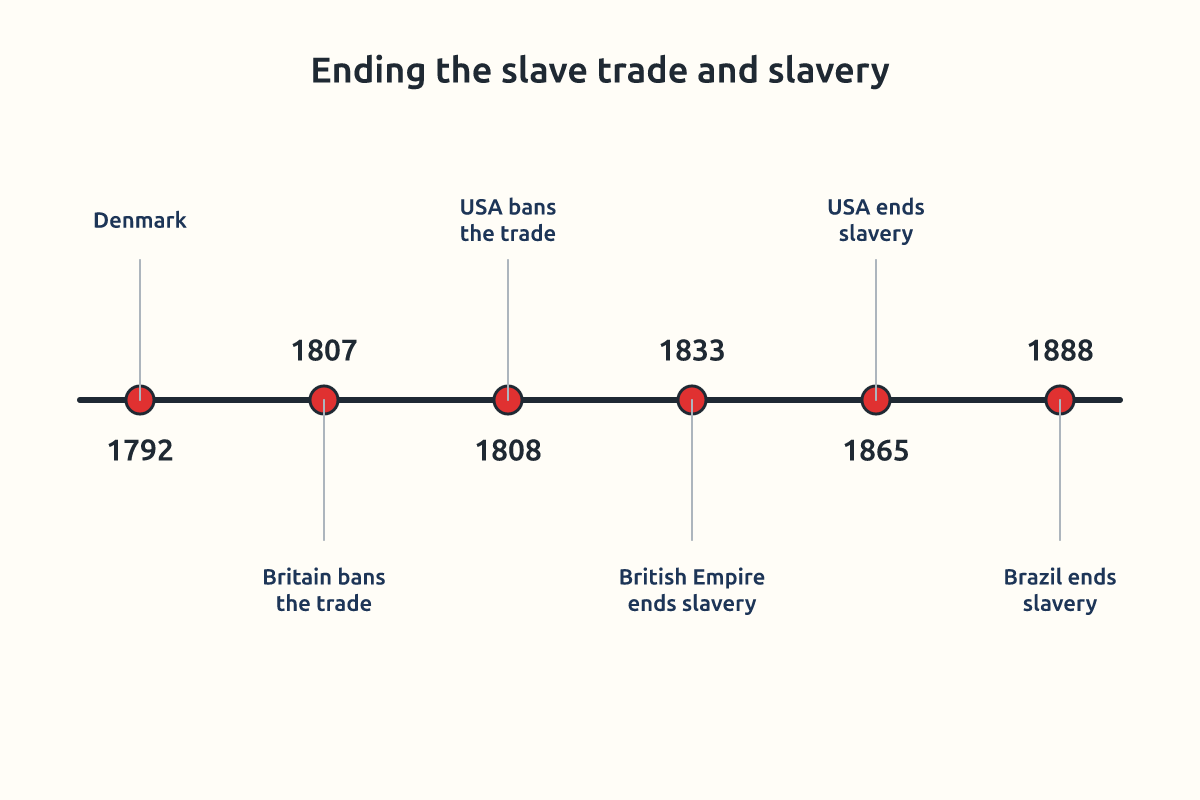
Many people worked to end the slave trade. Enslaved people resisted through revolts, such as the Haitian Revolution (1791–1804). Former slaves such as Olaudah Equiano wrote about their suffering. European campaigners such as William Wilberforce and Thomas Clarkson fought for laws to ban it. Industries in Europe also needed raw materials such as palm oil and cocoa more than slaves.
| Year | Event |
|---|---|
| 1792 | Denmark announced an end to its slave trade (in force from 1803) |
| 1807 | Britain abolished the slave trade |
| 1808 | The USA banned the import of slaves |
| 1833 | Britain abolished slavery in its empire |
| 1865 | Slavery was abolished in the USA |
| 1888 | Brazil abolished slavery |
After abolition, trade on the Gold Coast changed to "legitimate trade" in palm oil, rubber, gold and later cocoa.
4. Lessons for Today
The slave trade teaches us that every human being has dignity and must be treated with respect. Today, human trafficking and child labour are modern forms of slavery. We must speak out against them and protect children and adults from being exploited.
New words
- abolition
- The official ending of something.
- abolitionist
- A person who campaigned to end slavery.
- legitimate trade
- Trade in goods, not people.
- human trafficking
- Illegally moving people to exploit them.
- dignity
- The worth of every person.
- resistance
- Fighting against unfair treatment.
Summary
- The slave trade caused depopulation, wars and loss of skills in West Africa.
- Enslaved Africans shaped the culture of the Americas.
- Britain abolished the slave trade in 1807; slavery ended later in other places.
- Human trafficking is a modern form of slavery that we must oppose.
Class activity: Never Again Posters
- Make a poster against human trafficking and child labour.
- Include one fact about the trans-Atlantic slave trade.
- Display the posters in the school.
You need: Ghana map, Printed photographs of Ghanaian coastal forts, Castles, Cowrie shells, Trade beads
Exercises
Answer in your exercise book first, then check your answers.
1. When did Britain abolish the slave trade?
- A. 1807
- B. 1957
- C. 1482
- D. 2000
Show answer
Answer: 1807By an Act of Parliament.2. Which was an effect of the slave trade on West Africa?
- A. Loss of population
- B. More schools
- C. Cheaper food
- D. Better roads
Show answer
Answer: Loss of populationMillions were taken.3. After abolition, the Gold Coast traded mainly in…
- A. palm oil and gold
- B. slaves
- C. cars
- D. oil and gas
Show answer
Answer: palm oil and goldThis was legitimate trade.4. Human trafficking is a modern form of slavery.
- A. True
- B. False
Show answer
Answer: TruePeople are exploited.5. The slave trade made all African states weaker.
- A. True
- B. False
Show answer
Answer: FalseSome states that controlled it grew powerful, though Africa as a whole suffered.6. The official ending of the slave trade is called ______.
Show answer
Answer: abolitione.g. in 1807.7. Name two people who campaigned against the slave trade.
Show answer
Answer: Olaudah Equiano and William Wilberforce (or Thomas Clarkson).Any two.8. Explain two ways the slave trade affected West Africa.
Show answer
Answer: Loss of young, strong people reduced farming and skills; wars and guns brought insecurity.Any two explained.
Homework
- Write a short speech for Emancipation Day (1st August) about why we must remember the slave trade.