Basic 5 · Creative Arts · Planning, Making and Composing
Creating Our Own Performing Artworks
In this topic you will create your own performing artworks, such as a short song, a dance sequence or a drama sketch, based on your ideas and knowledge of artworks.
By the end of these notes you should be able to:
- Generate ideas for a performance
- Compose a short song, dance or drama sketch
- Rehearse and refine your performance
What you already know
- Performing artists of Ghana and Africa
Copy everything that has a blue line on its left into your notebook. The other parts are for reading.
- Strand
- Performing Arts
- Sub-strand
- Planning, Making and Composing
- Indicator
- B5.2.2.2.1 – Create own performing artworks based on own ideas knowledge and understanding of artworks
Introduction
Ephraim Amu, Efua Sutherland and the Ghana Dance Ensemble all began with an idea. You too can create your own song, dance or drama.
1. Getting Ideas
Ideas for performances can come from everyday life, folktales, festivals, school events, proverbs or problems in society. Brainstorm in your group by listing ideas and choosing one that everyone likes. Decide your message: what do you want the audience to learn or feel?
2. Composing a Song
- Choose a theme, such as cleanliness or unity.
- Write a short verse of four lines and a chorus that repeats.
- Make up a simple tune by singing the words.
- Add rhythm with clapping, a drum or a gourd shaker.
- Practise until you can sing it together.
3. Creating a Dance Sequence
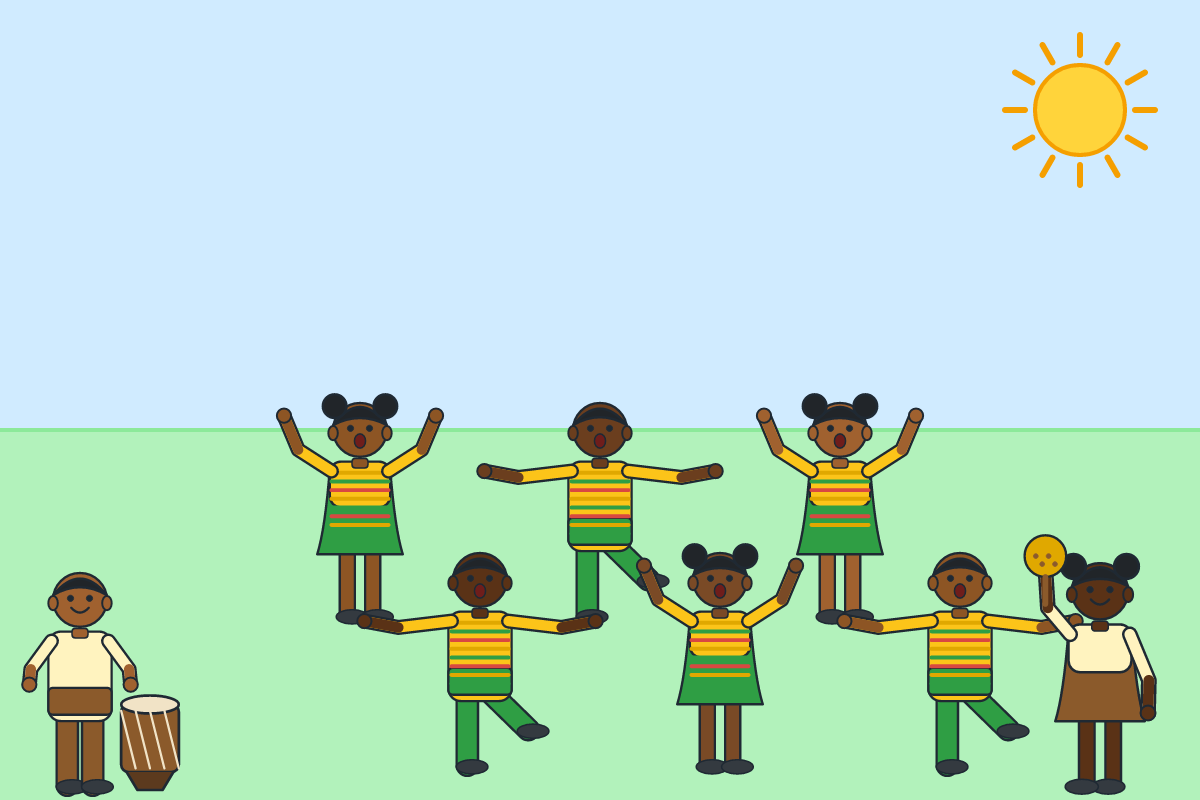
A dance sequence is a series of movements put together. Use movements from Ghanaian dances, such as the hand gestures of Adowa or the stepping of Kpanlogo. Plan a beginning (entry), middle (main movements) and end (exit or final pose). Use levels (high, medium, low), directions (forward, backward, sideways) and formations (lines, circles).
4. Creating a Drama Sketch
| Part | Description |
|---|---|
| characters | the people in the play |
| setting | where and when the story happens |
| plot | the events: beginning, problem, solution |
| dialogue | what the characters say |
| message | the lesson for the audience |
5. Rehearsing
Rehearse many times. Speak loudly and clearly, face the audience, and use gestures and facial expressions. Give each other helpful feedback and improve the performance. Time your performance so it is not too long.
New words
- compose
- To create a piece of music or writing.
- chorus
- The part of a song that repeats.
- dance sequence
- A series of dance movements.
- formation
- The arrangement of performers on stage.
- dialogue
- Words spoken by characters.
- rehearse
- To practise before performing.
Summary
- Ideas come from daily life, folktales and social issues.
- A song has verses and a chorus.
- A dance has a beginning, middle and end with levels and formations.
- A drama has characters, setting, plot, dialogue and a message.
Class activity: Group Creation
- Choose to create a song, a dance or a drama sketch.
- Plan it on paper and rehearse it.
- Perform it for the class.
You need: Locally made drum, Gourd shaker, Printed photographs of Ghanaian, African performances
Exercises
Answer in your exercise book first, then check your answers.
1. The part of a song that repeats is the…
- A. chorus
- B. verse
- C. title
- D. drum
Show answer
Answer: chorusIt is sung many times.2. The arrangement of dancers on stage is the…
- A. formation
- B. dialogue
- C. plot
- D. setting
Show answer
Answer: formatione.g. a circle.3. What a character says in a play is…
- A. dialogue
- B. setting
- C. rhythm
- D. costume
Show answer
Answer: dialogueSpoken words.4. Rehearsing helps improve a performance.
- A. True
- B. False
Show answer
Answer: TruePractice makes it better.5. A drama sketch does not need a message.
- A. True
- B. False
Show answer
Answer: FalseIt should teach or show something.6. To create a piece of music is to ______ it.
Show answer
Answer: composeComposers write music.7. Name three parts of a drama sketch.
Show answer
Answer: Characters, setting and plot (or dialogue, message).Any three.8. How can using different levels improve a dance?
Show answer
Answer: It adds variety and interest, making the dance more exciting to watch.High, medium and low.
Homework
- Write a four-line song about keeping your school clean.