Basic 4 · Physical Education · Space Awareness
Self-Space and Open Space
In this topic you will distinguish between self-space and open space and use them in games.
By the end of these notes you should be able to:
- Explain self-space and open space
- Stay in self-space during activities
- Move into open space in games
What you already know
- General space (Basic 3)
Copy everything that has a blue line on its left into your notebook. The other parts are for reading.
- Strand
- Movement Concepts
- Sub-strand
- Space Awareness
- Indicator
- B4.2.1.2.1 – Distinguish between self-space and open space
Introduction
When you stretch your arms and turn around, the space you can reach is your self-space. In a game, empty areas where you can move are open spaces.
1. Two Kinds of Space
| Space | Meaning | When we use it |
|---|---|---|
| self-space | the space around your body that you can reach | exercises and warm-ups |
| open space | empty areas in the general space | games, to receive passes and avoid others |
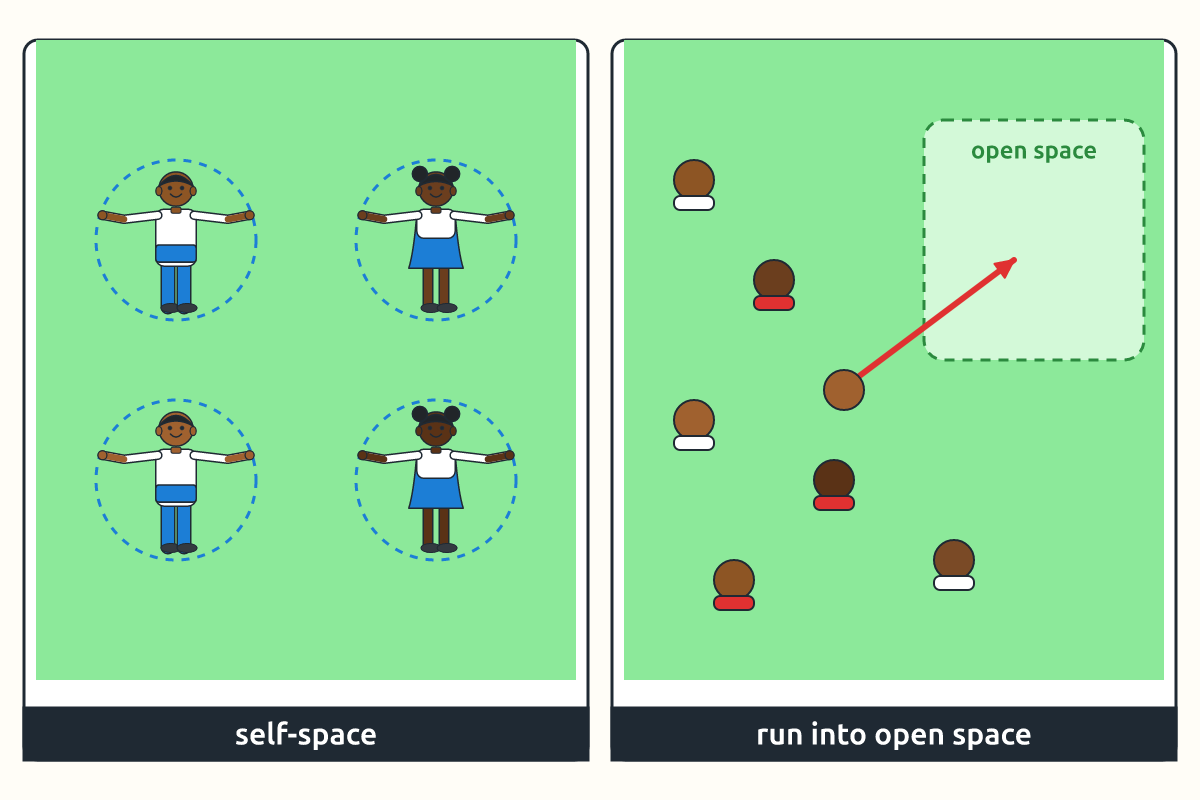
2. Using Space in Games
- Look up to find open space.
- Move away from opponents.
- Call for the ball when you are in open space.
- Spread out so the team uses the whole field.
New words
- self-space
- The space around your body.
- open space
- An empty area you can move into.
- general space
- The whole area shared by all.
- opponent
- A player on the other team.
- spread out
- To move apart.
- pass
- To send the ball to a teammate.
Summary
- Self-space is the space your body can reach.
- Open space is an empty area in the general space.
- Moving into open space helps you receive passes.
- Teams spread out to use the whole field.
Class activity: Space Invaders
- Do warm-ups in your self-space.
- Play a passing game; move into open space to receive passes.
- Freeze on the whistle and check if you are in open space.
You need: Plastic-bottle cones, Rope, Locally made ball
Exercises
Answer in your exercise book first, then check your answers.
1. The space around your body is…
- A. Self-space
- B. Open space
- C. Outer space
- D. Classroom
Show answer
Answer: Self-spaceThat is self-space.2. Why move into open space in a game?
- A. To receive a pass
- B. To hide
- C. To rest
- D. To leave the game
Show answer
Answer: To receive a passTeammates can reach you.3. A player on the other team is an…
- A. Opponent
- B. Teammate
- C. Referee
- D. Coach
Show answer
Answer: OpponentThat is an opponent.4. Warm-ups are done in self-space.
- A. True
- B. False
Show answer
Answer: TrueYou stay in your space.5. Teams should all crowd around the ball.
- A. True
- B. False
Show answer
Answer: FalseThey should spread out.6. To move apart is to spread ______.
Show answer
Answer: outThat is spreading out.7. Explain the difference between self-space and open space.
Show answer
Answer: Self-space is around your body; open space is an empty area in the general space.They differ.8. How does spreading out help a team?
Show answer
Answer: It creates passing options and uses the whole field.Space wins games.
Homework
- Watch a football match and notice players moving into open space.