Basic 4 · Physical Education · Locomotive Skills
Moving with Different Qualities
In this topic you will move slowly and quickly, heavily and lightly, hard and soft.
By the end of these notes you should be able to:
- Explain movement qualities
- Show slow and fast, heavy and light, hard and soft movements
- Change the quality of movement on a signal
What you already know
- Changing direction (Basic 3)
Copy everything that has a blue line on its left into your notebook. The other parts are for reading.
- Strand
- Motor Skill And Movement Patterns
- Sub-strand
- Locomotive Skills
- Indicator
- B4.1.1.1.1 – Demonstrate the difference between slow and fast heavy and light, hard and soft while moving
Introduction
An elephant walks slowly and heavily. A cat creeps lightly and softly. A boxer punches hard and fast. The way we move can change.
1. Movement Qualities
| Quality | Meaning | Example |
|---|---|---|
| slow | taking a long time | a tortoise walking |
| fast | taking a short time | a sprinter running |
| heavy | strong and forceful | an elephant stamping |
| light | gentle, using little force | a butterfly flying |
| hard | sharp and firm | a karate chop |
| soft | smooth and gentle | landing like a cat |
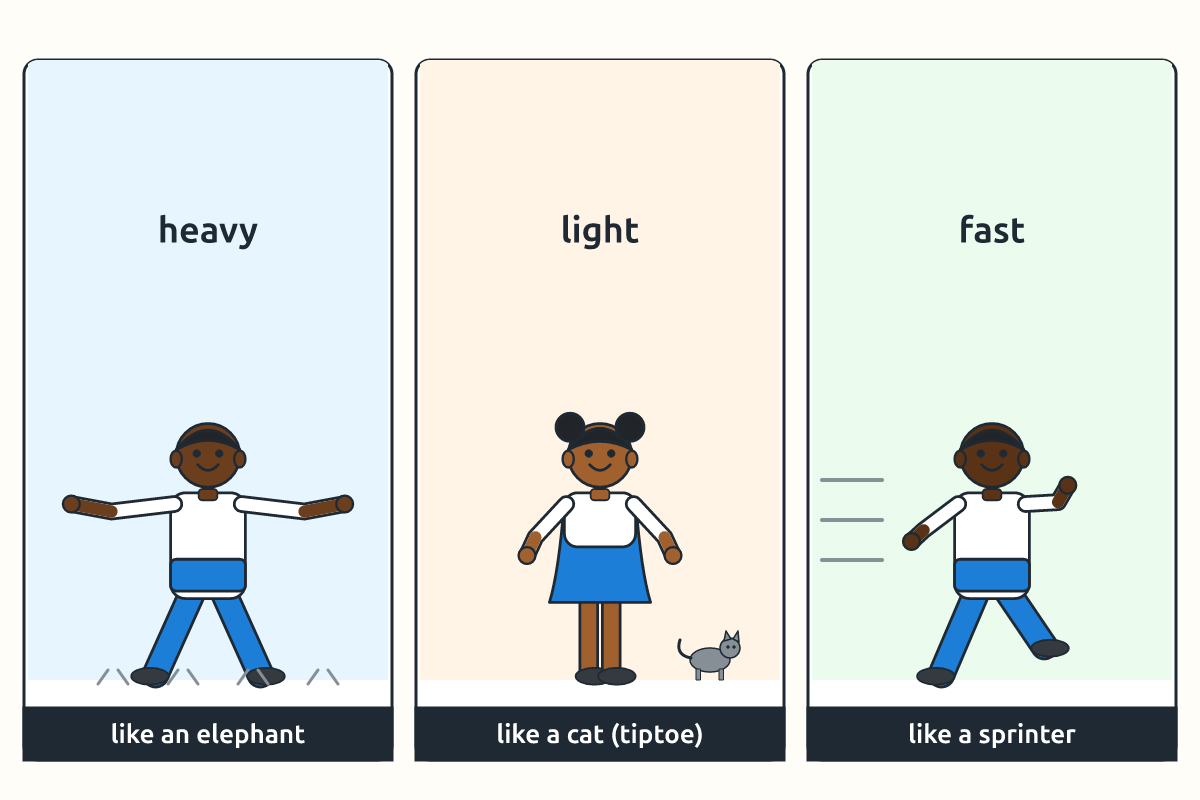
2. Practising the Qualities
- Walk slowly, then quickly.
- Stamp heavily, then tiptoe lightly.
- Jump and land hard, then land softly with bent knees.
Safety: Always land softly with bent knees to protect your joints.
New words
- quality
- How a movement is done.
- speed
- How fast or slow something moves.
- force
- Strength used in a movement.
- light
- Using little force.
- heavy
- Using much force.
- signal
- A sound or sign telling you to act.
Summary
- Movements can be slow or fast, heavy or light, hard or soft.
- We change movement quality on a signal.
- Soft landings protect our joints.
- Animals help us imagine different qualities.
Class activity: Animal Moves
- Move like an elephant, a cat, a sprinter and a tortoise.
- Change the quality when the drum changes.
- Name the quality of each movement.
You need: Plastic-bottle cones, Rope, Sticks of chalk
Exercises
Answer in your exercise book first, then check your answers.
1. How does a tortoise move?
- A. Slowly
- B. Fast
- C. Hard
- D. Heavily only
Show answer
Answer: SlowlyTortoises are slow.2. Tiptoeing is a…
- A. Light movement
- B. Heavy movement
- C. Hard movement
- D. Fast movement only
Show answer
Answer: Light movementIt uses little force.3. Strength used in a movement is…
- A. Force
- B. Speed
- C. Space
- D. Direction
Show answer
Answer: ForceThat is force.4. An elephant moves heavily.
- A. True
- B. False
Show answer
Answer: TrueIt uses much force.5. We should land hard with straight legs.
- A. True
- B. False
Show answer
Answer: FalseLand softly with bent knees.6. How fast or slow something moves is its ______.
Show answer
Answer: speedThat is speed.7. Name three pairs of movement qualities.
Show answer
Answer: Slow and fast, heavy and light, hard and soft.These are the pairs.8. Why do we land softly after jumping?
Show answer
Answer: To protect our knees and ankles from injury.Soft landings absorb force.
Homework
- Show your family a slow, fast, heavy and light movement.