Basic 4 · Our World and Our People · The Environment and the Weather
Making Our Environment Safe
In this topic you will identify hazards in the environment and ways of making it safe.
By the end of these notes you should be able to:
- Identify hazards in the home, school and community
- Explain ways of removing hazards
- Report hazards to adults
What you already know
- Keeping safe (Basic 3)
Copy everything that has a blue line on its left into your notebook. The other parts are for reading.
- Strand
- All about us
- Sub-strand
- The Environment and the Weather
- Indicator
- B4.2.1.1.1 – Explain ways of making the environment safe
Introduction
Broken bottles, open gutters and uncovered wells can cause accidents. A safe environment protects everyone, especially children.
1. Hazards Around Us
Hazard: Something that can cause harm or injury.
| Hazard | Danger | Solution |
|---|---|---|
| broken bottles | cuts | pick up carefully and dispose of safely |
| open gutters | falls, injuries | cover with slabs |
| uncovered wells | drowning | cover and fence |
| exposed electrical wires | electric shock | report to an adult or ECG |
| stagnant water | mosquitoes and malaria | drain or cover |
| stray animals | bites | report to authorities |
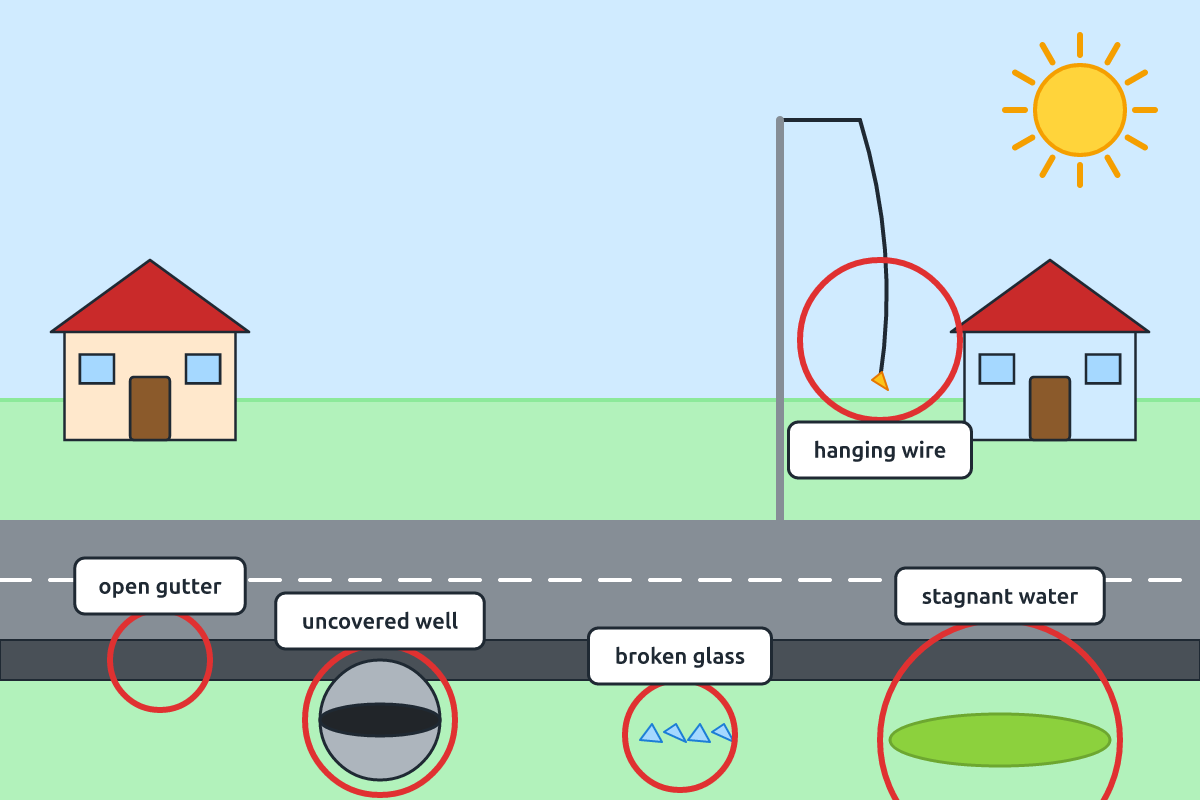
2. Making the Environment Safe
- clean up regularly
- cover wells, gutters and pits
- report dangers to parents, teachers or the assembly member
- keep medicines and chemicals out of children's reach
Safety: Never touch fallen electric wires. Stay far away and tell an adult.
New words
- hazard
- Something that can cause harm.
- injury
- Harm to the body.
- stagnant
- Not flowing.
- assembly member
- An elected local leader.
- electric shock
- Injury caused by electricity passing through the body.
- dispose
- To get rid of.
Summary
- Hazards can cause injury or disease.
- Common hazards include open gutters, broken bottles and exposed wires.
- We remove or cover hazards and report them.
- Never touch fallen electric wires.
Class activity: Hazard Hunt
- Walk around the school compound with your teacher.
- List any hazards you see.
- Suggest a solution for each and report them to the head teacher.
You need: Broom, Waste basket, Printed photographs of clean, Polluted Ghanaian surroundings
Exercises
Answer in your exercise book first, then check your answers.
1. Something that can cause harm is a…
- A. Hazard
- B. Gift
- C. Plant
- D. Song
Show answer
Answer: HazardThat is a hazard.2. What should you do if you see a fallen electric wire?
- A. Stay away and tell an adult
- B. Touch it
- C. Move it
- D. Play near it
Show answer
Answer: Stay away and tell an adultWires can kill.3. Stagnant water can cause…
- A. Malaria
- B. Strong bones
- C. Good harvests
- D. Rain
Show answer
Answer: MalariaMosquitoes breed there.4. Uncovered wells are dangerous.
- A. True
- B. False
Show answer
Answer: TruePeople can fall in.5. Broken bottles should be left on the path.
- A. True
- B. False
Show answer
Answer: FalseThey should be removed safely.6. Not flowing water is ______ water.
Show answer
Answer: stagnantThat is stagnant.7. Name three hazards in a community and their solutions.
Show answer
Answer: E.g. open gutters – cover; wells – cover; bottles – clear away.Each hazard has a solution.8. Why should medicines be kept out of children's reach?
Show answer
Answer: Children may swallow them by mistake and be poisoned.Medicines can harm.
Homework
- Check your home for one hazard and fix it with an adult.