Basic 4 · Ghanaian Language · Capitalization
Capital Letters After Colons
In this topic you will learn when to use a capital letter after a colon.
By the end of these notes you should be able to:
- Recognise the colon (:)
- Use a capital letter when a colon introduces direct speech or a full sentence
- Use colons correctly in writing
What you already know
- Capital letters for proper nouns (Basic 3)
Copy everything that has a blue line on its left into your notebook. The other parts are for reading.
- Strand
- Grammar Usage
- Sub-strand
- Capitalization
- Indicator
- B4.5.1.1.1-3 – Demonstrate an understanding of the use of capital letters after colons
Introduction
The colon (:) is two dots, one above the other. It introduces what comes next, such as a list or what someone said.
1. Uses of the Colon
| Use | Example |
|---|---|
| before a list | We need three things: soap, water and a towel. |
| before direct speech | The teacher said: "Bring your books tomorrow." |
| before a full sentence that explains | Remember this rule: Always wash your hands. |
2. Capital Letters After Colons
- Use a capital letter when the colon introduces direct speech: Mother said: "Come home early."
- Use a capital letter when what follows is a complete sentence or rule: The rule is: Respect your elders.
- Do not use a capital letter before an ordinary list: We bought: yams, fish and pepper.
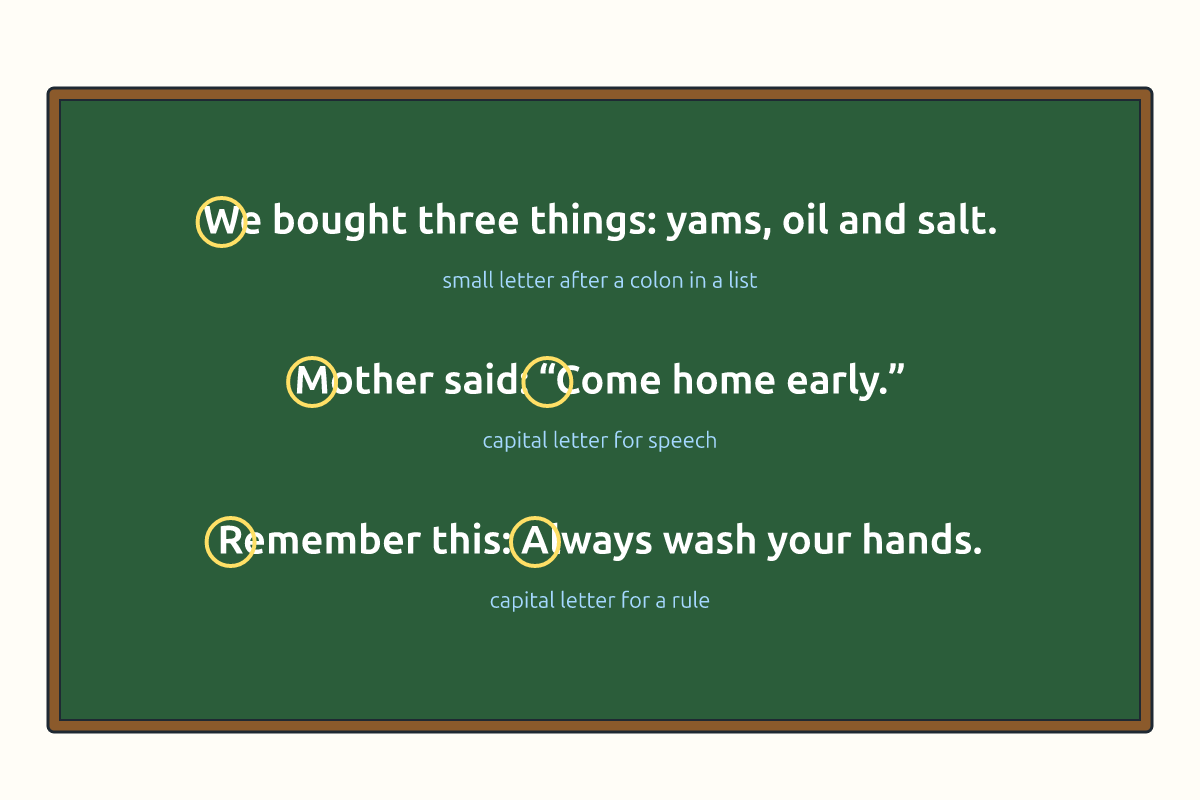
Tip: In your Ghanaian language, follow the same rule when writing what someone said.
New words
- colon
- The mark (:) that introduces what follows.
- direct speech
- The exact words someone said.
- list
- Several items named one after another.
- capital letter
- A big letter like A or M.
- rule
- A statement of what to do.
- introduce
- To present something.
Summary
- A colon introduces a list, direct speech or an explanation.
- Use a capital letter after a colon for direct speech or a full sentence.
- An ordinary list after a colon starts with a small letter.
- Colons make writing organised.
Class activity: Colon Practice
- Use the printed sentence cards.
- Add colons and capital letters where needed.
- Explain each choice to your partner.
You need: Printed cards of Ghanaian names, Place names, Chalkboard, Chalk, Exercise books, Pencils
Exercises
Answer in your exercise book first, then check your answers.
1. What does a colon look like?
- A. Two dots, one above the other (:)
- B. A dot above a comma
- C. A single comma (,)
- D. A single dot (.)
Show answer
Answer: Two dots, one above the other (:)That is a colon.2. Which is correct?
- A. Father said: "Sit down."
- B. Father said: "sit down."
- C. Father said "Sit down"
- D. father said: Sit down
Show answer
Answer: Father said: "Sit down."Direct speech starts with a capital.3. Which uses a small letter after the colon correctly?
- A. We bought: yams and fish.
- B. Rule: Respect elders.
- C. He said: "Come."
- D. Note: Be early.
Show answer
Answer: We bought: yams and fish.It is an ordinary list.4. A colon can introduce a list.
- A. True
- B. False
Show answer
Answer: TrueThat is one use.5. Direct speech after a colon starts with a small letter.
- A. True
- B. False
Show answer
Answer: FalseIt starts with a capital letter.6. The exact words someone said are direct ______.
Show answer
Answer: speechThat is direct speech.7. Write a sentence with a colon introducing a list.
Show answer
Answer: E.g. We need three colours: red, gold and green.Colon before a list.8. Write a sentence with a colon introducing direct speech.
Show answer
Answer: E.g. The chief said: "Keep the town clean."Capital after the colon.
Homework
- Write three sentences using colons correctly.