Basic 4 · Creative Arts · Planning, Making and Composing
Experimenting with Visual Art Media
In this topic you will experiment with different visual art media and methods to create artworks.
By the end of these notes you should be able to:
- Name visual art media and methods
- Experiment with at least three methods
- Create a small artwork using a chosen method
What you already know
- Making visual art with different methods (Basic 2)
Copy everything that has a blue line on its left into your notebook. The other parts are for reading.
- Strand
- Visual Arts
- Sub-strand
- Planning, Making and Composing
- Indicator
- B4.1.2.2.1 – Experiment with available visual arts media and methods to create artwork
Introduction
Artists experiment to find new ways of working. You will try painting, printing, collage, weaving and modelling with materials around you.
1. Media and Methods
| Method | Media | Example artwork |
|---|---|---|
| drawing | pencil, charcoal, crayon | portrait, landscape |
| painting | poster paint, natural dyes | a market scene |
| printing | cassava stamps, leaves, ink | adinkra-style cloth |
| collage | paper, fabric, seeds | a festival picture |
| weaving | paper strips, raffia, palm fronds | a mat or basket |
| modelling | clay, paper mâché | a pot or figure |
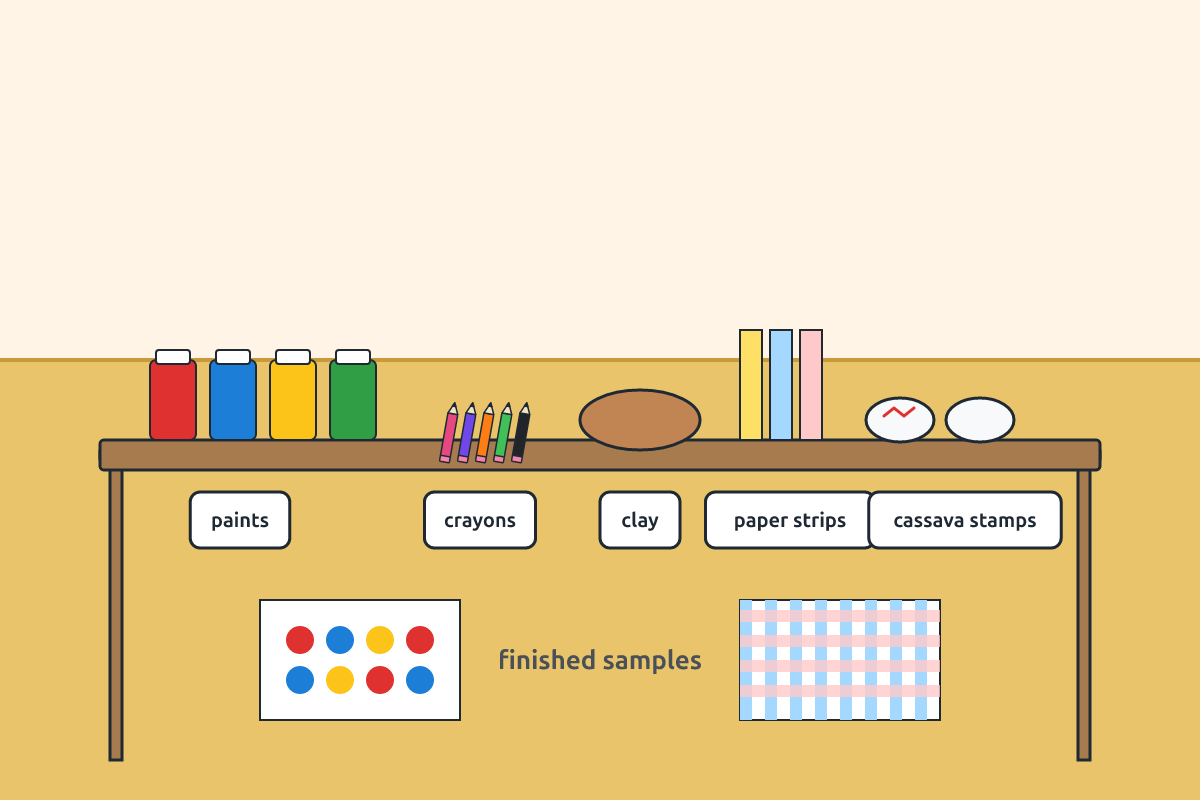
2. Elements of Art
| Element | Meaning |
|---|---|
| line | a mark made by moving a tool |
| shape | a flat area with edges |
| colour | red, blue, yellow and their mixes |
| texture | how a surface feels or looks like it feels |
| form | a 3-D shape |
3. Paper Weaving Steps
- Cut slits across a sheet of paper, leaving a border.
- Cut strips of a different colour.
- Weave strips over and under the slits.
- Push the strips close together and glue the ends.
Safety: Use scissors carefully and keep clay off your face.
New words
- media
- Materials used to make art.
- experiment
- To try something to see what happens.
- texture
- How a surface feels.
- collage
- A picture made by sticking materials onto a base.
- weaving
- Crossing strips over and under.
- form
- A three-dimensional shape.
Summary
- Art methods include drawing, painting, printing, collage, weaving and modelling.
- Elements of art include line, shape, colour, texture and form.
- Experimenting helps artists find new ideas.
- Paper weaving uses an over-and-under pattern.
Class activity: Art Stations
- Visit three stations: printing, weaving and modelling.
- Make a small sample at each.
- Choose your best sample and write how you made it.
You need: Pencils, Crayons, Old cartons, Manila paper, Kente, Adinkra samples
Exercises
Answer in your exercise book first, then check your answers.
1. Which is a modelling material?
- A. Clay
- B. Paper strips
- C. Crayon
- D. Ink
Show answer
Answer: ClayClay can be shaped.2. Crossing strips over and under is…
- A. Weaving
- B. Printing
- C. Painting
- D. Drawing
Show answer
Answer: WeavingThat is weaving.3. How a surface feels is its…
- A. Texture
- B. Colour
- C. Line
- D. Size
Show answer
Answer: TextureThat is texture.4. A collage is made by sticking materials onto a base.
- A. True
- B. False
Show answer
Answer: TrueThat is collage.5. Form means a flat shape.
- A. True
- B. False
Show answer
Answer: FalseForm is 3-D.6. Materials used to make art are called ______.
Show answer
Answer: mediaThat is media.7. Name three art methods and the media for each.
Show answer
Answer: E.g. painting – poster paint; printing – cassava stamps; modelling – clay.Any correct trio.8. Why do artists experiment with different media?
Show answer
Answer: To discover new effects, ideas and techniques.Experimenting builds skill.
Homework
- Make a small paper weaving at home using old magazines.