Basic 4 · Creative Arts · Planning, Making and Composing
Composing Music and Movement
In this topic you will experiment with voices, instruments and body percussion to create your own performing artwork.
By the end of these notes you should be able to:
- Use voice, instruments and body percussion
- Compose a short song with verse and chorus
- Add movements to your composition
What you already know
- Composing music and dance (Basic 2)
Copy everything that has a blue line on its left into your notebook. The other parts are for reading.
- Strand
- Performing Arts
- Sub-strand
- Planning, Making and Composing
- Indicator
- B4.2.2.2.1 – Experiment and create own artworks using available performing arts media
Introduction
You do not need expensive instruments to make music. Clapping, stamping, bottles and tins can make wonderful sounds.
1. Performing Arts Media
| Source | Examples |
|---|---|
| voice | singing, humming, chanting |
| body percussion | clapping, stamping, snapping, thigh slaps |
| local instruments | drums, gourd shakers, bells (gankogui), flutes |
| found objects | bottles, tins, sticks |
2. Structure of a Song
| Part | Meaning |
|---|---|
| verse | tells the story; words change each time |
| chorus | the part repeated after each verse |
| introduction | the opening music |
| ending | how the song finishes |
Example chorus: "Keep Ghana clean, keep Ghana green, the cleanest land you have ever seen!"
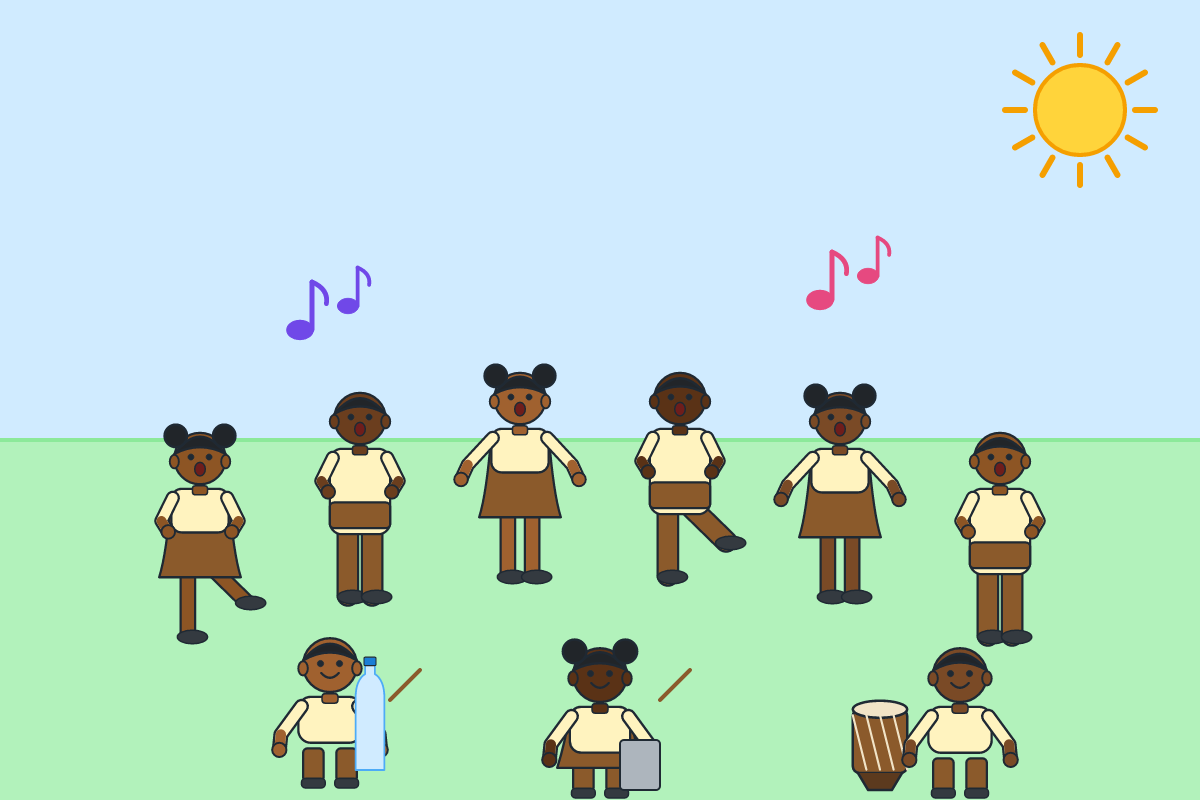
3. Adding Movement
- Step and clap on the beat during the chorus.
- Act out the words in the verses.
- Finish with a pose.
New words
- compose
- To create a new piece of music.
- body percussion
- Sounds made with the body.
- verse
- A part of a song that tells the story.
- chorus
- The repeated part of a song.
- melody
- The tune of a song.
- rhythm
- The pattern of beats.
Summary
- Performing arts media include voice, body percussion and instruments.
- A song has verses and a chorus.
- The chorus is repeated after each verse.
- Movements make performances lively.
Class activity: Our Class Song
- Write a chorus about a topic you care about.
- Write two short verses.
- Add body percussion and movement, then perform.
You need: Locally made drum, Gourd shaker, Printed photographs of Ghanaian, African performances
Exercises
Answer in your exercise book first, then check your answers.
1. The repeated part of a song is the…
- A. Chorus
- B. Verse
- C. Ending
- D. Title
Show answer
Answer: ChorusIt repeats.2. Clapping and stamping are examples of…
- A. Body percussion
- B. Painting
- C. Weaving
- D. Modelling
Show answer
Answer: Body percussionSounds made with the body.3. The tune of a song is its…
- A. Melody
- B. Lyrics
- C. Chorus
- D. Costume
Show answer
Answer: MelodyThat is the melody.4. Bottles and tins can be used to make music.
- A. True
- B. False
Show answer
Answer: TrueThey are found instruments.5. The verse is the part repeated after every chorus.
- A. True
- B. False
Show answer
Answer: FalseThe chorus is repeated.6. To create a new piece of music is to ______.
Show answer
Answer: composeThat is composing.7. Name three ways of making sound without a drum.
Show answer
Answer: E.g. clapping, stamping, tapping a bottle.Many sound sources exist.8. Why does a chorus help an audience enjoy a song?
Show answer
Answer: It repeats, so the audience can learn it quickly and sing along.Repetition is memorable.
Homework
- Create a body percussion rhythm and teach it to a family member.