Basic 3 · Physical Education · Manipulative Skills
Balancing While Holding an Object
In this topic you will move and hold objects while changing how your weight is spread.
By the end of these notes you should be able to:
- Change your base of support
- Hold or move an object while balancing
- Keep control of your body and the object
What you already know
- Balancing on different body parts (Basic 2)
Copy everything that has a blue line on its left into your notebook. The other parts are for reading.
- Strand
- Motor Skill And Movement, Patterns
- Sub-strand
- Manipulative Skills
- Indicator
- B3.1.4.1.5 – Manipulate an object while distributing weight and base of support
Introduction
A woman carrying a bucket of water on her head keeps her body balanced as she walks. You will practise balancing while holding objects.
1. Weight and Base of Support
Base of support: The body parts touching the ground.
A wide base is more stable. A narrow base is harder to balance on.
2. Balance Challenges
| Challenge | How |
|---|---|
| beanbag on head | walk slowly with a beanbag on your head |
| one-foot ball pass | stand on one foot and pass a ball hand to hand |
| table shape with beanbag | on hands and knees, balance a beanbag on your back |
| low squat throw | squat low and toss a ball up and catch it |
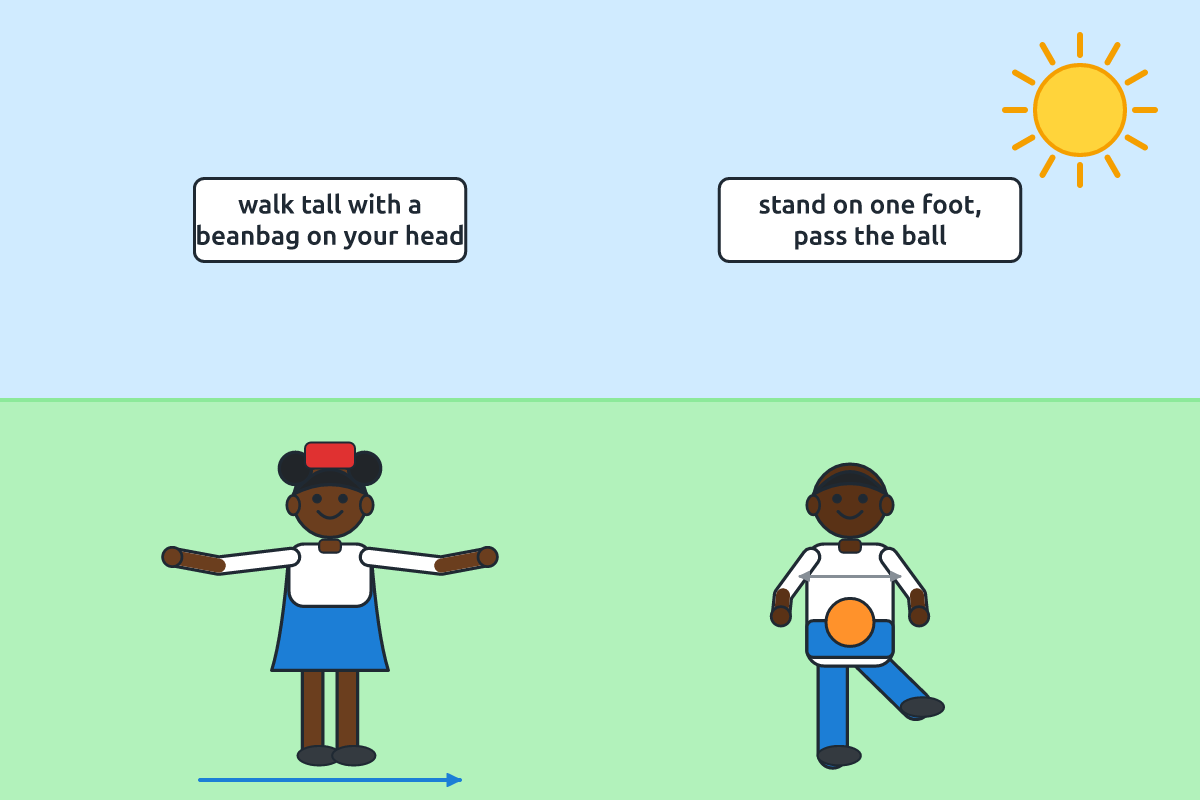
Tip: Look at a fixed spot ahead to help your balance.
New words
- base of support
- Body parts touching the ground.
- stable
- Steady and not likely to fall.
- weight
- How heavy your body is.
- manipulate
- To handle or move an object with skill.
Summary
- A wide base is more stable than a narrow base.
- We can balance while holding or moving objects.
- Looking at a fixed spot helps balance.
Class activity: Balance Stations
- Walk with a beanbag on your head.
- Pass a ball while standing on one foot.
- Hold a table shape with a beanbag on your back.
You need: Light locally made ball, Smooth wooden stick, Plastic-bottle boundary cones
Exercises
Answer in your exercise book first, then check your answers.
1. Which base is more stable?
- A. Wide
- B. Narrow
- C. One toe
- D. No base
Show answer
Answer: WideA wide base is steadier.2. What helps you balance?
- A. Looking at a fixed spot
- B. Spinning
- C. Closing your eyes
- D. Shaking
Show answer
Answer: Looking at a fixed spotFocus keeps you steady.3. Standing on one foot is a narrow base.
- A. True
- B. False
Show answer
Answer: TrueIt is harder to balance.4. A narrow base is easier to balance on.
- A. True
- B. False
Show answer
Answer: FalseA wide base is easier.5. Steady and not likely to fall is ______.
Show answer
Answer: stableThat is stable.6. Describe one balance challenge with an object.
Show answer
Answer: E.g. walk with a beanbag on your head.Any correct challenge.
Homework
- Walk across a room with a book on your head.