Basic 3 · Mathematics · Fractions
Comparing and Ordering Fractions
In this topic you will compare and order unit fractions and fractions with the same denominator.
By the end of these notes you should be able to:
- Compare unit fractions
- Compare fractions with the same denominator
- Order fractions on a number line
What you already know
- Understanding fractions
Copy everything that has a blue line on its left into your notebook. The other parts are for reading.
- Strand
- Number
- Sub-strand
- Fractions
- Indicator
- B3.1.3.1.3 – Compare and order unit fractions and fractions with like denominators by using concrete models pictorial representations and number line
Introduction
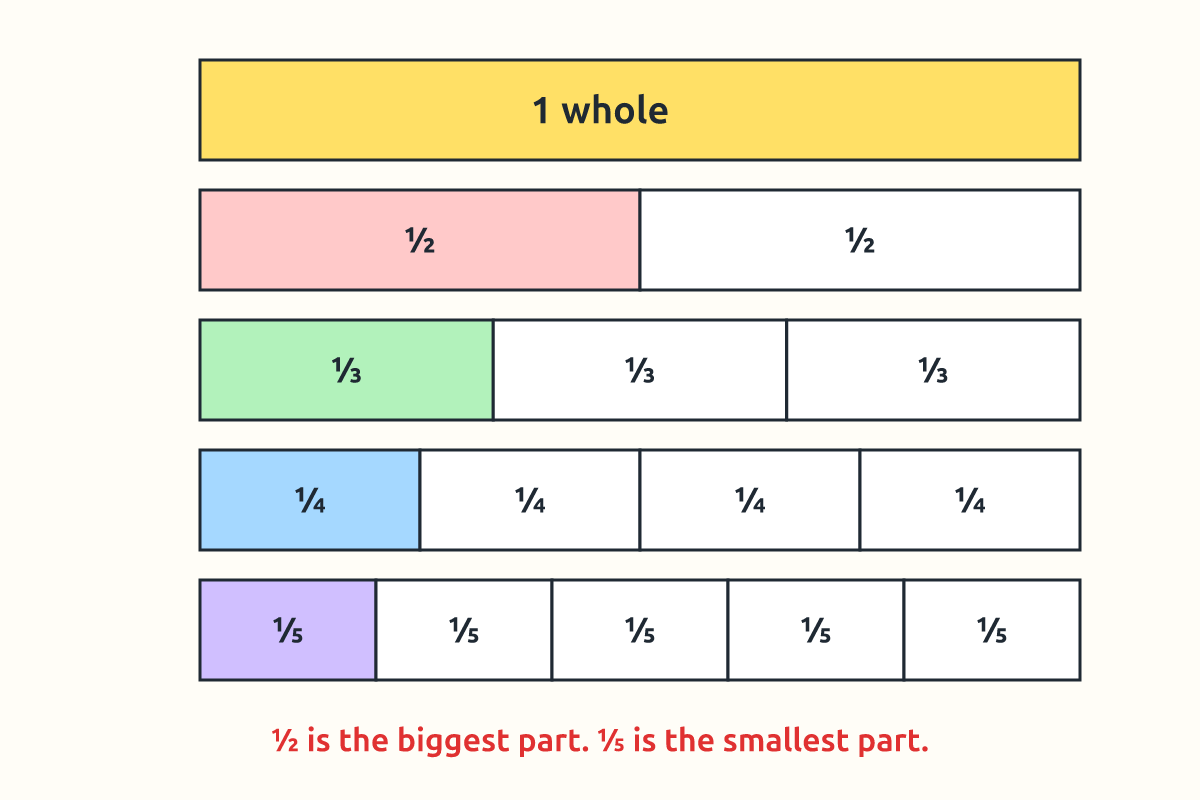
Would you rather have ½ of an orange or ¼ of the same orange? The more equal parts there are, the smaller each part is.
1. Comparing Unit Fractions
The bigger the denominator, the smaller the part.
½ > ⅓ > ¼ > ⅕
2. Same Denominator
When the denominators are the same, compare the numerators.
⅘ > ⅗ > ⅖ > ⅕
3. Fractions on a Number Line
On a line from 0 to 1 cut into 4 equal parts: 0, ¼, ²⁄₄, ¾, 1.
Example
Order from smallest to largest: ⅔, ⅓, 3/3.
- Same denominator (3), so compare numerators: 1, 2, 3.
Answer: ⅓, ⅔, 3/3
Remember: 3/3 is one whole.
New words
- compare
- To find which is bigger or smaller.
- order
- To arrange by size.
- number line
- A line with numbers in order.
- like denominators
- Fractions with the same bottom number.
Summary
- For unit fractions, a bigger denominator means a smaller part.
- With the same denominator, compare the numerators.
- Fractions can be shown on a number line.
Class activity: Fraction Line
- Draw a number line from 0 to 1 with chalk.
- Mark quarters on it.
- Place fraction cards in the right places.
You need: Fraction strips cut from old cartons, Bottle tops, Exercise books
Exercises
Answer in your exercise book first, then check your answers.
1. Which is bigger?
- A. ½
- B. ¼
- C. ⅕
- D. ⅙
Show answer
Answer: ½Fewer parts means bigger parts.2. Which is the smallest?
- A. ⅙
- B. ⅓
- C. ½
- D. ¼
Show answer
Answer: ⅙The biggest denominator gives the smallest part.3. ¾ > ¼
- A. True
- B. False
Show answer
Answer: True3 quarters is more than 1 quarter.4. ⅕ > ⅓
- A. True
- B. False
Show answer
Answer: False⅓ is bigger because the whole is cut into fewer parts.5. 4/4 = ______ whole
Show answer
Answer: 1Four quarters make one whole.6. Order from largest to smallest: ¼, ½, ⅓.
Show answer
Answer: ½, ⅓, ¼Smaller denominators give bigger parts.
Homework
- Fold three paper strips into halves, thirds and quarters. Compare one part of each.