Basic 3 · English Language
Directions, Fluent Reading, Opinion Paragraphs and Conjunctions
In this topic you will give and follow directions, read longer texts fluently, write a paragraph supporting an opinion and use conjunctions.
By the end of these notes you should be able to:
- Give and respond to directions
- Read long texts with pace, accuracy and expression
- Write a paragraph supporting an opinion with reasons
- Use conjunctions to join ideas
What you already know
- Describing places and prepositions
Copy everything that has a blue line on its left into your notebook. The other parts are for reading.
Lesson 1
- Strand
- Oral Language
- Sub-strand
- Giving and Responding Directions
- Indicator
- B3.1.9.1.1 – Give and respond to commands instructions and directions
Introduction
Visitors often ask for directions. Clear directions help them find their way.
Giving Directions
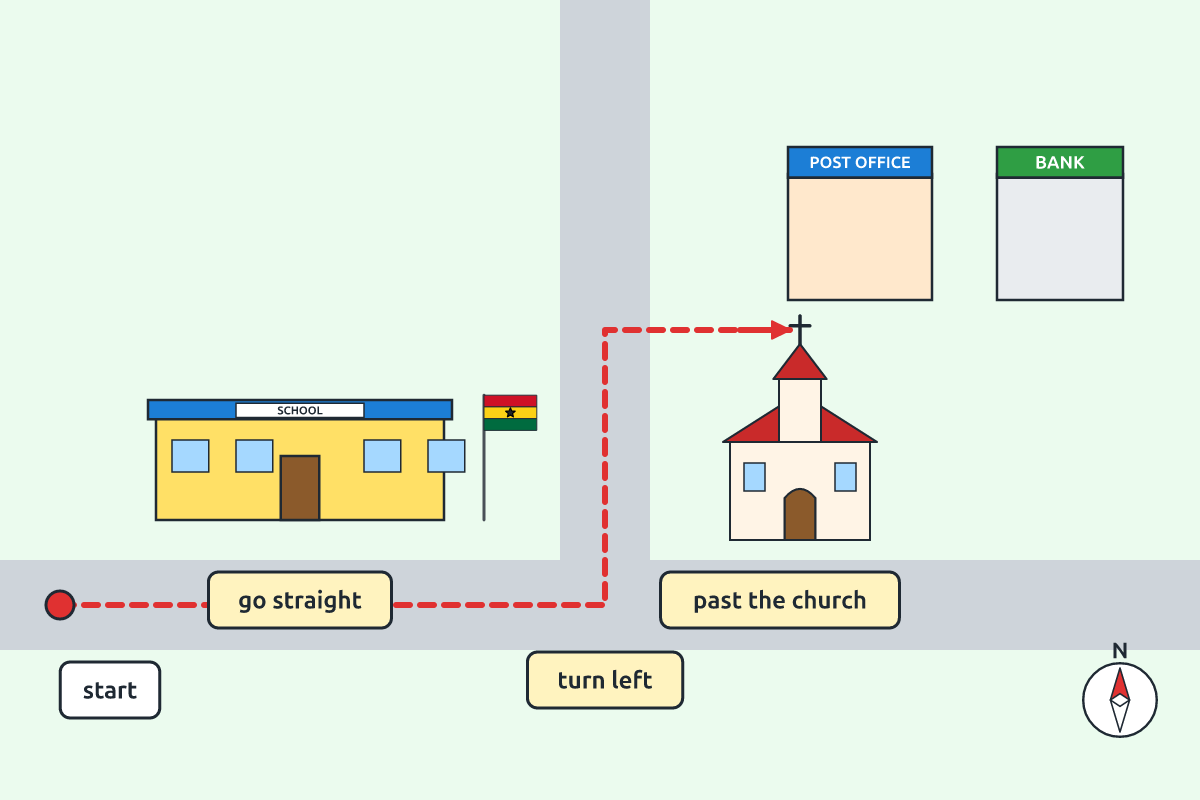
"To get to the post office, go straight along this road. Turn left at the junction. Walk past the church. The post office is on your right, next to the bank."
| Word | Meaning |
|---|---|
| straight | without turning |
| turn left / right | change direction |
| past | go beyond |
| next to | beside |
| opposite | facing |
New words
- direction
- Instructions on how to get somewhere.
- junction
- A place where roads meet.
- opposite
- Facing something.
Summary
- Clear directions use straight, turn, past, next to and opposite.
- We listen carefully when following directions.
Exercises
Answer in your exercise book first, then check your answers.
1. A place where roads meet is a…
- A. Junction
- B. Bank
- C. Bridge
- D. River
Show answer
Answer: JunctionThat is a junction.2. "Opposite" means facing.
- A. True
- B. False
Show answer
Answer: TrueThat is its meaning.3. The post office is ______ to the bank.
Show answer
Answer: nextNext to means beside.4. Give directions from your classroom to the school gate.
Show answer
Answer: Answers will differ.Use direction words.
Lesson 2
- Strand
- Reading
- Sub-strand
- Fluency
- Indicator
- B3.2.9.1.1 – Read long texts with good pace accuracy and expression
Introduction
Fluent readers read long texts smoothly, correctly and with expression.
Reading Longer Texts Fluently
| Skill | Check |
|---|---|
| pace | not too fast or slow |
| accuracy | every word correct |
| expression | voice shows feeling |
| phrasing | read groups of words together |
Tip: Read the text silently first, then aloud.
New words
- fluency
- Reading smoothly and well.
- phrasing
- Reading groups of words together.
- accuracy
- Being correct.
Summary
- Fluent reading needs pace, accuracy, expression and phrasing.
- Practise reading aloud often.
Exercises
Answer in your exercise book first, then check your answers.
1. Reading every word correctly is…
- A. Accuracy
- B. Pace
- C. Loudness
- D. Silence
Show answer
Answer: AccuracyThat is accuracy.2. Reading silently first helps fluency.
- A. True
- B. False
Show answer
Answer: TrueYou understand it first.3. Reading smoothly and well is ______.
Show answer
Answer: fluencyThat is fluency.4. Name two parts of fluent reading.
Show answer
Answer: Any two: pace, accuracy, expression, phrasing.These make fluent reading.
Lesson 3
- Strand
- Writing
- Sub-strand
- Argumentative Writing
- Indicator
- B3.4.13.1.1 – Write a short paragraph to support an opinion or claims with clear reasons
Introduction
An opinion paragraph says what you think and gives reasons.
Supporting an Opinion
Example: "I think every school should have a library. First, books help us learn new things. Second, reading improves our English. Finally, a library is a quiet place to study. That is why every school needs a library."
| Part | Example |
|---|---|
| opinion | I think every school should have a library. |
| reasons | First… Second… Finally… |
| conclusion | That is why every school needs a library. |
New words
- opinion
- What you think.
- reason
- Why you think it.
- conclusion
- The ending that sums up.
Summary
- State your opinion clearly.
- Give reasons with first, second and finally.
Exercises
Answer in your exercise book first, then check your answers.
1. What comes first in an opinion paragraph?
- A. The opinion
- B. The conclusion
- C. A list of names
- D. A question only
Show answer
Answer: The opinionState it first.2. Reasons support an opinion.
- A. True
- B. False
Show answer
Answer: TrueThey explain why.3. The ending that sums up is the ______.
Show answer
Answer: conclusionThat is the conclusion.4. Write one reason why children should eat fruit.
Show answer
Answer: E.g. Fruits have vitamins that keep us healthy.A reason supports an opinion.
Lesson 4
- Strand
- Grammar Usage
- Sub-strand
- Using Simple and Compound Sentences
- Indicator
- B3.5.9.1.1 – Identify and use coordinating conjunctions to join similar ideas or contrasting ideas in sentences
Introduction
Conjunctions join words and ideas.
Conjunctions
| Conjunction | Use | Example |
|---|---|---|
| and | adds ideas | I like rice and beans. |
| but | shows contrast | I am tired but happy. |
| or | gives a choice | Do you want tea or milk? |
| so | shows result | It rained, so we stayed inside. |
New words
- conjunction
- A joining word.
- contrast
- A difference.
- result
- What happens because of something.
Summary
- And, but, or and so are conjunctions.
- They join similar or contrasting ideas.
Exercises
Answer in your exercise book first, then check your answers.
1. Which conjunction shows contrast?
- A. but
- B. and
- C. or
- D. so
Show answer
Answer: butBut shows difference.2. "Or" gives a choice.
- A. True
- B. False
Show answer
Answer: TrueTea or milk.3. It rained, ______ we stayed inside. (so / or)
Show answer
Answer: soSo shows result.4. Join with a conjunction: "I am small. I am strong."
Show answer
Answer: I am small but strong.But shows contrast.
Lesson 5
- Strand
- Extensive Reading
- Sub-strand
- Reading
- Indicator
- B3.6.1.1.1 – Read a variety of age and level- appropriate books and summarize them
Introduction
Today we read and summarise a longer story.
Reading and Summarising
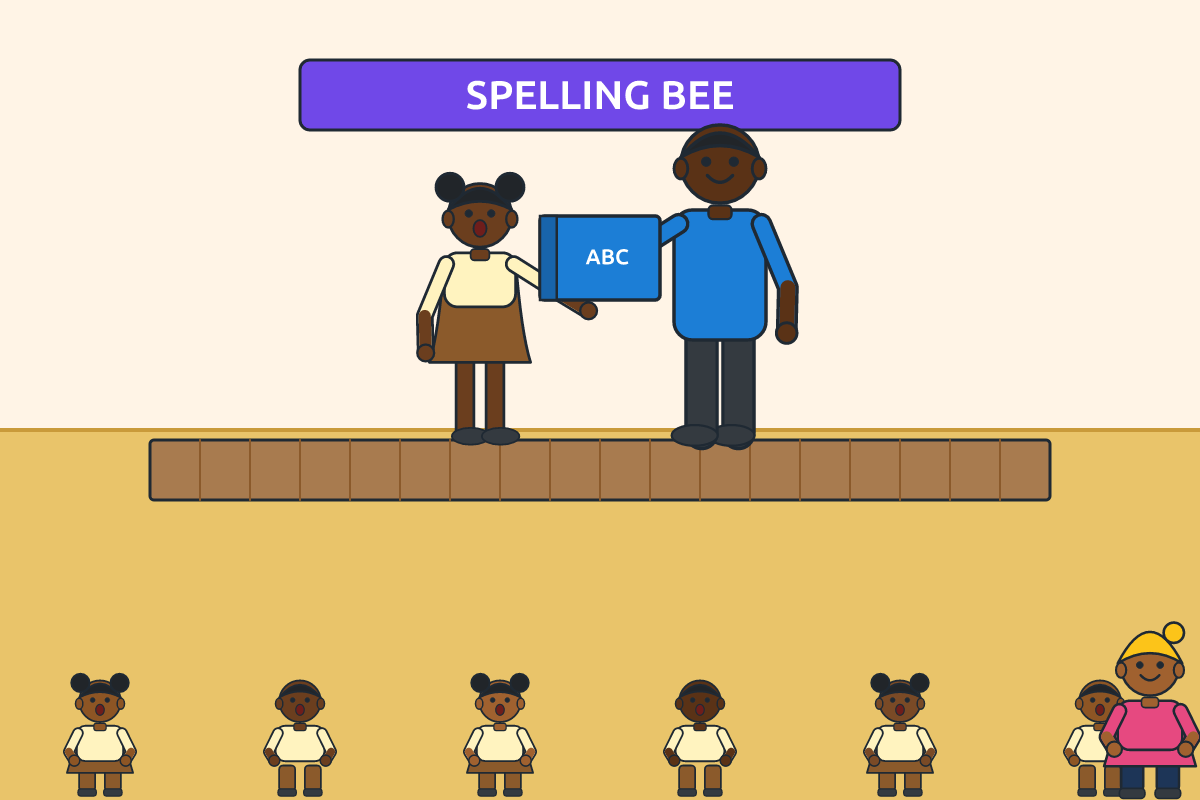
"Abena wanted to win the school spelling competition. Every evening, she learnt ten new words with her mother. On the day of the competition, she was nervous, but she remembered her practice. She spelt every word correctly and won first prize, a big dictionary. Her mother was very proud."
Summary: Abena practised every day and won the spelling competition.
New words
- competition
- A contest to find the best.
- nervous
- A little afraid.
- dictionary
- A book of words and their meanings.
Summary
- Abena practised spelling every evening.
- She won the competition and a dictionary.
Exercises
Answer in your exercise book first, then check your answers.
1. What did Abena win?
- A. A dictionary
- B. A bicycle
- C. Money
- D. A bag
Show answer
Answer: A dictionaryThe story says so.2. Abena practised with her mother.
- A. True
- B. False
Show answer
Answer: TrueThe story says so.3. A contest to find the best is a ______.
Show answer
Answer: competitionThat is a competition.4. Write a one-sentence summary.
Show answer
Answer: Abena practised hard and won the spelling competition.Main points.
Homework
- Write an opinion paragraph: "Why we should keep our school clean."