Basic 2 · Physical Education · Manipulative Skills
Balancing on Different Body Parts
In this topic you will balance on the ground and on low objects using body parts other than both feet.
By the end of these notes you should be able to:
- Balance on different body parts
- Balance on a low bench or beam
- Hold a balance with control
What you already know
- Balancing (Basic 1)
Copy everything that has a blue line on its left into your notebook. The other parts are for reading.
- Strand
- Motor Skill & Movement Patterns
- Sub-strand
- Manipulative Skills
- Indicator
- B2.1.4.1.4 – Demonstrate balance on the ground and on objects using bases of support other than both feet
Introduction
Gymnasts can balance on one hand, on their knees or on a beam. Today you will try balances on the ground and on a low bench.
1. Bases of Support
Base of support: The body parts touching the ground when you balance.
| Base of support | Balance |
|---|---|
| one foot | stork stand |
| two hands and two knees | table shape |
| one knee and one hand | side balance |
| bottom | V-sit |
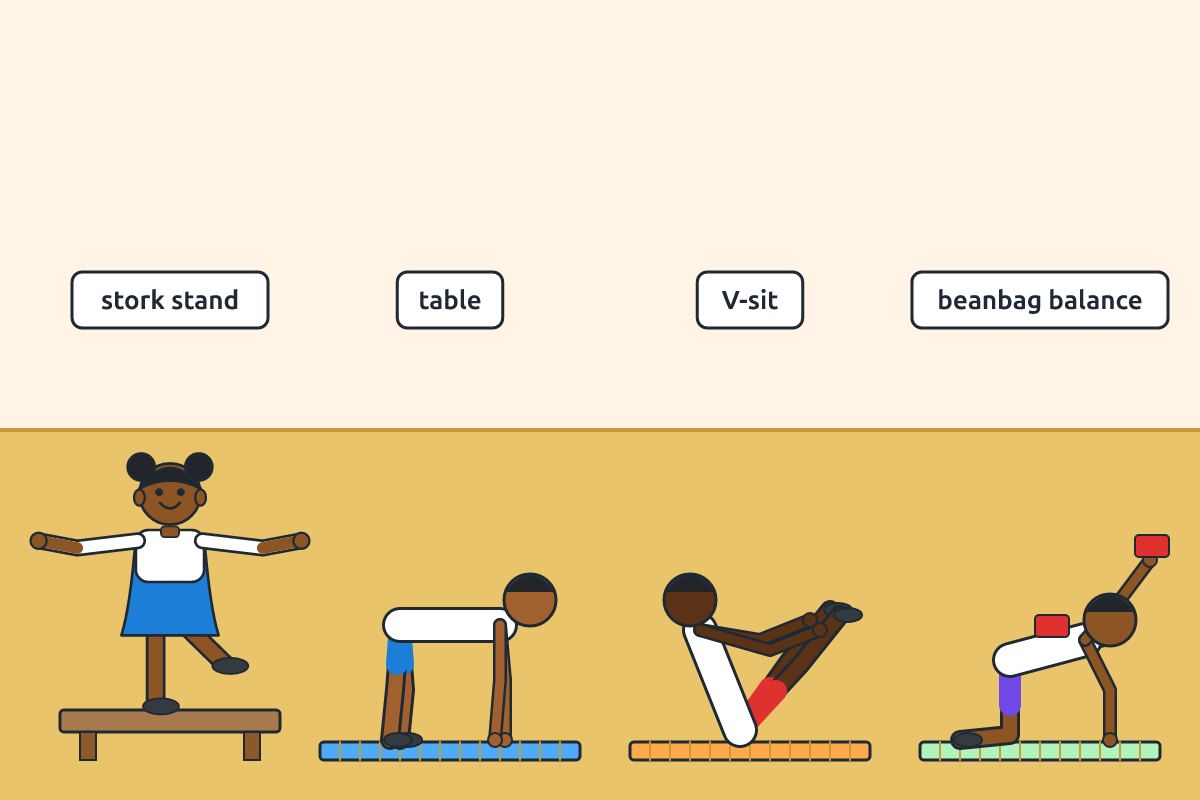
2. Holding a Balance
- Tighten your tummy.
- Look at one spot in front of you.
- Hold still and count to five.
Safety: Use a mat and keep the bench low.
New words
- base of support
- The parts touching the ground.
- stork stand
- Standing on one leg.
- V-sit
- Sitting with legs and arms up in a V shape.
- control
- Moving the body the way you want.
Summary
- A base of support is the body parts touching the ground.
- We can balance on one foot, knees, hands or our bottom.
- Tighten the tummy and look at one spot.
Class activity: Balance Circuit
- Do a stork stand on the low bench.
- Make a table shape on the mat.
- Hold a V-sit for five seconds.
You need: Low wooden bench, Beanbag, Woven mat
Exercises
Answer in your exercise book first, then check your answers.
1. Standing on one leg is a…
- A. Stork stand
- B. V-sit
- C. Table shape
- D. Push-up
Show answer
Answer: Stork standIt looks like a stork.2. What helps you hold a balance?
- A. Looking at one spot
- B. Closing your eyes
- C. Shaking
- D. Talking
Show answer
Answer: Looking at one spotFocus helps balance.3. A V-sit balances on your bottom.
- A. True
- B. False
Show answer
Answer: TrueLegs and arms are up.4. Balancing on a high wall is safe for class.
- A. True
- B. False
Show answer
Answer: FalseUse a low bench and a mat.5. The parts touching the ground are the base of ______.
Show answer
Answer: supportThat is the base of support.6. Name two body parts you can balance on other than both feet.
Show answer
Answer: E.g. one foot, knees, hands, bottom.There are many bases of support.
Homework
- Practise a stork stand on each leg for ten seconds.