Basic 2 · Ghanaian Language · Punctuation
The Full Stop and the Comma
In this topic you will learn to use the full stop and the comma.
By the end of these notes you should be able to:
- Use a full stop at the end of a sentence
- Use commas in a list
- Read sentences with full stops and commas correctly
What you already know
- Copying sentences neatly
Copy everything that has a blue line on its left into your notebook. The other parts are for reading.
- Strand
- Writing Conventions
- Sub-strand
- Punctuation
- Indicator
- B2.5.2.1.1 – Know what the full stop and the comma are
Introduction
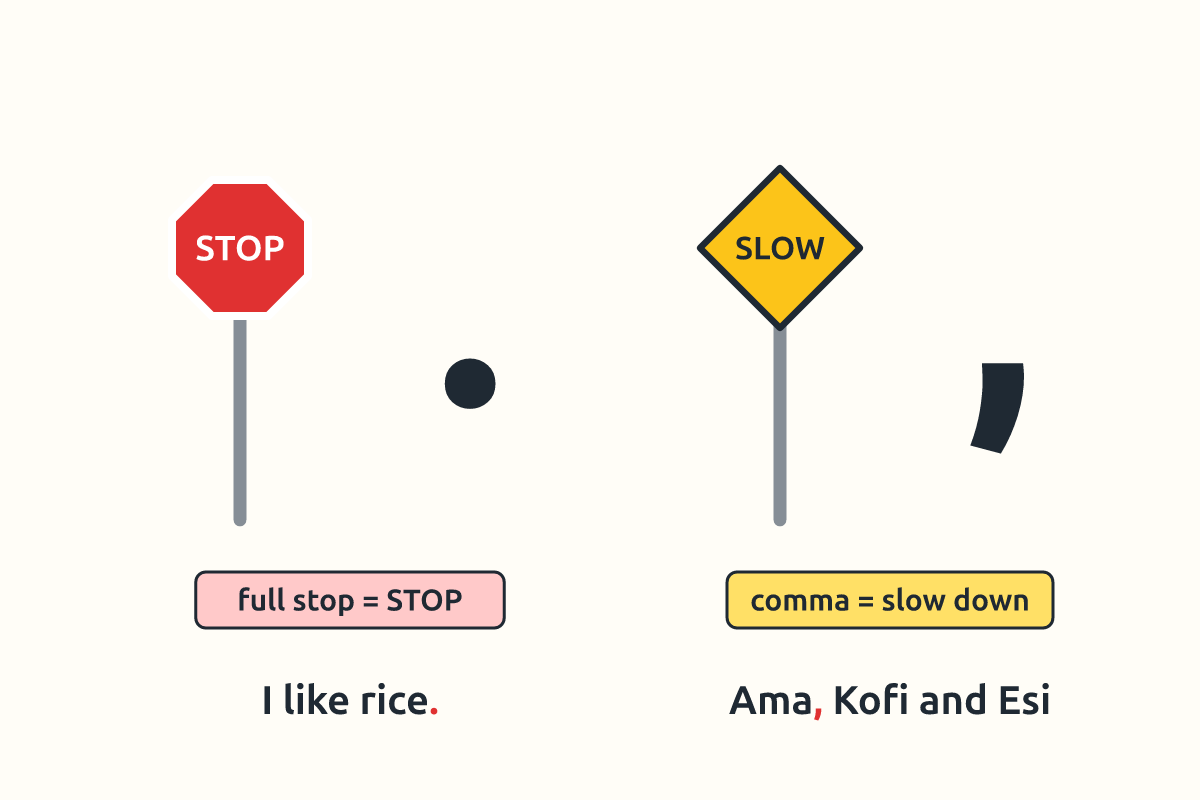
Punctuation marks are like traffic signals for reading. A full stop says "stop". A comma says "pause".
1. The Full Stop (.)
A full stop ends a sentence that tells something.
Example: The market is busy.
2. The Comma (,)
A comma separates things in a list. It tells the reader to pause.
Example: Mother bought yam, fish, pepper and tomatoes.
Common mistake: Do not put a comma before "and" in a simple list: "yam, fish and pepper".
New words
- punctuation
- Marks that help us read, like . and ,
- full stop
- The mark (.) that ends a sentence.
- comma
- The mark (,) that shows a pause.
- list
- Things written one after another.
Summary
- A full stop ends a sentence.
- A comma separates things in a list.
- Punctuation helps us read clearly.
Class activity: Punctuation Cards
- Read the sentence strips about local life.
- Add the missing full stops and commas with the punctuation cards.
- Read the sentences aloud with pauses.
You need: Locally made punctuation cards, Sentence strips about local life, Exercise books, Pencils
Exercises
Answer in your exercise book first, then check your answers.
1. Which mark ends a sentence?
- A. Full stop
- B. Comma
- C. Question
- D. Space
Show answer
Answer: Full stopA full stop ends a sentence.2. Where do commas go in "I like rice beans and gari"?
- A. After rice
- B. After gari
- C. After I
- D. After like
Show answer
Answer: After rice"I like rice, beans and gari."3. A comma tells the reader to pause.
- A. True
- B. False
Show answer
Answer: TrueCommas mean pause.4. A full stop goes at the start of a sentence.
- A. True
- B. False
Show answer
Answer: FalseIt goes at the end.5. The mark (,) is called a ______.
Show answer
Answer: commaThat is a comma.6. Write a sentence with a list of three foods using commas.
Show answer
Answer: E.g. I eat rice, beans and plantain.Commas separate the list.
Homework
- Write two sentences with full stops and one list with commas.