Basic 1 · Physical Education · Flexibility
Balancing
In this topic you will balance and hold still in different body shapes.
By the end of these notes you should be able to:
- Hold still in a balance
- Make symmetrical and asymmetrical shapes
- Balance on body parts other than both feet
What you already know
- Rolling a ball
Copy everything that has a blue line on its left into your notebook. The other parts are for reading.
- Strand
- Physical Fitness
- Sub-strand
- Flexibility
- Indicator
- B1.1.4.1.4 – Balance oneself demonstrating momentary stillness, in symmetrical and asymmetrical shapes using body parts other than both feet as a base of support
Introduction
Can you stand on one foot like a flamingo? Can you balance on your hands and knees? Balancing makes our bodies strong and steady.
1. Holding Still
Balance: Keeping your body steady without falling.
Hold each balance and count to five.
2. Body Shapes
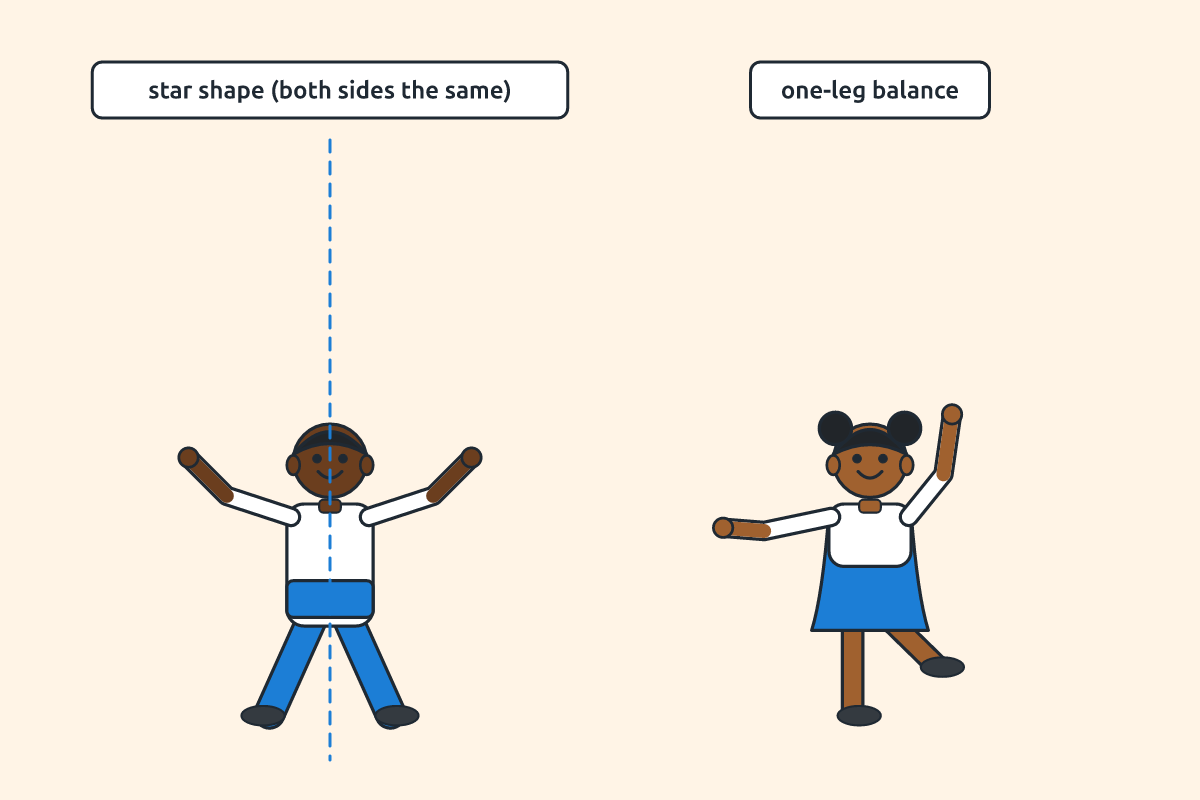
| Shape | Meaning | Example |
|---|---|---|
| symmetrical | both sides look the same | stand with feet apart and arms out to both sides |
| asymmetrical | the two sides are different | stand on one leg with one arm up |
3. Balancing on Other Body Parts
- hands and knees
- one knee and one hand
- bottom only (legs and arms up)
Safety: Balance on a mat or soft grass.
New words
- balance
- Keeping steady without falling.
- symmetrical
- Both sides are the same.
- asymmetrical
- The two sides are different.
- still
- Not moving.
Summary
- A balance means holding still without falling.
- Symmetrical shapes look the same on both sides.
- We can balance on hands, knees and other body parts.
Class activity: Balance Stations
- Balance on a low bench with arms out.
- Carry a beanbag on your head while standing still.
- Make a balance on the mat using hands and knees.
You need: Low wooden bench, Beanbag, Woven mat
Exercises
Answer in your exercise book first, then check your answers.
1. A shape that is the same on both sides is…
- A. Symmetrical
- B. Asymmetrical
- C. Round
- D. Fast
Show answer
Answer: SymmetricalBoth sides match.2. How long should you hold a balance?
- A. Count to five
- B. One second
- C. One hour
- D. Do not hold
Show answer
Answer: Count to fiveHolding still shows control.3. We can balance on our hands and knees.
- A. True
- B. False
Show answer
Answer: TrueThese are body parts we can balance on.4. Standing on one leg with one arm up is symmetrical.
- A. True
- B. False
Show answer
Answer: FalseThe sides are different, so it is asymmetrical.5. Keeping steady without falling is ______.
Show answer
Answer: balanceThat is balance.6. Name two body parts you can balance on.
Show answer
Answer: Any two: feet, hands, knees, bottom.We can balance on many parts.
Homework
- Stand on one foot for ten seconds. Then try the other foot.