Basic 1 · English Language
Rhymes, Copying Letters and Capitals
In this topic you will recite rhymes and tongue-twisters, copy letters neatly and use capital letters.
By the end of these notes you should be able to:
- Recite rhymes and tongue-twisters with actions
- Copy letters of the alphabet clearly
- Use capital letters for names
What you already know
- Songs, books and patterns
Copy everything that has a blue line on its left into your notebook. The other parts are for reading.
Lesson 1
- Strand
- Oral Language
- Sub-strand
- Rhymes
- Indicator
- B1.1.2.1.1 – Listen to and recite rhymes and tongue-twisters with accompanying actions
Introduction
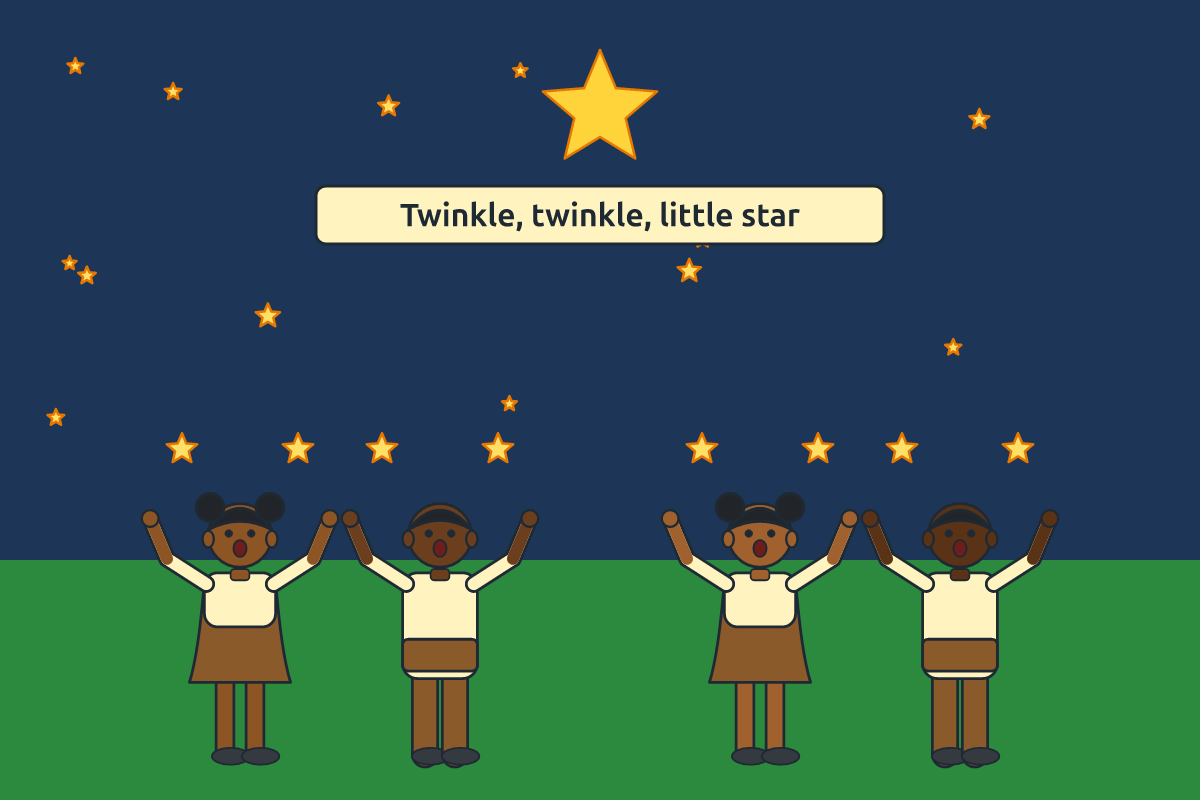
Rhymes are fun to say. Tongue-twisters are fun and tricky! Let us say them with actions.
Rhymes and Tongue-Twisters
Rhyme: A short poem with words that sound alike at the end.
Tongue-twister: A sentence that is hard to say quickly.
Rhyme: "Twinkle, twinkle, little star, how I wonder what you are."
Tongue-twister: "Red lorry, yellow lorry."
Star and are sound alike. They rhyme.
New words
- rhyme
- A short poem with sounding-alike words.
- tongue-twister
- A sentence that is hard to say fast.
- recite
- To say from memory.
Summary
- Rhymes have words that sound alike at the end.
- Tongue-twisters are fun and help us speak clearly.
Exercises
Answer in your exercise book first, then check your answers.
1. Which word rhymes with "star"?
- A. Car
- B. Cat
- C. Sun
- D. Pen
Show answer
Answer: CarStar and car sound alike.2. A tongue-twister is easy to say fast.
- A. True
- B. False
Show answer
Answer: FalseIt is hard to say fast.3. To say from memory is to ______.
Show answer
Answer: reciteWe recite rhymes.4. Say "Red lorry, yellow lorry" three times fast. Was it easy?
Show answer
Answer: Answers will differ.It is a tongue-twister.
Lesson 2
- Strand
- Reading
- Sub-strand
- Pre-Reading Activities
- Indicator
- B1.2.1.1.1 – Handle books appropriately
Introduction
Books are friends. Now we learn the parts of a book.
Parts of a Book
| Part | What it is |
|---|---|
| front cover | the front outside of the book |
| back cover | the back outside of the book |
| spine | the edge that holds the pages |
| title | the name of the book |
New words
- spine
- The edge that holds the pages together.
- front cover
- The front outside of a book.
- back cover
- The back outside of a book.
Summary
- A book has a front cover, back cover, spine and pages.
- The title is on the front cover.
Exercises
Answer in your exercise book first, then check your answers.
1. Where is the title of a book?
- A. On the front cover
- B. Inside the spine only
- C. On the floor
- D. Nowhere
Show answer
Answer: On the front coverWe read the title on the front.2. The spine holds the pages together.
- A. True
- B. False
Show answer
Answer: TrueThat is the job of the spine.3. The back outside of a book is the back ______.
Show answer
Answer: coverThat is the back cover.4. Name two parts of a book.
Show answer
Answer: Any two: front cover, back cover, spine, pages, title.These are book parts.
Lesson 3
- Strand
- Writing
- Sub-strand
- Penmanship
- Indicator
- B1.4.2.1.1 – Copy letters of the alphabet clearly
Introduction
When we copy letters, we make them the same size and shape as the model.
Copying Letters
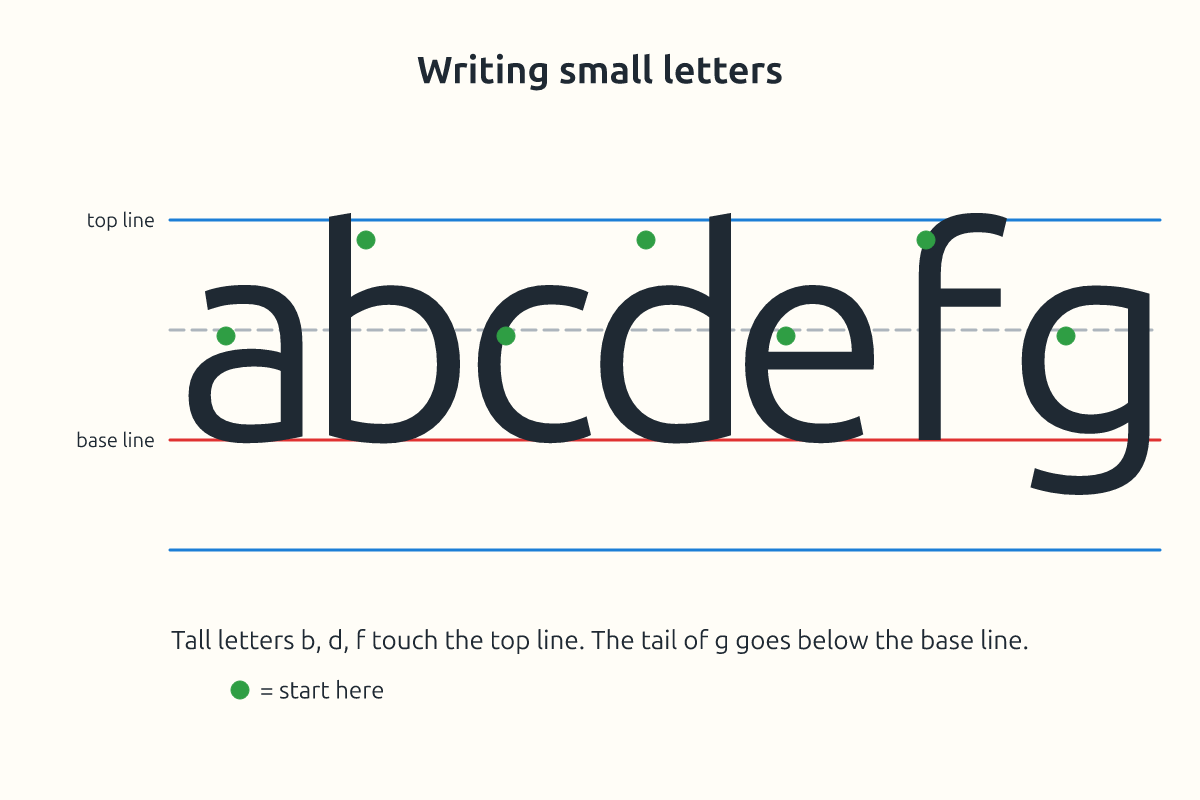
- Look at the letter carefully.
- Start at the right point.
- Copy it slowly on the lines.
- Check that it looks like the model.
| a b c d e f g | h i j k l m n | o p q r s t u | v w x y z |
|---|---|---|---|
| tall letters: b d f h k l t | tails: g j p q y | round letters: a c e o | others: i m n r s u v w x z |
New words
- copy
- To make the same as a model.
- model
- An example to follow.
- neat
- Clean and tidy.
Summary
- Look carefully and copy letters slowly.
- Tall letters go up; tail letters go down.
Exercises
Answer in your exercise book first, then check your answers.
1. Which letter has a tail below the line?
- A. g
- B. a
- C. c
- D. o
Show answer
Answer: gg goes below the line.2. We should copy letters slowly and carefully.
- A. True
- B. False
Show answer
Answer: TrueThis makes neat writing.3. An example to follow is a ______.
Show answer
Answer: modelWe copy the model.4. Write the letters a, b and c neatly.
Show answer
Answer: a b cLearners copy the letters.
Lesson 4
- Strand
- Writing Conventions & Grammar Usage
- Sub-strand
- Using Capitalization
- Indicator
- B1.5.1.1.2 – Write capital letters correctly
Introduction
We use capital letters for the names of people, places and days.
Capital Letters for Names
| People | Places | Days |
|---|---|---|
| Kofi | Accra | Monday |
| Esi | Tamale | Friday |
| Mr Mensah | Ho | Sunday |
Common mistake: "monday" is wrong. Write "Monday".
New words
- person
- A man, woman, boy or girl.
- place
- A town, city or area.
- day
- Monday, Tuesday and so on.
Summary
- Names of people, places and days start with capital letters.
- "Accra" and "Monday" begin with capitals.
Exercises
Answer in your exercise book first, then check your answers.
1. Which is written correctly?
- A. Tamale
- B. tamale
- C. tAmale
- D. TAMALe
Show answer
Answer: TamalePlace names start with a capital letter.2. Days of the week start with capital letters.
- A. True
- B. False
Show answer
Answer: TrueMonday, Tuesday and so on.3. Write "friday" correctly: ______
Show answer
Answer: FridayDays begin with a capital letter.4. Write the name of your town with a capital letter.
Show answer
Answer: Answers will differ.Place names begin with capitals.
Lesson 5
- Strand
- Extensive Reading
- Sub-strand
- Building the Love and Culture of Reading
- Indicator
- B1.6.1.1.1 – Read a variety of age and level appropriate books and texts from print
Introduction
Reading every day makes us better readers. Now we read about a market day.
Reading Time
Read this with your teacher:
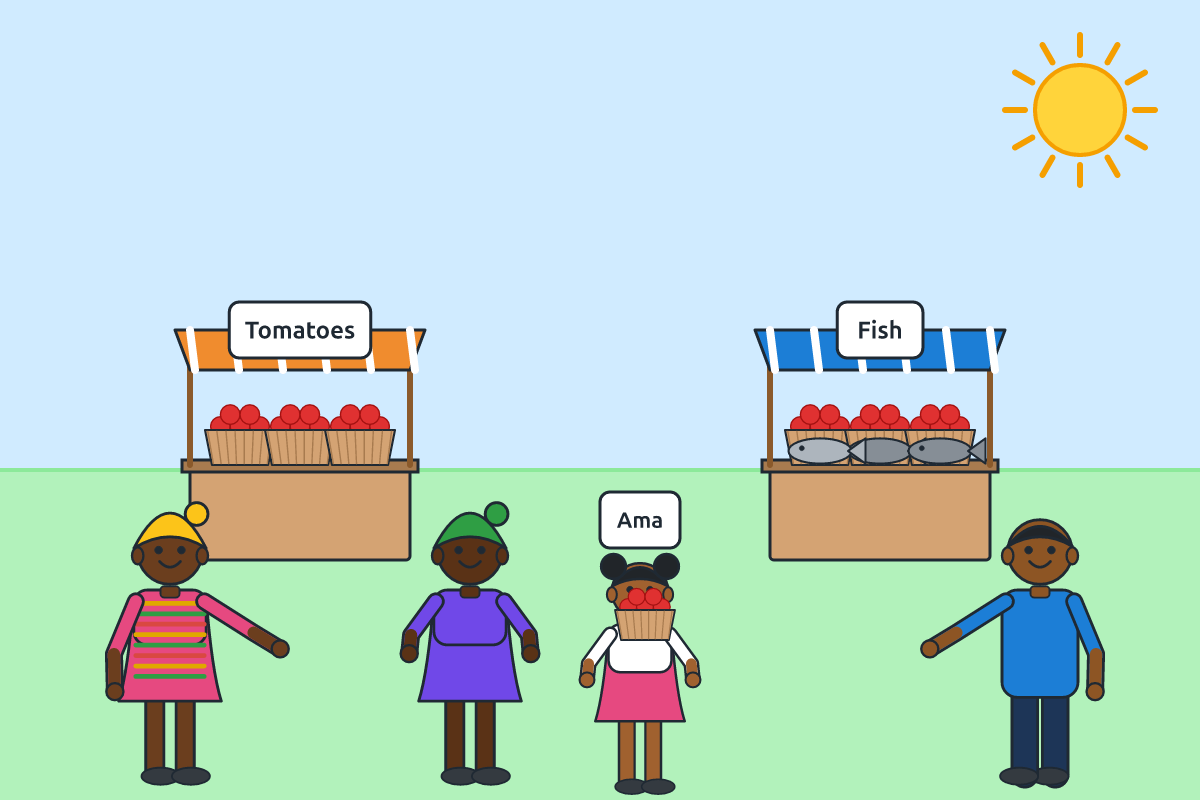
"It is market day. Mother goes to the market. She buys tomatoes and fish. Ama carries the basket."
Talk about it
- Who goes to the market? (Mother)
- What does she buy? (tomatoes and fish)
- What does Ama carry? (the basket)
New words
- market
- A place where people buy and sell.
- basket
- A container made of woven straw.
- buy
- To get something by paying money.
Summary
- We read about a market day.
- We answer questions about what we read.
Exercises
Answer in your exercise book first, then check your answers.
1. What does Mother buy?
- A. Tomatoes and fish
- B. Shoes
- C. Books
- D. A car
Show answer
Answer: Tomatoes and fishThe story says so.2. Ama carries the basket.
- A. True
- B. False
Show answer
Answer: TrueThe story says so.3. A place where people buy and sell is a ______.
Show answer
Answer: marketThat is a market.4. Name one thing people buy at the market.
Show answer
Answer: E.g. tomatoes.Many foods are sold.
Homework
- Say a rhyme to your family and write five capital letters.