Basic 1 · English Language
Role-Play, Letter Sounds and Action Words
In this topic you will act out stories, say letter names and sounds, match small and capital letters and use action words.
By the end of these notes you should be able to:
- Act out a short story
- Say letter names and sounds
- Match small and capital letters
- Use action words for things we do every day
What you already know
- The alphabet in order
Copy everything that has a blue line on its left into your notebook. The other parts are for reading.
Lesson 1
- Strand
- Oral Language
- Sub-strand
- Dramatization and Role-Play
- Indicator
- B1.1.5.1.1 – Dramatize stories heard
Introduction
Acting out a story makes it come alive. We use our voices, faces and bodies.
Acting Out a Story
- Listen to the story.
- Choose your character.
- Say your words clearly.
- Use actions and facial expressions.
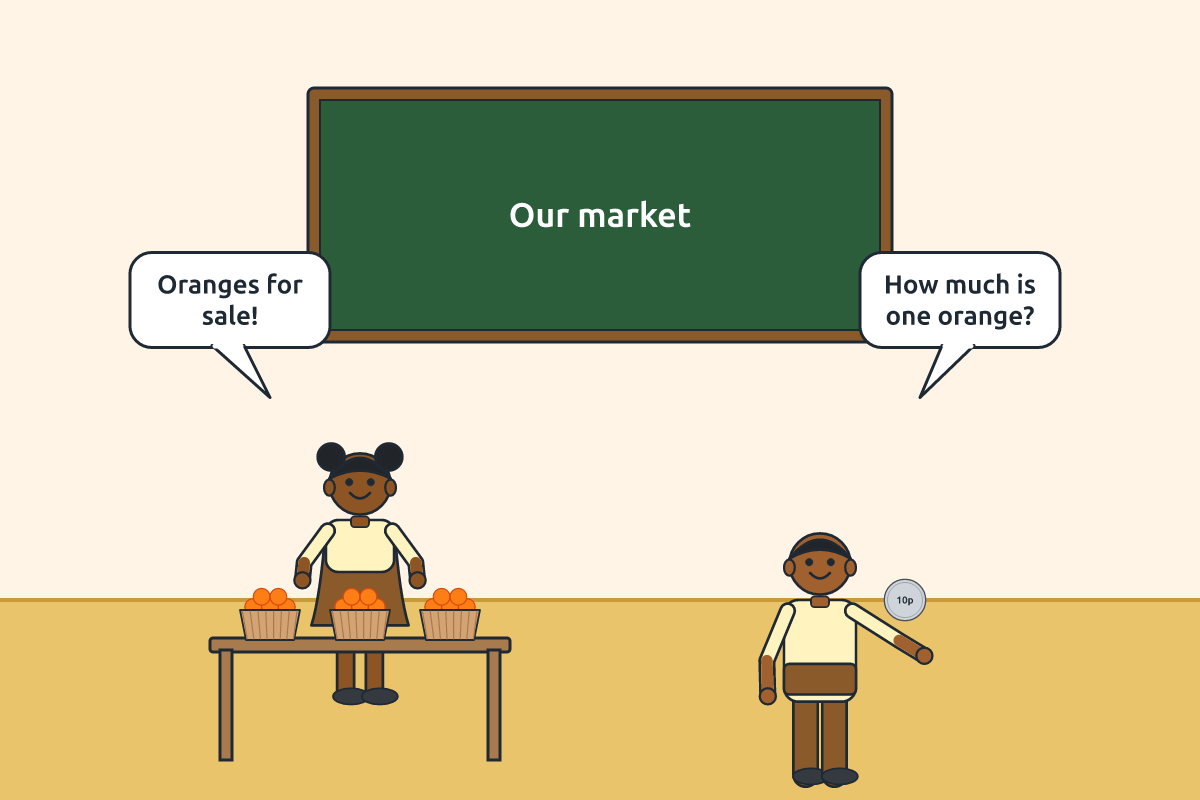
Example scene: a seller and a buyer at the market. "How much is the orange?" "One cedi, please."
New words
- act
- To pretend to be someone.
- role-play
- Acting out a part.
- scene
- One part of a story acted out.
Summary
- We act out stories with voices, faces and actions.
- Each person plays a character.
Exercises
Answer in your exercise book first, then check your answers.
1. To pretend to be someone is to…
- A. Act
- B. Sleep
- C. Write
- D. Read
Show answer
Answer: ActActing is pretending.2. We should speak clearly when acting.
- A. True
- B. False
Show answer
Answer: TrueThe audience must hear.3. Acting out a part is role-______.
Show answer
Answer: playIt is called role-play.4. What would a seller say at the market?
Show answer
Answer: E.g. "Oranges for sale!"Sellers call buyers.
Lesson 2
- Strand
- Reading
- Sub-strand
- Phonics
- Indicator
- B1.2.2.1.2 – Recognize and produce letter names and sounds randomly
Introduction
Each letter has a name and a sound. The letter B is called "bee" but sounds /b/ as in "ball".
Letter Names and Sounds
| Letter | Name | Sound | Word |
|---|---|---|---|
| a | ay | /a/ | ant |
| b | bee | /b/ | ball |
| c | see | /k/ | cat |
| d | dee | /d/ | dog |
| m | em | /m/ | mango |
| s | ess | /s/ | sun |
New words
- letter name
- What we call a letter.
- letter sound
- The sound a letter makes in a word.
- word
- Letters that make sense together.
Summary
- Letters have names and sounds.
- The sound helps us read words.
Exercises
Answer in your exercise book first, then check your answers.
1. Which word starts with /m/?
- A. Mango
- B. Ball
- C. Sun
- D. Dog
Show answer
Answer: MangoMango starts with m.2. The letter s makes the /s/ sound in "sun".
- A. True
- B. False
Show answer
Answer: TrueSun starts with /s/.3. "Ball" starts with the letter ______.
Show answer
Answer: bB makes /b/.4. Write a word that starts with /d/.
Show answer
Answer: E.g. dog, door.It must start with d.
Lesson 3
- Strand
- Writing
- Sub-strand
- Writing Letters – Small and Capital
- Indicator
- B1.4.3.1.1 – Match lower and upper case letters
Introduction
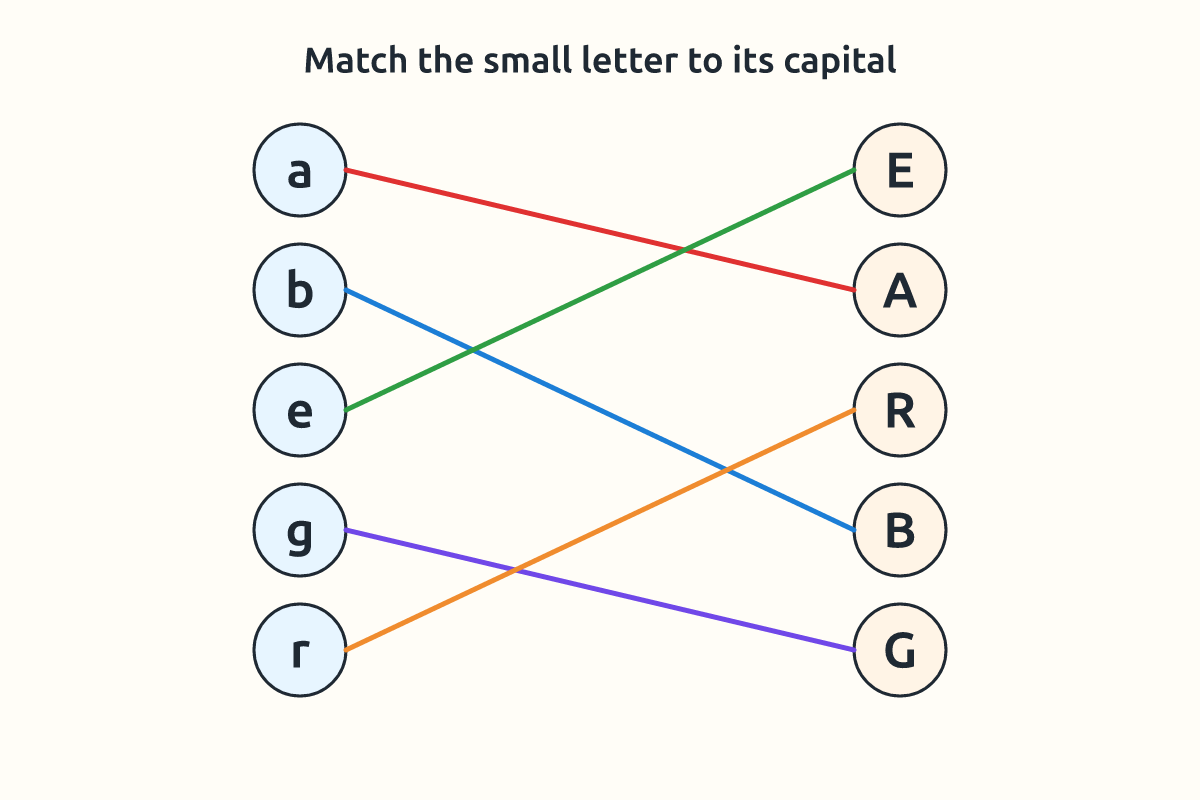
Every small letter has a capital partner.
Small and Capital Letters
| Small | Capital |
|---|---|
| a | A |
| b | B |
| e | E |
| g | G |
| r | R |
| t | T |
New words
- small letter
- A little letter, like a.
- capital letter
- A big letter, like A.
- match
- To find the one that goes with it.
Summary
- Every small letter has a capital letter.
- We match a to A, b to B and so on.
Exercises
Answer in your exercise book first, then check your answers.
1. The capital of "g" is…
- A. G
- B. Q
- C. C
- D. J
Show answer
Answer: Gg matches G.2. "t" and "T" are the same letter.
- A. True
- B. False
Show answer
Answer: TrueOne is small, one is capital.3. The capital of "r" is ______.
Show answer
Answer: Rr matches R.4. Write the capitals of b and e.
Show answer
Answer: B and EEach small letter has a capital.
Lesson 4
- Strand
- Writing Conventions & Grammar Usage
- Sub-strand
- Using Action Words
- Indicator
- B1.5.4.1.1 – Use the present tense of verbs to describe habitual actions
Introduction
We do many things every day. We eat, sleep, walk and read. These are action words.
Action Words
Verb: An action word, like run or eat.
We use action words to say what we do every day.
- I eat rice every day.
- Kofi walks to school.
- We sleep at night.
- The hen lays eggs.
Tip: Add "s" when talking about one other person: I walk, Kofi walks.
New words
- verb
- An action word.
- action
- Something you do.
- every day
- Each day.
Summary
- Action words tell what we do.
- Kofi walks; I walk.
Exercises
Answer in your exercise book first, then check your answers.
1. Which is an action word?
- A. Run
- B. Table
- C. Blue
- D. Ama
Show answer
Answer: RunRun is something we do.2. "Kofi walks to school." is correct.
- A. True
- B. False
Show answer
Answer: TrueAdd s for one other person.3. We ______ at night. (sleep / sleeps)
Show answer
Answer: sleep"We" takes sleep.4. Write one thing you do every day.
Show answer
Answer: E.g. I brush my teeth.It uses an action word.
Lesson 5
- Strand
- Extensive Reading
- Sub-strand
- Building the Love and Culture of Reading
- Indicator
- B1.6.1.1.1 – Read a variety of age – appropriate books and texts from print
Introduction
Today we read about a farm.
Reading Time
"Grandfather has a farm. He grows maize and cassava. Every morning he goes to the farm. I help him on Saturday."
Questions
- What does Grandfather grow? (maize and cassava)
- When does the child help? (on Saturday)
New words
- farm
- Land where crops are grown.
- grow
- To plant and care for crops.
- maize
- A crop with yellow seeds on a cob.
Summary
- We read about Grandfather's farm.
- He grows maize and cassava.
Exercises
Answer in your exercise book first, then check your answers.
1. What does Grandfather grow?
- A. Maize and cassava
- B. Cars
- C. Shoes
- D. Books
Show answer
Answer: Maize and cassavaThe story says so.2. The child helps on Saturday.
- A. True
- B. False
Show answer
Answer: TrueThe story says so.3. Grandfather goes to the farm every ______.
Show answer
Answer: morningThe story says every morning.4. Name one crop you know.
Show answer
Answer: E.g. maize, cassava, yam.Crops grow on farms.
Homework
- Write three action words and draw a picture for one.