Basic 1 · English Language
Greetings, Sounds and Action Words
In this topic you will greet people at different times of day, say letter sounds, match letters and use action words to describe things now.
By the end of these notes you should be able to:
- Use greetings for morning, afternoon and evening
- Say letter names and sounds
- Match small and capital letters
- Use "is" and "are" to describe things now
What you already know
- Letter sounds and action words
Copy everything that has a blue line on its left into your notebook. The other parts are for reading.
Lesson 1
- Strand
- Oral Language
- Sub-strand
- Conversation
- Indicator
- B1.1.6.1.1 – Use appropriate greetings for different times of the day
Introduction
Ghanaians love greetings. We greet people when we meet them.
Greetings for Different Times
| Time | Greeting | Reply |
|---|---|---|
| morning | Good morning. | Good morning. |
| afternoon | Good afternoon. | Good afternoon. |
| evening | Good evening. | Good evening. |
| bedtime | Good night. | Good night. |
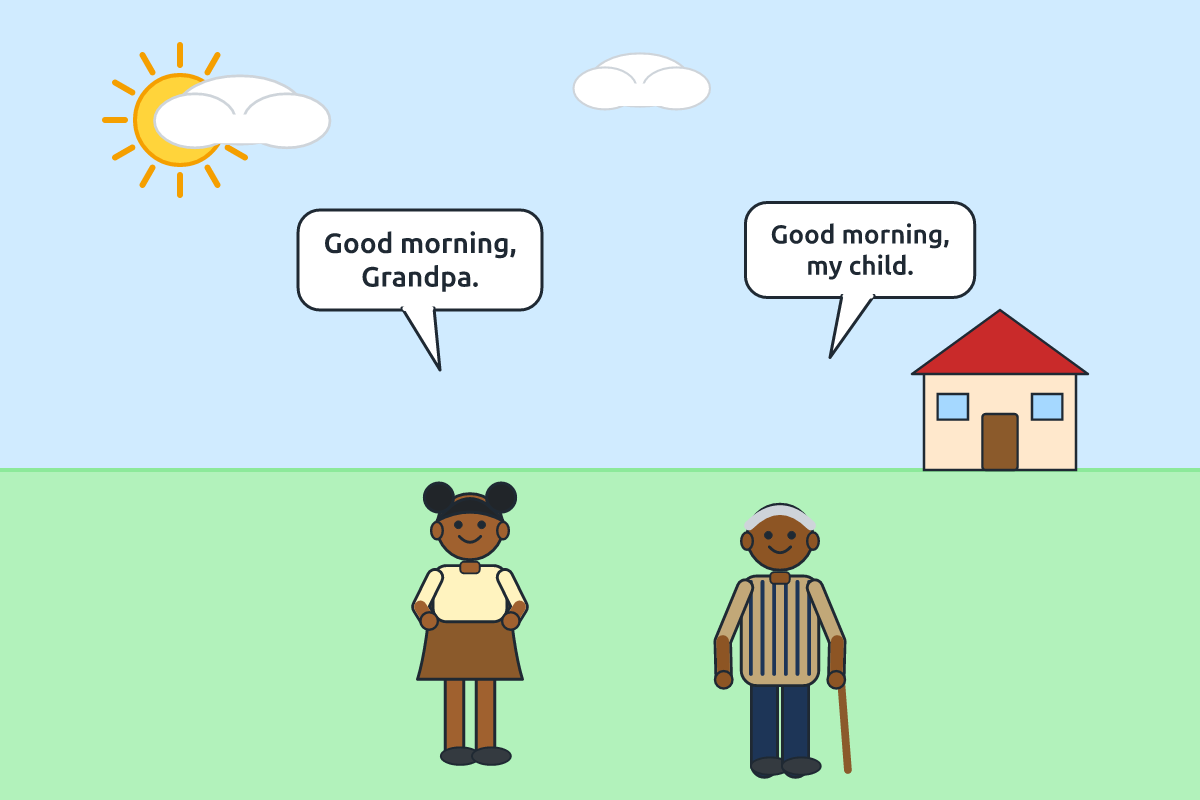
Remember: Greet elders first and politely.
New words
- greeting
- Words we say when we meet someone.
- polite
- Showing good manners.
- reply
- To answer.
Summary
- We say good morning, good afternoon and good evening.
- We greet elders politely.
Exercises
Answer in your exercise book first, then check your answers.
1. What do you say at 8 o'clock in the morning?
- A. Good morning
- B. Good night
- C. Good evening
- D. Goodbye
Show answer
Answer: Good morningIt is morning.2. We say "Good night" before sleeping.
- A. True
- B. False
Show answer
Answer: TrueThat is the bedtime greeting.3. Words we say when we meet someone are a ______.
Show answer
Answer: greetingThat is a greeting.4. What do you say to your teacher at 2 o'clock in the afternoon?
Show answer
Answer: Good afternoon.2 o'clock is afternoon.
Lesson 2
- Strand
- Reading
- Sub-strand
- Phonics
- Indicator
- B1.2.2.1.2 – Recognize and produce letter names and sounds randomly
Introduction
We keep practising letter sounds. Sounds help us read new words.
More Letter Sounds
| Letter | Sound | Word |
|---|---|---|
| f | /f/ | fish |
| g | /g/ | goat |
| h | /h/ | hen |
| p | /p/ | pot |
| t | /t/ | tap |
| y | /y/ | yam |
New words
- sound
- What we hear when a letter is said.
- start
- The beginning.
- word
- Letters that make sense together.
Summary
- Each letter has a sound.
- "Goat" starts with /g/.
Exercises
Answer in your exercise book first, then check your answers.
1. Which word starts with /h/?
- A. Hen
- B. Pot
- C. Yam
- D. Fish
Show answer
Answer: HenHen starts with h.2. "Yam" starts with the /y/ sound.
- A. True
- B. False
Show answer
Answer: TrueY makes /y/.3. "Fish" starts with the letter ______.
Show answer
Answer: fF makes /f/.4. Write a word that starts with /p/.
Show answer
Answer: E.g. pot, pen.It must start with p.
Lesson 3
- Strand
- Writing
- Sub-strand
- Writing Letters – Small and Capital
- Indicator
- B1.4.3.1.1 – Match lower and upper case letters
Introduction
Let us match more small letters to their capitals.
Matching More Letters
| Small | Capital |
|---|---|
| h | H |
| m | M |
| n | N |
| q | Q |
| w | W |
| y | Y |
New words
- partner
- One of a pair.
- pair
- Two things that go together.
- letter
- A sign used to write words.
Summary
- Each small letter has a capital partner.
- m matches M; w matches W.
Exercises
Answer in your exercise book first, then check your answers.
1. The capital of "n" is…
- A. N
- B. M
- C. H
- D. W
Show answer
Answer: Nn matches N.2. "q" and "Q" are a pair.
- A. True
- B. False
Show answer
Answer: TrueThey are the same letter.3. The capital of "w" is ______.
Show answer
Answer: Ww matches W.4. Write the small letters for H and Y.
Show answer
Answer: h and yEach capital has a small letter.
Lesson 4
- Strand
- Writing Conventions & Grammar Usage
- Sub-strand
- Using Action Words
- Indicator
- B1.5.4.1.2 – Use the present tense of verbs to express the present state of things or situations
Introduction
We use "is" and "are" to say how things are now.
Is and Are
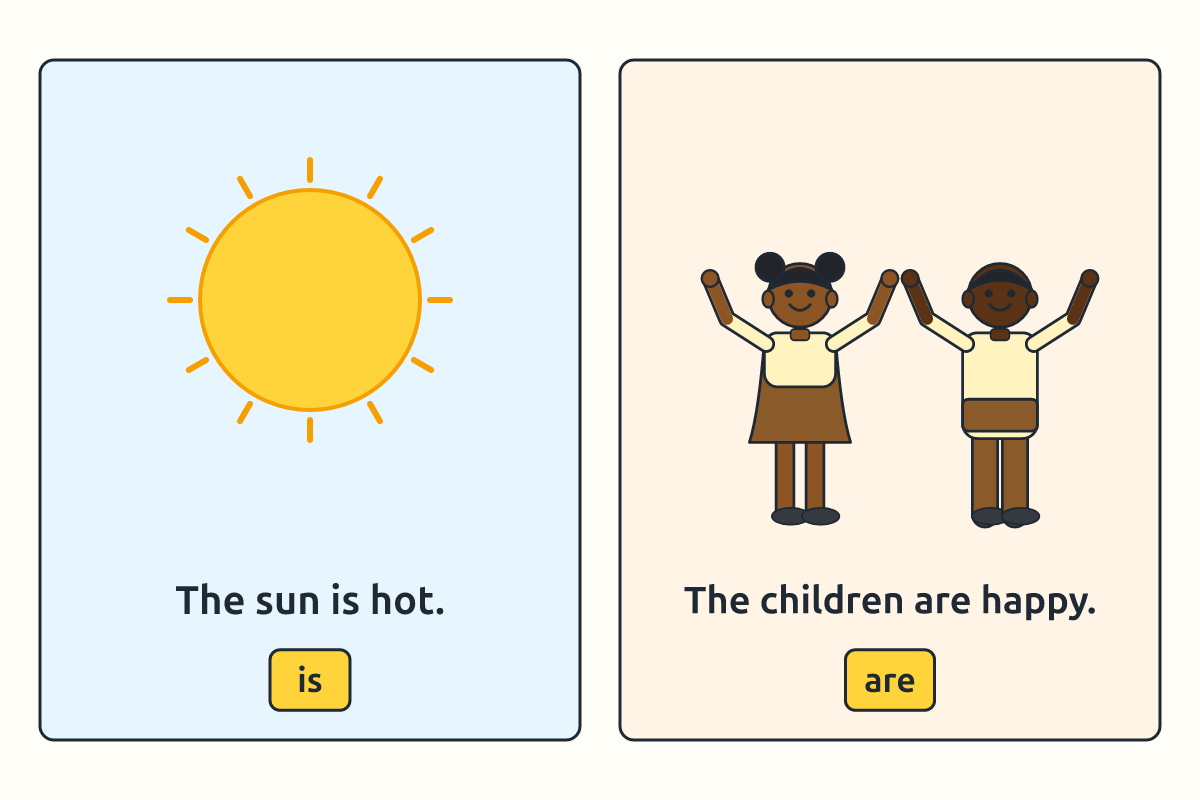
Use "is" for one thing. Use "are" for more than one.
- The sun is hot.
- The mango is sweet.
- The children are happy.
- The goats are hungry.
New words
- is
- Used for one thing now.
- are
- Used for more than one thing now.
- now
- At this time.
Summary
- Use "is" for one thing.
- Use "are" for more than one thing.
Exercises
Answer in your exercise book first, then check your answers.
1. The children ___ playing.
- A. are
- B. is
- C. am
- D. be
Show answer
Answer: areChildren is more than one.2. "The dog is big." is correct.
- A. True
- B. False
Show answer
Answer: TrueOne dog takes "is".3. The mango ______ sweet. (is / are)
Show answer
Answer: isOne mango takes "is".4. Write a sentence with "are".
Show answer
Answer: E.g. The birds are singing."Are" is for more than one.
Lesson 5
- Strand
- Extensive Reading
- Sub-strand
- Building the Love and Culture of Reading
- Indicator
- B1.6.1.1.1 – Read a variety of age – appropriate books and texts from print
Introduction
Today we read about the rain.
Reading Time
"The sky is dark. The rain is falling. The children are inside. Mother is cooking."
Questions
- What is falling? (the rain)
- Where are the children? (inside)
New words
- sky
- The space above us.
- dark
- Without light.
- inside
- In a house or room.
Summary
- We read about a rainy day.
- The children are inside because of the rain.
Exercises
Answer in your exercise book first, then check your answers.
1. Where are the children?
- A. Inside
- B. On the farm
- C. At the beach
- D. At school
Show answer
Answer: InsideThe story says they are inside.2. Mother is cooking.
- A. True
- B. False
Show answer
Answer: TrueThe story says so.3. The ______ is falling.
Show answer
Answer: rainIt is raining.4. What colour is the sky in the story?
Show answer
Answer: DarkThe story says the sky is dark.
Homework
- Greet three people at home at the right time of day.