Basic 6 · Science · Materials
Uses of Mixtures in Everyday Life
In this topic you will examine how mixtures are used at home, in health, in building and in industry.
By the end of these notes you should be able to:
- Give examples of useful mixtures
- Explain why mixtures are used instead of pure substances
- Prepare a useful mixture safely
What you already know
- Forming and separating mixtures (Basic 5)
Copy everything that has a blue line on its left into your notebook. The other parts are for reading.
- Strand
- Diversity Of Matter
- Sub-strand
- Materials
- Indicator
- B6.1.2.2.1 – Examine some uses of mixtures in everyday life
Introduction
The air we breathe, the concrete in our school buildings and the soup we eat are all mixtures. Mixtures are everywhere and very useful.
1. Mixtures Around Us
| Area | Mixture | Components | Use |
|---|---|---|---|
| home | palm nut soup | palm fruit extract, water, meat, spices | food |
| home | soapy water | soap and water | washing |
| health | oral rehydration solution (ORS) | clean water, salt and sugar | treats dehydration from diarrhoea |
| health | cough syrup | medicine, sugar, water | treats cough |
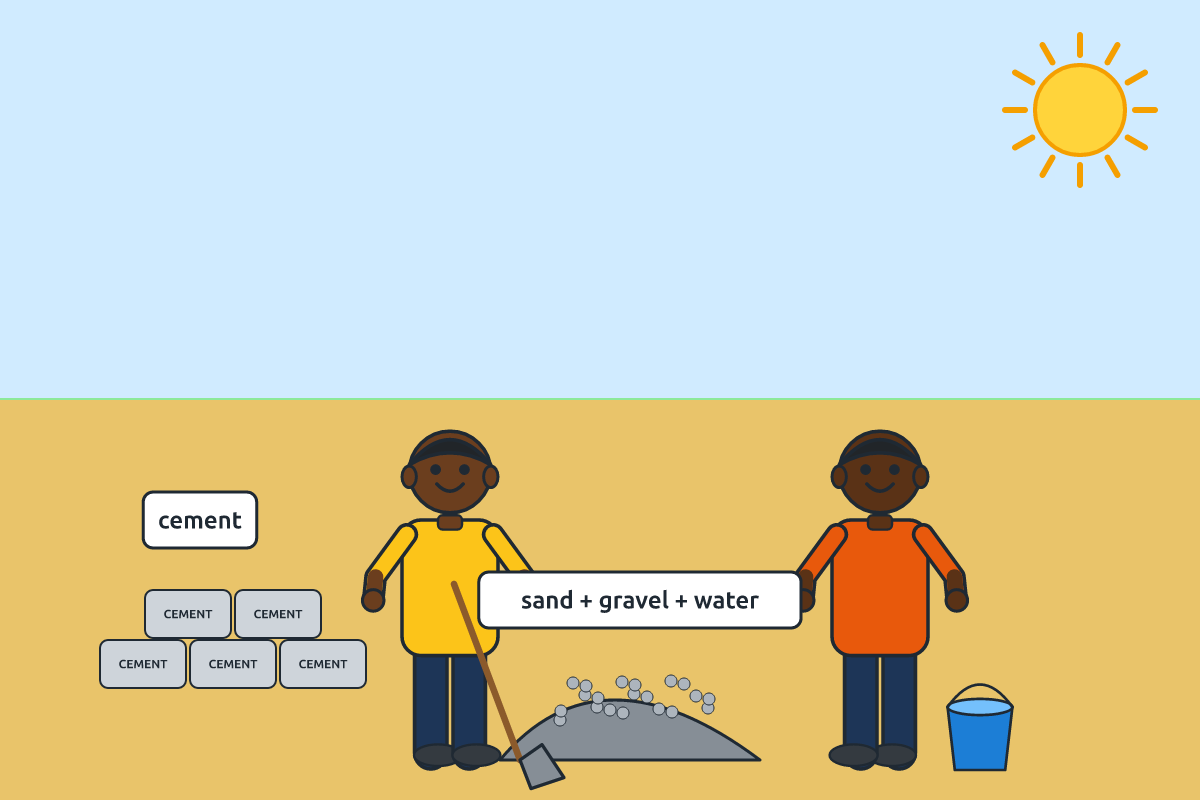
| building | concrete | cement, sand, gravel, water | buildings, bridges |
| building | mortar | cement, sand, water | joining blocks |
| industry | alloys | metal + other elements | tools, machines |
| industry | paint | pigment, liquid, binder | colouring and protecting surfaces |
| nature | air | nitrogen, oxygen, carbon dioxide, other gases | breathing, burning |
| farming | soil | rock particles, humus, water, air | growing crops |
2. Why Use Mixtures?
Mixtures often have better properties than their separate parts. Concrete is much stronger than sand or cement alone. Steel is stronger than pure iron. ORS replaces both water and salts lost from the body. By changing the amounts in a mixture, we can change its properties, such as making soup thicker or concrete stronger.
3. Preparing ORS
ORS can save the life of a child with diarrhoea. The World Health Organization recommends using ready-made ORS sachets dissolved in the right amount of clean water. If sachets are not available, health workers teach a home solution: 1 litre of clean, boiled and cooled water, 6 level teaspoons of sugar and half a level teaspoon of salt, stirred until dissolved.
Safety: Measure ORS ingredients carefully. Too much salt can be harmful. Always follow a health worker's instructions.
4. Air: An Important Mixture
| Gas | Approximate amount |
|---|---|
| nitrogen | 78% |
| oxygen | 21% |
| argon and other gases | about 1% |
| carbon dioxide | about 0.04% |
| water vapour | varies |
The oxygen in air is needed for breathing and burning, while nitrogen dilutes the oxygen so that fires do not burn too fiercely.
New words
- mixture
- Two or more substances combined without forming a new substance.
- component
- One part of a mixture.
- ORS
- Oral rehydration solution.
- concrete
- A mixture of cement, sand, gravel and water.
- dehydration
- Loss of too much water from the body.
- composition
- What something is made of.
Summary
- Mixtures are used in food, health, building, industry and nature.
- Mixtures often have better properties than their parts.
- ORS treats dehydration and must be prepared correctly.
- Air is a mixture of mainly nitrogen and oxygen.
Class activity: Mixture Survey
- List ten mixtures used at home and school.
- Name the components of each.
- Explain why each mixture is useful.
You need: Sand, Water, Clear plastic cups, Clean cotton cloth
Exercises
Answer in your exercise book first, then check your answers.
1. Which is a mixture used in building?
- A. Concrete
- B. Gold
- C. Oxygen
- D. Iron
Show answer
Answer: ConcreteCement, sand, gravel and water.2. ORS is used to treat…
- A. dehydration
- B. malaria
- C. headache
- D. broken bones
Show answer
Answer: dehydrationIt replaces water and salts.3. The most common gas in air is…
- A. nitrogen
- B. oxygen
- C. carbon dioxide
- D. argon
Show answer
Answer: nitrogenAbout 78%.4. Air is a mixture.
- A. True
- B. False
Show answer
Answer: TrueOf several gases.5. Mixtures are never useful.
- A. True
- B. False
Show answer
Answer: FalseMany are very useful.6. Mortar is a mixture of cement, sand and ______.
Show answer
Answer: waterUsed to join blocks.7. Name three useful mixtures and their uses.
Show answer
Answer: Concrete (building), ORS (treating dehydration), soapy water (washing).Any three.8. Why is concrete used instead of only sand for building?
Show answer
Answer: Concrete is much stronger and harder than sand alone, so it supports buildings.Mixture improves properties.
Homework
- Write five mixtures used in your kitchen and their components.