Basic 6 · Science · Materials
General Properties of Metals
In this topic you will learn the general properties of metals, such as lustre, malleability, ductility and conductivity.
By the end of these notes you should be able to:
- State the general properties of metals
- Test some properties of metals
- Distinguish metals from non-metals
What you already know
- Classifying materials (Basic 5)
Copy everything that has a blue line on its left into your notebook. The other parts are for reading.
- Strand
- Diversity Of Matter
- Sub-strand
- Materials
- Indicator
- B6.1.2.1.1 – Know the general properties of metals such as lustre malleability, conductivity and ductility
Introduction
Cooking pots, roofing sheets, electric wires and gold jewellery are all made of metals. Metals share special properties that make them useful.
1. What Are Metals?
Metals are elements such as iron, aluminium, copper, gold, silver, zinc and lead. Ghana is rich in metals: gold is mined at Obuasi and Tarkwa, bauxite (the ore of aluminium) at Awaso, and manganese at Nsuta.
2. Properties of Metals
| Property | Meaning | Example |
|---|---|---|
| lustre | shiny when cut or polished | polished gold and silver shine |
| malleability | can be hammered into thin sheets without breaking | aluminium foil, roofing sheets |
| ductility | can be drawn into thin wires | copper wire |
| conductivity (heat) | allows heat to pass through | aluminium cooking pots |
| conductivity (electricity) | allows electricity to pass through | copper and aluminium cables |
| sonority | makes a ringing sound when struck | school bells, gongs |
| strength and hardness | strong and hard to break (most metals) | iron rods, steel |
| high melting point | melts only at very high temperatures | iron melts at about 1,500 °C |
| density | usually heavy for their size | lead, iron |
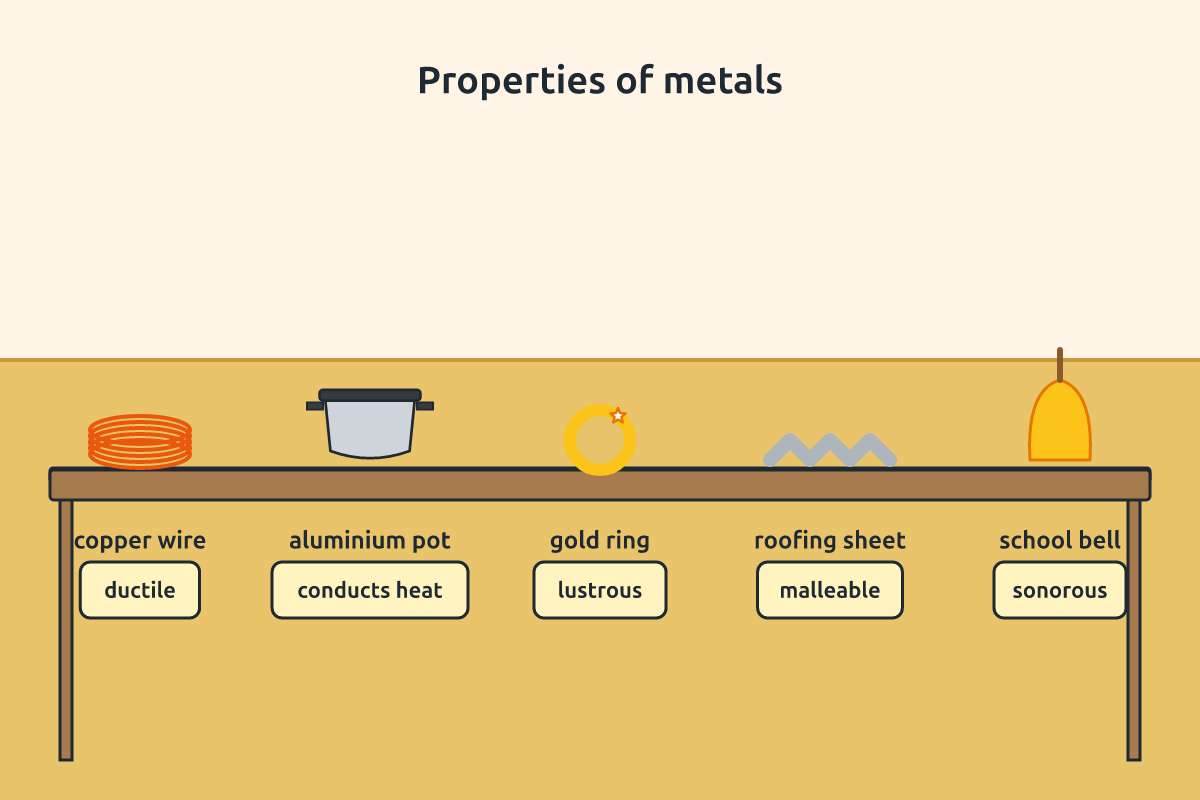
3. Exceptions
Not all metals have every property. Mercury is a metal that is liquid at room temperature. Sodium and potassium are so soft that they can be cut with a knife. Some metals, like iron, rust when exposed to water and air, while gold does not rust or tarnish.
4. Metals and Non-Metals
| Property | Metals | Non-metals (e.g. sulphur, carbon, oxygen) |
|---|---|---|
| appearance | shiny | dull (mostly) |
| heat and electricity | good conductors | poor conductors (except graphite) |
| when hammered | flatten (malleable) | break or crumble (brittle) |
| sound | ringing | dull |
| state at room temperature | mostly solid | solid, liquid or gas |
Safety: Do not test electrical conductivity with mains electricity. Use a torch battery, bulb and wires with your teacher.
To test a material, connect a battery, a bulb and two wires with a gap between the wire ends. Touch the ends to the material. If the bulb lights, the material conducts electricity.
New words
- metal
- A shiny element that conducts heat and electricity.
- lustre
- Shininess.
- malleable
- Can be hammered into sheets.
- ductile
- Can be drawn into wires.
- conductor
- A material that lets heat or electricity pass.
- sonorous
- Making a ringing sound.
Summary
- Metals are lustrous, malleable, ductile and good conductors.
- Most metals are strong, sonorous and have high melting points.
- Mercury is a liquid metal; gold does not rust.
- Non-metals are usually dull, brittle and poor conductors.
Class activity: Metal Tests
- Test a metal spoon, a plastic spoon and a piece of wood.
- Check for shine, ringing sound when tapped and conduction in a simple battery-and-bulb circuit.
- Record which ones are metals.
You need: Aluminium cooking pot, Steel spoon, Copper wire
Exercises
Answer in your exercise book first, then check your answers.
1. Which property allows copper to be drawn into wires?
- A. Ductility
- B. Lustre
- C. Sonority
- D. Brittleness
Show answer
Answer: DuctilityDuctile metals form wires.2. Which metal is liquid at room temperature?
- A. Mercury
- B. Iron
- C. Copper
- D. Gold
Show answer
Answer: MercuryUsed in old thermometers.3. Roofing sheets show which property?
- A. Malleability
- B. Ductility
- C. Sonority
- D. Brittleness
Show answer
Answer: MalleabilityHammered into sheets.4. Metals are good conductors of electricity.
- A. True
- B. False
Show answer
Answer: TrueUsed in cables.5. All metals rust.
- A. True
- B. False
Show answer
Answer: FalseGold does not rust.6. The shininess of metals is called ______.
Show answer
Answer: lustrePolished metals shine.7. State four properties of metals.
Show answer
Answer: Lustre, malleability, ductility, conductivity (or sonority, strength).Any four.8. Give two differences between metals and non-metals.
Show answer
Answer: Metals are shiny and conduct electricity; non-metals are dull and poor conductors (or malleable vs brittle).Any two.
Homework
- List ten metal objects in your home and the property that makes each useful.