Basic 6 · Science · Living and Non-Living Things
Tap Roots and Fibrous Roots
In this topic you will classify plants according to their root systems, focusing on tap roots and fibrous roots.
By the end of these notes you should be able to:
- Describe the tap root and fibrous root systems
- Classify common plants by their root systems
- Relate root systems to the type of plant (dicot or monocot)
What you already know
- Parts of a plant and their functions (Basic 5)
Copy everything that has a blue line on its left into your notebook. The other parts are for reading.
- Strand
- Diversity Of Matter
- Sub-strand
- Living and Non-Living Things
- Indicator
- B6.1.1.1.1 – Classify plants based on their root system
Introduction
When you uproot a bean plant and a grass plant, their roots look very different. One has a thick main root, and the other has a bunch of thin roots. Scientists use these differences to group plants.
1. Functions of Roots (Review)
Roots anchor the plant firmly in the soil, absorb water and mineral salts through root hairs, and in some plants store food. Roots grow downward towards gravity and towards water.
2. The Tap Root System
A tap root system has one main thick root, called the primary root or tap root, that grows straight down. Smaller lateral (side) roots branch from it, and these have even smaller branches. The tap root develops from the radicle of the seed. Tap roots can grow deep into the soil to reach water during the dry season.
Examples: bean, groundnut, mango, orange, pawpaw, cocoa, neem, tomato and pepper.
3. The Fibrous Root System
A fibrous root system has many thin roots of about the same size growing from the base of the stem. There is no main root. Fibrous roots spread out near the surface of the soil like a mat. They hold the topsoil firmly and help to prevent erosion.
Examples: maize, rice, millet, sorghum, sugarcane, grasses, onion and the oil palm.
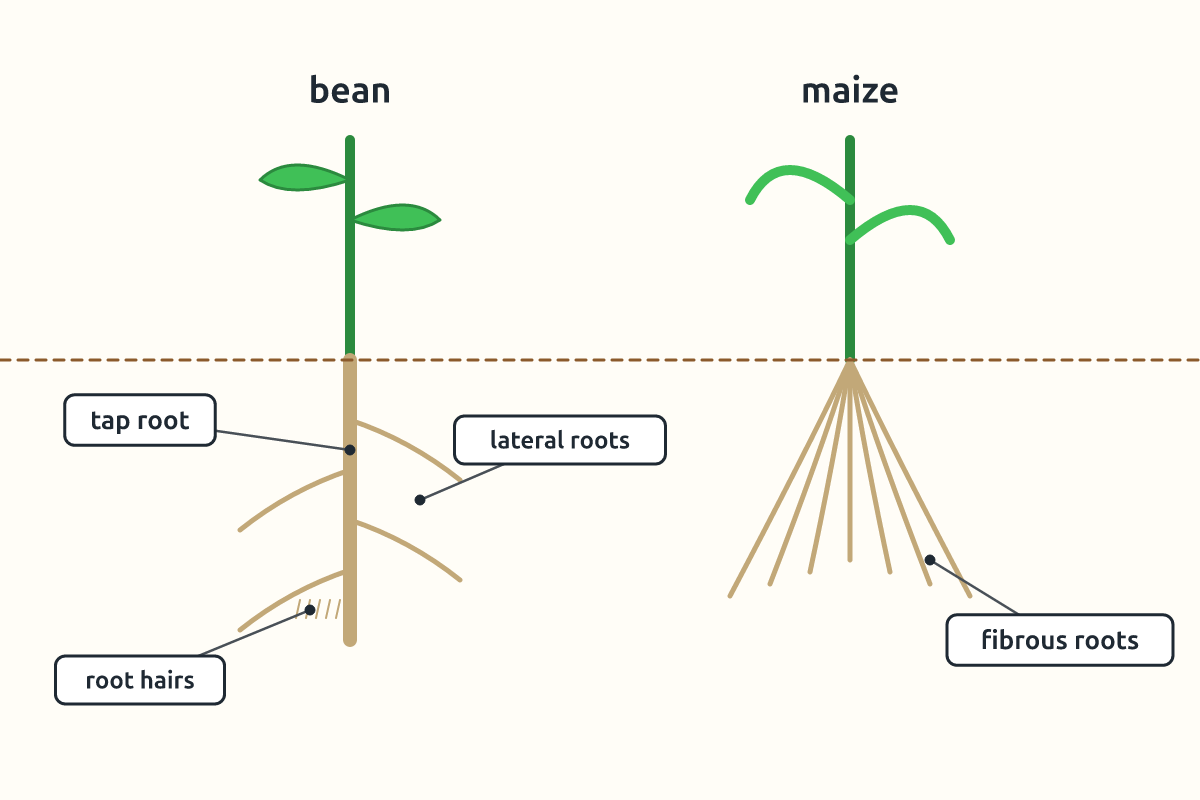
4. Root Systems and Plant Groups
| Feature | Tap root | Fibrous root |
|---|---|---|
| main root | one thick primary root | no main root |
| depth | deep | shallow and spread out |
| origin | grows from the radicle | grows from the base of the stem |
| plant group | usually dicots (two seed leaves) | usually monocots (one seed leaf) |
| other features of the plant | net-veined leaves | parallel-veined leaves |
| examples | bean, mango, groundnut | maize, rice, grass |
This means you can often predict a plant's roots by looking at its leaves. A leaf with veins like a net usually belongs to a tap-rooted dicot; a long leaf with parallel veins usually belongs to a fibrous-rooted monocot.
New words
- tap root
- One main root with smaller side roots.
- fibrous roots
- Many thin roots of similar size.
- lateral root
- A side root.
- radicle
- The first root of a seedling.
- dicot
- A plant with two seed leaves.
- monocot
- A plant with one seed leaf.
Summary
- Roots anchor plants and absorb water and minerals.
- Tap roots have one main root; fibrous roots have many similar roots.
- Dicots usually have tap roots; monocots usually have fibrous roots.
- Fibrous roots help to prevent soil erosion.
Class activity: Root Classification
- Carefully uproot five different plants around the school.
- Wash the soil off the roots and observe them with a hand lens.
- Classify each plant as tap-rooted or fibrous-rooted and record your findings in a table.
You need: Uprooted bean, Grass plants, Cassava cutting, Hand lens
Exercises
Answer in your exercise book first, then check your answers.
1. Which plant has a tap root?
- A. Bean
- B. Maize
- C. Rice
- D. Grass
Show answer
Answer: BeanBean is a dicot.2. Fibrous roots are found mainly in…
- A. monocots
- B. dicots
- C. all trees
- D. mushrooms
Show answer
Answer: monocotse.g. maize.3. Which root system helps most to prevent erosion of topsoil?
- A. Fibrous
- B. Tap
- C. None
- D. Storage only
Show answer
Answer: FibrousIt forms a mat near the surface.4. The tap root grows from the radicle.
- A. True
- B. False
Show answer
Answer: TrueThe first seed root.5. Maize has a tap root system.
- A. True
- B. False
Show answer
Answer: FalseIt has fibrous roots.6. Side roots that grow from the main root are ______ roots.
Show answer
Answer: lateralSide branches.7. Give three differences between tap roots and fibrous roots.
Show answer
Answer: Tap: one main root, deep, dicots. Fibrous: many similar roots, shallow, monocots.Any three.8. A plant has parallel-veined leaves. Predict its root system and explain.
Show answer
Answer: Fibrous, because parallel veins show it is a monocot, and monocots usually have fibrous roots.Linking leaves and roots.
Homework
- Collect two plants at home, one with each root system. Draw and label them.