Basic 6 · Physical Education · Strength
Fifteen Continuous Sit-Ups
In this topic you will perform 15 continuous sit-ups to build abdominal strength and endurance.
By the end of these notes you should be able to:
- Explain the importance of strong abdominal muscles
- Perform sit-ups with correct technique
- Progress to 15 continuous sit-ups
What you already know
- Pull-ups for upper-body strength (Basic 5)
Copy everything that has a blue line on its left into your notebook. The other parts are for reading.
- Strand
- Physical Fitness
- Sub-strand
- Strength
- Indicator
- B6.3.2.3.2 – Perform 15 continuous sit-ups
Introduction
Strong stomach (abdominal) muscles help you sit and stand straight, protect your back and give power in throwing, kicking and jumping. Sit-ups are a simple way to build them.
1. Why Abdominal Strength Matters
- Supports good posture.
- Protects the lower back from pain and injury.
- Helps in sports that need twisting and power.
- Helps with daily tasks such as lifting and carrying.
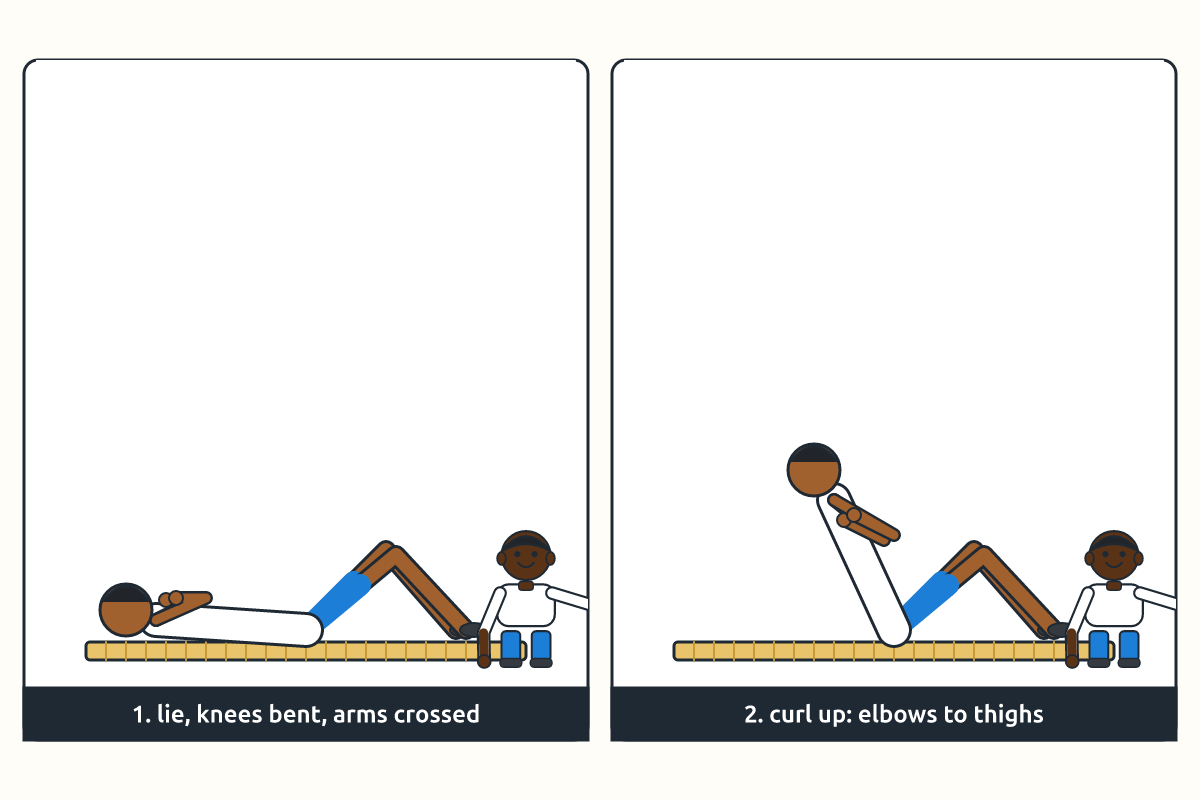
2. Sit-Up Technique
| Step | Action |
|---|---|
| 1 | lie on your back on a mat, knees bent, feet flat on the floor |
| 2 | cross your arms over your chest (or place fingertips lightly beside your ears) |
| 3 | a partner may hold your feet |
| 4 | tighten your stomach and curl your upper body up until your elbows touch your thighs |
| 5 | lower yourself slowly until your shoulder blades touch the mat |
| 6 | breathe out as you come up, breathe in as you go down |
3. Common Mistakes
| Mistake | Correction |
|---|---|
| pulling on the neck with the hands | cross arms over the chest |
| jerking up quickly | move smoothly and with control |
| straight legs | keep knees bent to protect the back |
| holding the breath | breathe out on the way up |
4. Building Up to 15
If 15 sit-ups are too many at first, start with curl-ups (lifting only the shoulders) or do 3 sets of 5 with a short rest. Add one or two sit-ups each week. Aim for 15 continuous sit-ups with good form.
| Week | Target |
|---|---|
| 1 | 3 sets of 5 |
| 2 | 2 sets of 8 |
| 3 | 1 set of 12 |
| 4 | 15 continuous |
Safety: Use a mat or soft grass. Stop if you feel pain in your back or neck.
New words
- abdominal muscles
- The stomach muscles.
- sit-up
- An exercise lifting the upper body from lying to sitting.
- curl-up
- A smaller version lifting only the shoulders.
- posture
- The way you hold your body.
- set
- A group of repetitions.
- endurance
- The ability of muscles to keep working.
Summary
- Strong abdominal muscles support posture and protect the back.
- Keep knees bent, arms crossed and move smoothly.
- Avoid pulling on the neck or jerking.
- Build up gradually to 15 continuous sit-ups.
Class activity: Sit-Up Partners
- One partner does sit-ups while the other holds the feet and counts.
- Check technique using the table.
- Record your best number of correct sit-ups.
You need: Woven exercise mats, Local drum, Sticks of chalk
Exercises
Answer in your exercise book first, then check your answers.
1. Sit-ups strengthen the…
- A. abdominal muscles
- B. arm muscles only
- C. toes
- D. ears
Show answer
Answer: abdominal musclesStomach muscles.2. Where should the arms be?
- A. Crossed over the chest
- B. Pulling the neck
- C. Behind the back
- D. Holding the floor
Show answer
Answer: Crossed over the chestProtects the neck.3. When should you breathe out?
- A. On the way up
- B. On the way down
- C. Never
- D. Only at the end
Show answer
Answer: On the way upEffort phase.4. Knees should be bent during sit-ups.
- A. True
- B. False
Show answer
Answer: TrueProtects the back.5. Jerking up quickly is the best technique.
- A. True
- B. False
Show answer
Answer: FalseMove smoothly.6. A group of repetitions is a ______.
Show answer
Answer: sete.g. 3 sets of 5.7. Give two common sit-up mistakes and their corrections.
Show answer
Answer: Pulling the neck (cross arms); straight legs (bend knees).Any two.8. Explain why strong abdominal muscles protect the back.
Show answer
Answer: They support the spine and help hold the body upright, reducing strain on the lower back.Core strength.
Homework
- Follow the progress plan and record your sit-ups each day.