Basic 6 · Physical Education · Healthy Diet
Weight-Bearing Activities and Strong Bones
In this topic you will explain how weight-bearing activities help to build strong bones and how diet supports bone health.
By the end of these notes you should be able to:
- Explain weight-bearing activities
- Describe how they strengthen bones
- Identify foods that build strong bones
What you already know
- Fitness plans
Copy everything that has a blue line on its left into your notebook. The other parts are for reading.
- Strand
- Values And Psycho-Social Concepts
- Sub-strand
- Healthy Diet
- Indicator
- B6.4.1.4.2 – Explain the role that weight bearing activities play in bone strength
Introduction
Bones are living tissue. Like muscles, they become stronger when they are used. Childhood and adolescence are the best times to build strong bones that last a lifetime.
1. Weight-Bearing Activities
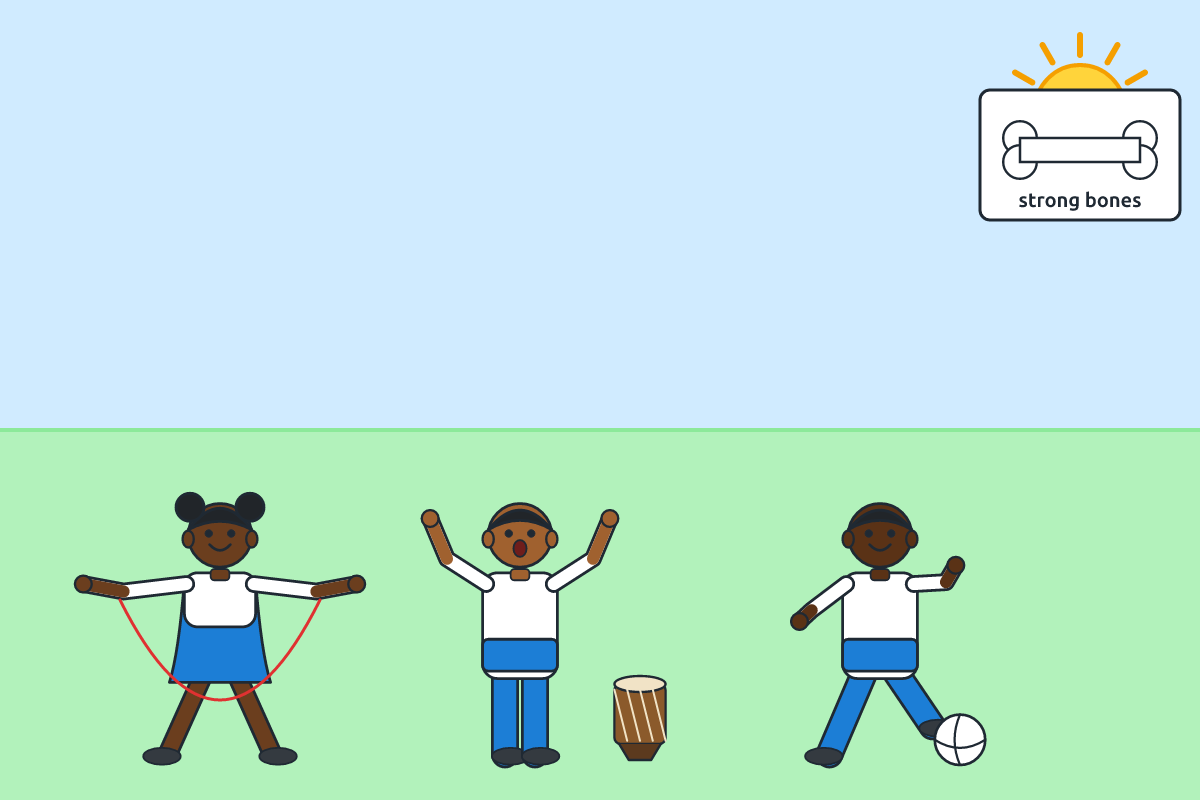
Weight-bearing activity: Exercise in which your bones and muscles work against gravity while supporting your body weight.
| Weight-bearing | Not weight-bearing |
|---|---|
| running, jogging, walking | swimming |
| skipping and jumping | cycling |
| football, netball, basketball | |
| dancing (Adowa, Kpanlogo) | |
| climbing stairs, hiking | |
| push-ups and resistance exercises |
2. How Bones Become Stronger
When you jump, run or dance, your bones feel stress from your body weight and the impact with the ground. Bone cells respond by adding more minerals, especially calcium, making the bones denser and stronger. Without this stress, bones become weaker. Astronauts in space, where there is little gravity, lose bone strength.
3. Foods for Strong Bones
| Nutrient | Role | Ghanaian food sources |
|---|---|---|
| calcium | builds bone | milk, small dried fish eaten whole with their bones (such as anchovies, known locally as "Keta school boys"), wagashi (local cheese), dark green leaves (kontomire) |
| vitamin D | helps the body absorb calcium | sunlight on the skin, eggs, oily fish |
| protein | builds bone and muscle tissue | beans, groundnuts, fish, eggs, meat |
| phosphorus | works with calcium | fish, groundnuts, beans |
4. Habits for Healthy Bones
- Be active for at least 60 minutes a day, including jumping and running.
- Eat a balanced diet with calcium-rich foods.
- Spend some time in the sun for vitamin D.
- Avoid too many fizzy drinks.
- Avoid smoking and alcohol, which weaken bones.
Strong bones reduce the risk of fractures and of osteoporosis (weak, brittle bones) later in life.
New words
- weight-bearing
- Supporting body weight against gravity.
- calcium
- A mineral that makes bones strong.
- vitamin D
- A vitamin that helps the body absorb calcium.
- bone density
- How solid and strong bones are.
- osteoporosis
- A condition of weak, brittle bones.
- fracture
- A broken bone.
Summary
- Weight-bearing activities include running, jumping, skipping and dancing.
- Stress on bones makes them denser and stronger.
- Calcium, vitamin D and protein build bones.
- Activity and good diet in youth protect bones for life.
Class activity: Bone-Builder Circuit
- Set up stations: skipping, star jumps, hopscotch, stair steps and dancing.
- Spend one minute at each station.
- List three calcium-rich foods you will eat this week.
You need: Filled plastic water bottles, Woven exercise mat, Printed weight-bearing activity cards
Exercises
Answer in your exercise book first, then check your answers.
1. Which is a weight-bearing activity?
- A. Skipping
- B. Swimming
- C. Sleeping
- D. Reading
Show answer
Answer: SkippingJumping against gravity.2. Which mineral makes bones strong?
- A. Calcium
- B. Iron
- C. Sugar
- D. Salt
Show answer
Answer: CalciumBone mineral.3. Vitamin D is mainly obtained from…
- A. sunlight
- B. darkness
- C. fizzy drinks
- D. sweets
Show answer
Answer: sunlightAnd some foods.4. Bones become stronger when they are used.
- A. True
- B. False
Show answer
Answer: TrueLike muscles.5. Swimming is the best weight-bearing activity.
- A. True
- B. False
Show answer
Answer: FalseWater supports the body weight.6. A condition of weak, brittle bones is ______.
Show answer
Answer: osteoporosisLater in life.7. Name three weight-bearing activities and two calcium-rich foods.
Show answer
Answer: Running, skipping, football; milk, small dried fish.Activities and foods.8. Explain how jumping makes bones stronger.
Show answer
Answer: The impact stresses the bones, and bone cells respond by adding minerals, making them denser.Bone adaptation.
Homework
- Keep a one-week record of your weight-bearing activities and calcium-rich foods.