Basic 6 · Physical Education · Dynamics
Preparing for Forehand and Backhand Strokes
In this topic you will identify the time needed to prepare for and begin forehand and backhand strokes in racket games.
By the end of these notes you should be able to:
- Describe the forehand and backhand strokes
- Explain the preparation (ready position and backswing)
- Practise timing the stroke
What you already know
- Striking skills (Basic 5)
Copy everything that has a blue line on its left into your notebook. The other parts are for reading.
- Strand
- Movement Concepts
- Sub-strand
- Dynamics
- Indicator
- B6.2.2.2.2 – Identify the time necessary to prepare for and begin a forehand stroke and a backhand stroke
Introduction
In table tennis, badminton and tennis, the ball or shuttle comes very fast. Players who prepare early hit better shots. Timing your preparation is the secret.
1. The Ready Position
Stand with feet shoulder-width apart, knees slightly bent, weight on the balls of the feet, racket held in front of the body at waist height. From this position you can move quickly to either side.
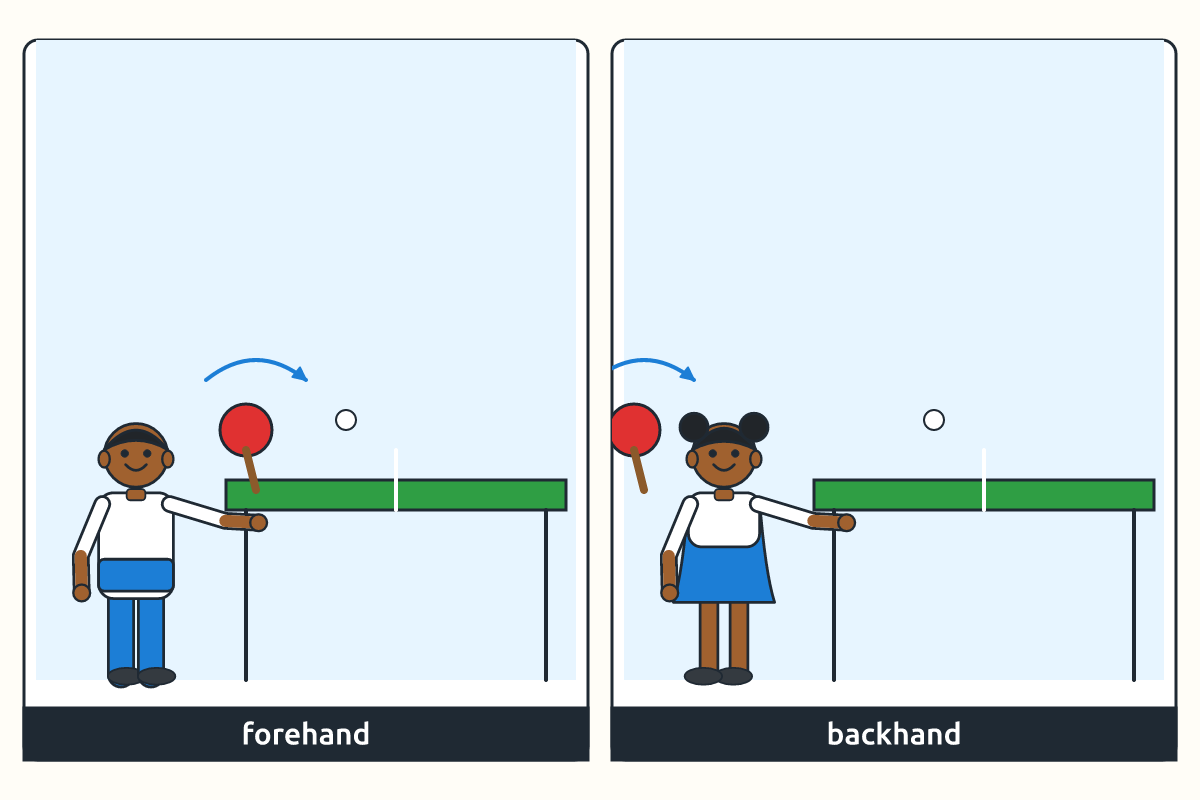
2. Forehand and Backhand
| Stroke | Side | Description |
|---|---|---|
| forehand | the side of your racket hand (right side for right-handers) | palm faces the ball; swing from back to front across the body |
| backhand | the opposite side (left for right-handers) | back of the hand faces the ball; swing across from the opposite side |
3. Preparation Phases and Timing
| Phase | Action | When |
|---|---|---|
| watch | see the ball leave the opponent's racket | immediately |
| decide | judge whether it is forehand or backhand | in the first moment |
| move | step to get into position | as the ball travels |
| backswing | take the racket back | before the ball bounces on your side |
| contact | hit the ball in front of the body | at the top of the bounce or just after |
| follow-through | continue the swing towards the target | after contact |
Because the ball can cross the table in less than a second, you must decide and begin the backswing early. Late preparation leads to rushed shots and mistakes. In tennis there is more time, but early preparation still gives better control.
4. Practice Drills
- Shadow strokes: practise forehand and backhand without a ball.
- Wall rally: hit a ball against a wall, alternating forehand and backhand.
- Partner feed: a partner throws balls to your forehand or backhand side; call out which stroke before hitting.
Safety: Keep a safe distance from other players when swinging rackets.
New words
- forehand
- A stroke on the racket-hand side.
- backhand
- A stroke across the body on the opposite side.
- ready position
- A balanced stance ready to move.
- backswing
- Taking the racket back before hitting.
- follow-through
- Continuing the swing after contact.
- timing
- Hitting at the right moment.
Summary
- Start in the ready position.
- Forehand is on the racket-hand side; backhand is across the body.
- Watch, decide, move and begin the backswing early.
- Practise with shadow strokes, wall rallies and partner feeds.
Class activity: Call and Hit
- Your partner throws a ball to either side.
- Call "forehand" or "backhand" as early as possible, then hit.
- Swap roles and count successful returns.
You need: Locally made table-tennis paddles, Lightweight table-tennis balls, Table with improvised net
Exercises
Answer in your exercise book first, then check your answers.
1. Which stroke is on the racket-hand side?
- A. Forehand
- B. Backhand
- C. Serve
- D. Smash
Show answer
Answer: ForehandSame side as the hand.2. Taking the racket back before hitting is the…
- A. backswing
- B. follow-through
- C. contact
- D. rally
Show answer
Answer: backswingPreparation.3. Why prepare early in table tennis?
- A. The ball travels very fast
- B. The table is long
- C. There is no net
- D. It is easy
Show answer
Answer: The ball travels very fastLess than a second.4. The ready position has knees slightly bent.
- A. True
- B. False
Show answer
Answer: TrueFor quick movement.5. You should begin the backswing after the ball has passed you.
- A. True
- B. False
Show answer
Answer: FalseBefore it arrives.6. Continuing the swing after contact is the ______.
Show answer
Answer: follow-throughFinal phase.7. List the phases of a stroke in order.
Show answer
Answer: Watch, decide, move, backswing, contact, follow-through.In order.8. Explain why late preparation causes mistakes.
Show answer
Answer: The player has no time to get into position or swing properly, so shots are rushed and inaccurate.Timing.
Homework
- Practise 50 shadow forehands and 50 shadow backhands.