Basic 6 · Our World and Our People · Plants and Animals
Making and Using Compost and Manure Safely
In this topic you will learn how to make compost with animal waste and plant materials and use it safely in gardens and farms.
By the end of these notes you should be able to:
- Explain composting
- Make a simple compost heap
- Use manure and compost safely
What you already know
- The importance of animal waste to plants
Copy everything that has a blue line on its left into your notebook. The other parts are for reading.
- Strand
- All Around Us
- Sub-strand
- Plants and Animals
- Indicator
- B6.2.2.1.1 – Explain the importance of animal waste to plants
Introduction
Fresh animal droppings can burn young plants and spread germs. Turning them into compost makes them safe and even more useful for crops.
1. What Is Compost?
Compost: Rotted organic matter, such as plant waste and animal manure, used to enrich soil.
Composting is the breaking down of organic materials by microbes, worms and insects into a dark, crumbly, earthy-smelling material. Heat produced in the heap kills many germs and weed seeds.
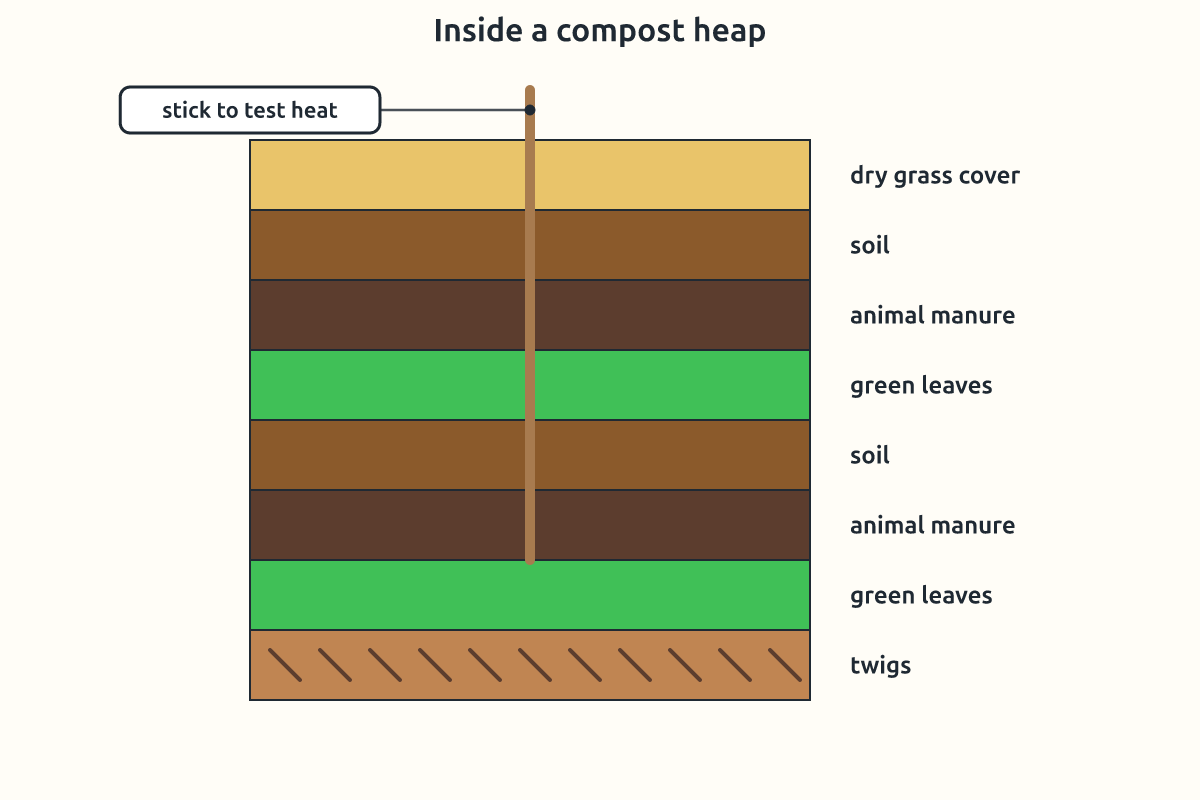
2. Making a Compost Heap
| Layer | Material |
|---|---|
| bottom | twigs and dry stalks (for air) |
| 2 | green materials: grass cuttings, vegetable peels, leaves |
| 3 | animal manure (cow dung, poultry droppings) |
| 4 | a thin layer of soil (adds microbes) |
| repeat | continue layers until the heap is about 1 m high |
| top | cover with dry grass or banana leaves |
- Choose a shady spot near the garden.
- Build the layers and sprinkle water on each layer to keep it damp, not soaked.
- Push a stick into the middle; if it feels hot after a few days, composting is working.
- Turn the heap every two weeks to add air.
- After about 2–3 months, the compost is dark and crumbly and ready to use.
3. Using Compost and Manure
- Mix compost into the soil before planting.
- Spread a layer around growing plants (do not touch the stems).
- Use well-rotted manure; fresh poultry droppings can burn plants.
- Apply in the right amounts; too much can harm plants and pollute water.
4. Safety
| Rule | Reason |
|---|---|
| wear gloves and boots | prevent infection from germs in manure |
| wash hands with soap afterwards | remove germs |
| keep manure away from drinking water | prevent pollution |
| do not put meat, bones or plastic in compost | attract pests or do not rot |
| keep children away from fresh manure | prevent illness |
Good compost smells earthy, not rotten. A bad smell means the heap is too wet or needs turning.
New words
- compost
- Rotted organic matter used to enrich soil.
- organic matter
- Material from living things.
- decompose
- To rot or break down.
- microbes
- Tiny living things that break down waste.
- well-rotted
- Fully decomposed and safe to use.
- layer
- One level of material on top of another.
Summary
- Compost is made by rotting plant waste and animal manure.
- Build layers, keep them damp and turn the heap.
- Use well-rotted compost and manure in the right amounts.
- Follow safety rules: gloves, handwashing and keeping manure away from water.
Class activity: School Compost Project
- Build a compost heap in the school garden.
- Record its temperature (by feel) and appearance every week.
- Use the finished compost to plant vegetables.
You need: Sealed mature compost sample, Potted maize plant, Hand trowel, Disposable gloves
Exercises
Answer in your exercise book first, then check your answers.
1. Compost is made from…
- A. plant waste and manure
- B. plastic and glass
- C. stones
- D. metal
Show answer
Answer: plant waste and manureOrganic matter.2. Why should fresh poultry droppings not be put directly on young plants?
- A. They can burn the plants
- B. They are too cold
- C. They are plastic
- D. They have no nutrients
Show answer
Answer: They can burn the plantsToo strong when fresh.3. Why turn a compost heap?
- A. To add air
- B. To remove water only
- C. To make it cold
- D. To stop rotting
Show answer
Answer: To add airHelps microbes.4. Gloves should be worn when handling manure.
- A. True
- B. False
Show answer
Answer: TrueTo prevent infection.5. Plastic can be put in compost.
- A. True
- B. False
Show answer
Answer: FalseIt does not rot.6. Fully decomposed manure is described as well-______.
Show answer
Answer: rottedSafe to use.7. List the layers of a compost heap.
Show answer
Answer: Twigs, green materials, animal manure, soil, repeated, with a cover on top.In order.8. Why does heat in a compost heap make the compost safer?
Show answer
Answer: The heat kills many germs and weed seeds.Safety.
Homework
- Collect vegetable peels at home for a week and start a small compost container.