Basic 6 · Mathematics · Fractions
Multiplying Fractions
In this topic you will use models to explain multiplying a fraction by a whole number, a whole number by a fraction, and a fraction by a fraction.
By the end of these notes you should be able to:
- Multiply fractions and whole numbers
- Use the area model to multiply a fraction by a fraction
- Simplify products and solve word problems
What you already know
- Multiplying fractions and whole numbers (Basic 5)
Copy everything that has a blue line on its left into your notebook. The other parts are for reading.
- Strand
- Number
- Sub-strand
- Fractions
- Indicator
- B6.1.3.1.3 – Use models to explain the result of multiplying a fraction by whole number a whole number by a fraction and a fraction by fraction
Introduction
Half of a farm is planted with maize, and ⅓ of the maize area is affected by pests. What fraction of the whole farm is affected? We need to multiply ⅓ × ½.
1. Fraction × Whole Number (Review)
4 × ⅔ = 8/3 = 2⅔ (multiply the numerator by the whole number). ⅔ of 12 = 12 ÷ 3 × 2 = 8.
2. Fraction × Fraction: The Area Model
To find ⅓ × ½, draw a square for the whole farm. Divide it into 2 columns and shade 1 column (½). Then divide it into 3 rows and shade 1 row (⅓) across the whole square. The part shaded twice is ⅓ × ½.
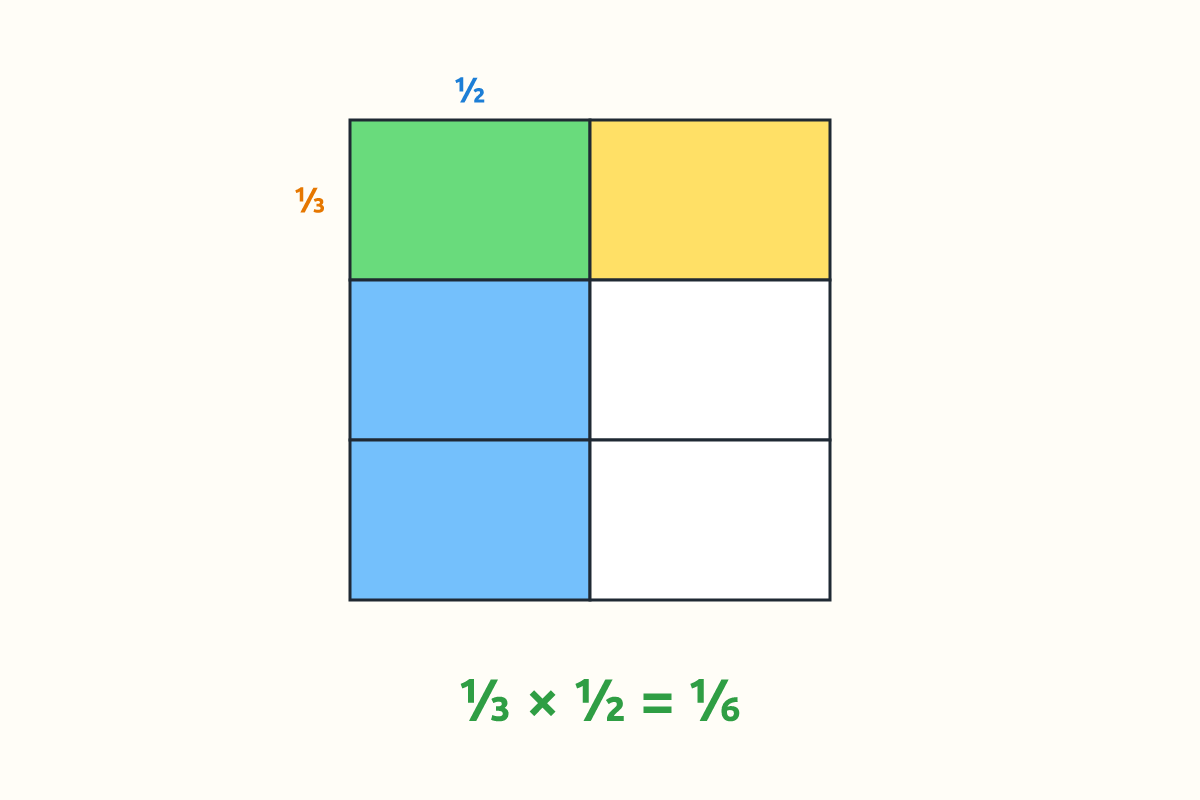
The square has 2 × 3 = 6 small parts. 1 part is shaded twice. So ⅓ × ½ = ⅙.
3. The Rule
Multiply the numerators, then multiply the denominators: a/b × c/d = (a × c)/(b × d).
Example 1
¾ × ⅔
- Numerators: 3 × 2 = 6
- Denominators: 4 × 3 = 12
- Simplify: 6/12 = ½
Answer: ½
Example 2
2½ × ⅘
- Change to an improper fraction: 2½ = 5/2
- 5/2 × 4/5 = 20/10
Answer: 2
4. Cancelling First
You can simplify before multiplying by dividing a numerator and a denominator by a common factor. In 5/2 × 4/5, cancel the 5s and divide 4 and 2 by 2: 1/1 × 2/1 = 2.
Remember: Multiplying by a proper fraction makes a number smaller. ½ of 8 is 4.
New words
- area model
- A rectangle used to show multiplication.
- numerator
- The top number of a fraction.
- denominator
- The bottom number of a fraction.
- simplify
- To reduce a fraction to lowest terms.
- cancel
- To divide a numerator and denominator by a common factor.
- improper fraction
- A fraction greater than one.
Summary
- Fraction × fraction: multiply numerators and multiply denominators.
- The area model shows why the rule works.
- Change mixed numbers to improper fractions first.
- Cancel common factors to make working easier.
Class activity: Paper Folding
- Fold a paper in half vertically and shade one half.
- Fold it in thirds horizontally and shade two thirds in another colour.
- Count the double-shaded parts and write the multiplication.
You need: Fraction strips cut from old cartons, Bottle tops, Exercise books
Exercises
Answer in your exercise book first, then check your answers.
1. ½ × ½ = ?
- A. ¼
- B. 1
- C. ½
- D. ⅛
Show answer
Answer: ¼1 × 1 over 2 × 2.2. ⅔ × ¾ = ?
- A. ½
- B. 6/7
- C. 5/12
- D. 1/12
Show answer
Answer: ½6/12 = ½.3. ⅗ of 25 = ?
- A. 15
- B. 10
- C. 5
- D. 20
Show answer
Answer: 1525 ÷ 5 × 3.4. ⅓ × 3 = 1
- A. True
- B. False
Show answer
Answer: True3/3 = 1.5. Multiplying by a proper fraction makes a number bigger.
- A. True
- B. False
Show answer
Answer: FalseIt makes it smaller.6. ⅖ × ½ = ______
Show answer
Answer: ⅕ (or 2/10)Multiply across.7. Work out 1½ × ⅔.
Show answer
Answer: 13/2 × 2/3 = 6/6 = 1.8. ¾ of a field is planted. ⅖ of the planted part is cassava. What fraction of the field is cassava?
Show answer
Answer: 3/10⅖ × ¾ = 6/20 = 3/10.
Homework
- Draw area models for ½ × ⅗ and ⅔ × ⅚, then check with the rule.