Basic 6 · Mathematics · Counting, Representation and Cardinality
Modelling Numbers up to 1,000,000
In this topic you will model and represent numbers up to 1,000,000 using graph sheets, multi-base blocks and place value.
By the end of these notes you should be able to:
- Model numbers using graph sheets and multi-base (base ten) blocks
- Represent numbers in figures, words and expanded form
- Explain the value of each digit up to the millions
What you already know
- Reading and writing numbers up to 1,000,000 (Basic 5)
Copy everything that has a blue line on its left into your notebook. The other parts are for reading.
- Strand
- Number
- Sub-strand
- Counting, Representation and Cardinality
- Indicator
- B6.1.1.1.1 – Model number quantities up to, 1,000,000 using graph sheets and multi-base block
Introduction
How big is one million? If you counted one number every second without stopping, it would take you more than 11 days to count to 1,000,000. Models help us understand such big numbers.
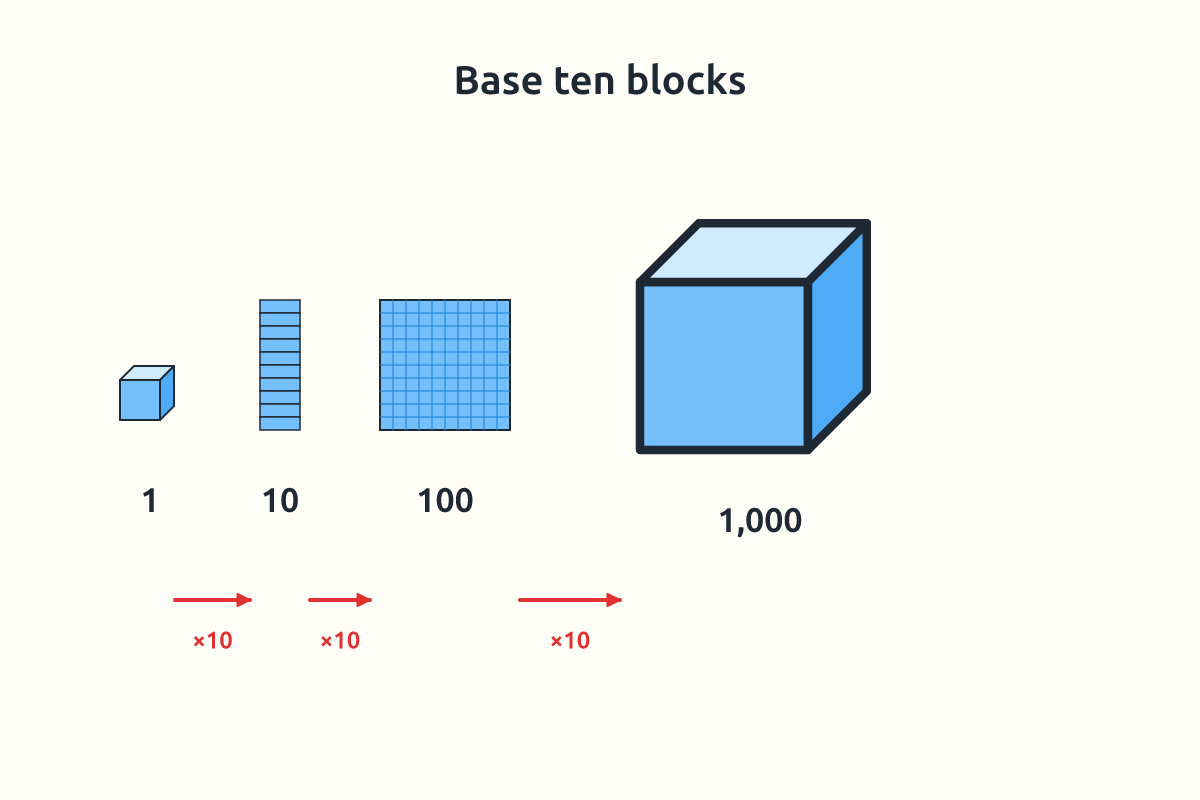
1. Base Ten Blocks
| Block | Value | Made of |
|---|---|---|
| unit (cube) | 1 | one small cube |
| rod (long) | 10 | 10 units |
| flat | 100 | 10 rods |
| block (cube) | 1,000 | 10 flats |
| long block | 10,000 | 10 thousand-blocks in a row |
| flat block | 100,000 | 10 long blocks |
| big block | 1,000,000 | 10 flat blocks |
Each block is ten times the one before it. This is why our number system is called a base ten system.
2. Graph Sheet Models
On graph paper, one small square shows 1. A strip of 10 squares shows 10. A 10 × 10 square shows 100, and ten of those 10 × 10 squares show 1,000. A sheet with 100 rows and 100 columns holds 10,000 small squares, so 100 such sheets would be needed to show 1,000,000. This is why we use blocks and place-value charts as a shorthand for very large numbers.
3. Representing a Number
Example 1
Represent 352,618 in different ways.
- Place value: 3 hundred thousands, 5 ten thousands, 2 thousands, 6 hundreds, 1 ten, 8 ones
- Expanded form: 300,000 + 50,000 + 2,000 + 600 + 10 + 8
- Words: three hundred and fifty-two thousand, six hundred and eighteen
Answer: 352,618 shown in place value, expanded form and words
Example 2
What number is shown by 6 flat blocks (100,000 each), 4 thousand-blocks, 9 rods and 3 units?
- 6 × 100,000 = 600,000
- 4 × 1,000 = 4,000
- 9 × 10 = 90; 3 × 1 = 3
Answer: 600,000 + 4,000 + 90 + 3 = 604,093
4. Value and Place Value
The place value is the position of a digit; the value is how much it is worth. In 604,093 the digit 4 is in the thousands place, so its value is 4,000. The 0s hold empty places (ten thousands and hundreds).
Common mistake: Do not forget zeros for empty places. 6 hundred thousands and 4 thousands is 604,000, not 64,000.
New words
- model
- A drawing or object that represents an idea.
- base ten
- A system where each place is ten times the one on its right.
- multi-base blocks
- Blocks used to show place value.
- expanded form
- A number written as the sum of its place values.
- place value
- The position of a digit in a number.
- value
- How much a digit is worth.
Summary
- Base ten blocks and graph sheets model large numbers.
- Each place is ten times the place on its right.
- Numbers can be shown in figures, words and expanded form.
- Zeros hold empty places.
Class activity: Block Builders
- Use sticks, bundles and drawings to build a 6-digit number.
- Another group writes it in figures, words and expanded form.
- Swap and check.
You need: Bundles of sticks, Place-value chart on manila card, Locally made digit cards
Exercises
Answer in your exercise book first, then check your answers.
1. How many rods make a flat?
- A. 10
- B. 100
- C. 1
- D. 1,000
Show answer
Answer: 1010 tens = 100.2. What is the value of 7 in 172,450?
- A. 70,000
- B. 7,000
- C. 700
- D. 700,000
Show answer
Answer: 70,000Ten thousands place.3. 5 flat blocks (100,000) and 3 rods is…
- A. 500,030
- B. 503,000
- C. 530,000
- D. 5,030
Show answer
Answer: 500,030Zeros hold places.4. Our number system is base ten.
- A. True
- B. False
Show answer
Answer: TrueEach place is ten times bigger.5. 400,000 + 6,000 + 5 = 406,500
- A. True
- B. False
Show answer
Answer: FalseIt equals 406,005.6. 10 thousand-blocks make ______.
Show answer
Answer: 10,000Ten thousands.7. Write 815,207 in expanded form.
Show answer
Answer: 800,000 + 10,000 + 5,000 + 200 + 7Add the place values.8. How many hundreds are there in 1,000,000?
Show answer
Answer: 10,0001,000,000 ÷ 100.
Homework
- Write five 6-digit numbers from newspapers (prices, populations) in words and expanded form.