Basic 6 · Creative Arts · Appreciating and Appraising
Examining and Finding Meaning in Our Own Artworks
In this topic you will use agreed guidelines to examine your own artworks from the term, derive their meanings and prepare a reflective portfolio.
By the end of these notes you should be able to:
- Apply the elements, principles and the four-step method to your own work
- Explain the meaning and message of your artworks
- Prepare a reflective portfolio with targets
What you already know
- Analysing artworks
Copy everything that has a blue line on its left into your notebook. The other parts are for reading.
- Strand
- Visual Arts & Performing Arts
- Sub-strand
- Appreciating and Appraising
- Indicator
- B6.1.4.6 – Use the agreed guidelines to examine and derive meaning from own artworks
Introduction
At the end of a term, artists look back at their work to see how they have grown. Reflecting on your own art helps you understand your ideas and plan your next steps.
1. Agreed Guidelines
| Step | Questions |
|---|---|
| describe | What did I make? Which media and techniques did I use? |
| analyse | Which elements (line, colour, texture) and principles (balance, contrast, emphasis) did I use? |
| interpret | What is the meaning or message? What symbols did I use? |
| judge | What are the strengths? What would I improve? Did I achieve my aim? |
2. Deriving Meaning
The meaning of an artwork comes from its subject, symbols, colours, materials and the context in which it was made. For example, a pupil's collage of a globe made from plastic sachets may mean that "the world is being buried in plastic". Choosing waste materials makes the message stronger, because the material itself is part of the problem.
3. Sample Reflection
"My poster 'Our Planet Is Melting' shows the earth as a melting ice cream cone. I used bright red and orange for heat and brown for the dry ground. The large globe in the centre is the emphasis. The message is that global warming is destroying our planet and we must act quickly. Its strength is the clear symbol and slogan. I would improve the lettering, which is uneven, by using a ruler and guidelines."
4. The Reflective Portfolio
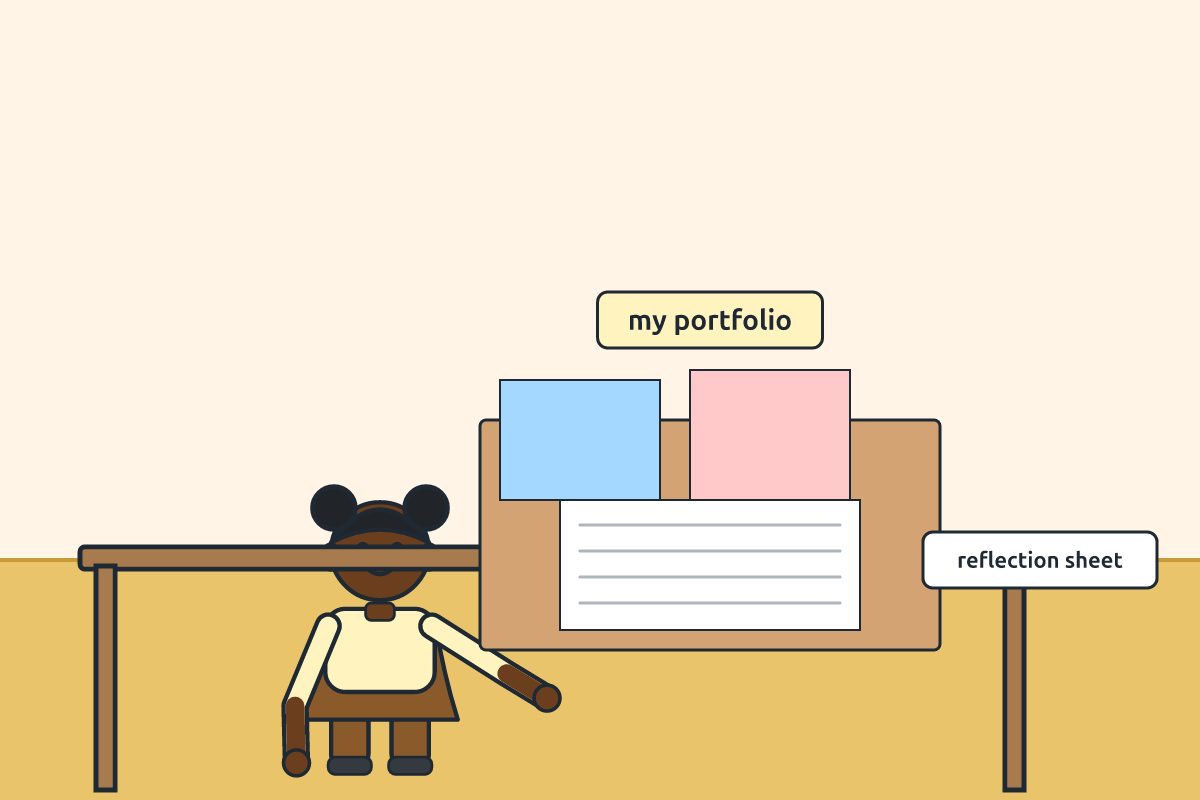
- Choose your three best works from the term (visual and performing).
- Write a reflection for each using the guidelines.
- Include photos of three-dimensional works and performances.
- Write an overall statement: what you learnt and how you improved.
- Set two targets for next term.
5. Peer Review
Exchange portfolios with a partner. Give one compliment and one suggestion for each work. Peer review helps you see your work through another person's eyes.
New words
- self-appraisal
- Judging your own work honestly.
- reflection
- Careful thinking about what you have done.
- portfolio
- A collection of an artist's works.
- meaning
- What an artwork expresses.
- context
- The circumstances in which a work is made.
- peer review
- Feedback from classmates.
Summary
- Use describe, analyse, interpret and judge on your own work.
- Meaning comes from subject, symbols, colours, materials and context.
- A reflective portfolio includes your best works, reflections and targets.
- Peer review gives fresh views on your work.
Class activity: My Term Portfolio
- Select three artworks and write reflections.
- Exchange with a partner for peer review.
- Set two targets for next term.
You need: Learners’ own artworks, Label cards cut from manila paper, String, Clothes pegs
Exercises
Answer in your exercise book first, then check your answers.
1. A collection of an artist's works is a…
- A. portfolio
- B. programme
- C. slogan
- D. stage
Show answer
Answer: portfolioKeeps your best work.2. Which question belongs to "interpret"?
- A. What is the message?
- B. What media did I use?
- C. Where is the venue?
- D. What is the price?
Show answer
Answer: What is the message?Meaning.3. Feedback from classmates is called…
- A. peer review
- B. self-portrait
- C. exhibition
- D. tableau
Show answer
Answer: peer reviewFrom peers.4. Materials can add meaning to an artwork.
- A. True
- B. False
Show answer
Answer: Truee.g. waste for pollution.5. A reflection should list only strengths.
- A. True
- B. False
Show answer
Answer: FalseIt includes improvements.6. Careful thinking about what you have done is ______.
Show answer
Answer: reflectionLeads to growth.7. List the four steps of the self-appraisal guidelines.
Show answer
Answer: Describe, analyse, interpret, judge.In order.8. Explain how the material of an artwork can add to its meaning.
Show answer
Answer: When the material relates to the message, such as plastic waste in an artwork about pollution, it strengthens the message.Material and meaning.
Homework
- Complete your reflective portfolio and show it to a family member.