Basic 5 · Physical Education · Rhythmic Skills
Striking a Dropping Ball to a Teammate
In this topic you will strike a dropping light ball upward and forward to a teammate using the hands or feet.
By the end of these notes you should be able to:
- Strike a dropping ball with the hands (volley)
- Strike a dropping ball with the foot (juggle and pass)
- Pass accurately to a teammate
What you already know
- Manipulative skills
Copy everything that has a blue line on its left into your notebook. The other parts are for reading.
- Strand
- Motor Skill And Movement Patterns
- Sub-strand
- Rhythmic Skills
- Indicator
- B5.1.6.1.6 – Strike a dropping light ball upward and forward to a teammate using the hands or feet
Introduction
In volleyball, players hit the ball upward to a teammate before it touches the ground. In football, players juggle and volley the ball. These skills need good timing and control.
1. Striking with the Hands (Volley)
- Stand with feet shoulder-width apart, knees bent.
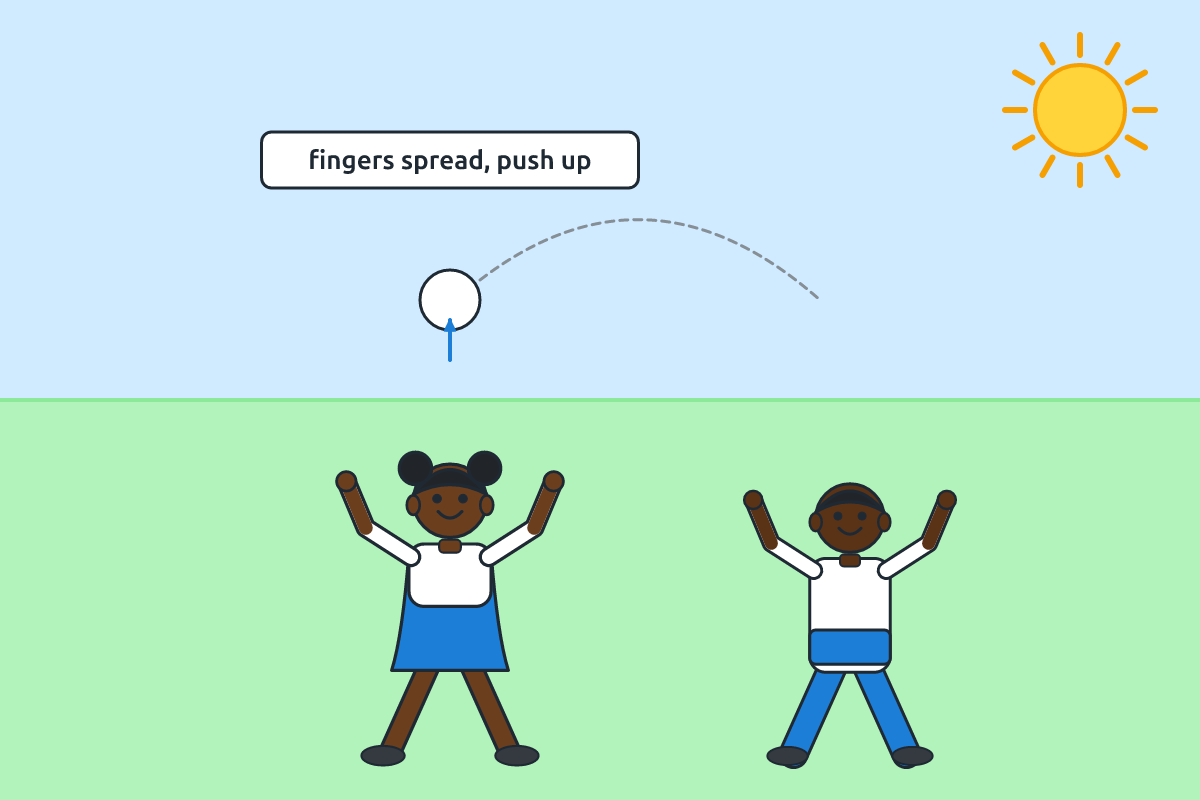
- Raise your hands above your forehead, fingers spread, making a "window" with thumbs and index fingers.
- Watch the ball through the window as it drops.
- Contact the ball with your fingertips (not palms) just above your forehead.
- Push upward and forward by straightening your arms and legs towards your teammate.
2. The Forearm Pass (Dig)
For a low ball, join your hands together, keep your arms straight and make a flat platform with your forearms. Bend your knees and let the ball hit your forearms. Lift gently with your legs to send it upward to your teammate.
3. Striking with the Foot
Drop the ball from your hands and strike it with the top of your foot (laces) or the inside of your foot just before it touches the ground. Keep your ankle firm and your eyes on the ball. Aim it upward and forward to your partner's chest so they can catch or control it.
4. Practice Drills
| Drill | Description |
|---|---|
| self-volley | volley the ball upward to yourself 10 times |
| partner volley | volley back and forth with a partner 3 metres away |
| circle volley | a group of 5 keeps the ball up in a circle |
| foot juggle | keep the ball up with your feet; count the touches |
| drop-kick pass | drop the ball and kick it to a partner |
5. Timing
Timing means striking the ball at the right moment. Move under the ball early, get ready before it arrives and keep your eyes on it until contact. Good timing makes passes accurate.
New words
- strike
- To hit.
- volley
- To hit a ball before it touches the ground.
- forearm pass
- Hitting the ball with the forearms joined.
- juggle
- To keep the ball in the air with repeated touches.
- timing
- Striking at the right moment.
- accuracy
- Sending the ball exactly where intended.
Summary
- Volley with fingertips above the forehead.
- Use a forearm pass for low balls.
- Strike with the laces or inside of the foot and keep the ankle firm.
- Good timing and watching the ball give accurate passes.
Class activity: Keep It Up
- Form a circle of five.
- Keep the ball in the air using volleys and forearm passes.
- Count the touches and try to beat your record.
You need: Locally made ball, Plastic-bottle targets, Sticks of chalk
Exercises
Answer in your exercise book first, then check your answers.
1. Hitting a ball before it touches the ground is a…
- A. volley
- B. roll
- C. bounce
- D. throw
Show answer
Answer: volleyUsed in volleyball.2. Which part of the hand contacts the ball in a volley?
- A. Fingertips
- B. Palm
- C. Fist
- D. Elbow
Show answer
Answer: FingertipsFor control.3. For a low ball in volleyball, use a…
- A. forearm pass
- B. header
- C. overhead smash
- D. throw
Show answer
Answer: forearm passAlso called a dig.4. You should watch the ball until contact.
- A. True
- B. False
Show answer
Answer: TrueIt helps timing.5. The ankle should be loose when striking with the foot.
- A. True
- B. False
Show answer
Answer: FalseKeep it firm.6. Keeping the ball in the air with repeated touches is to ______.
Show answer
Answer: juggleFootball skill.7. Describe the hand position for a volley.
Show answer
Answer: Hands above the forehead, fingers spread, thumbs and index fingers forming a window.Fingertip contact.8. Why is moving under the ball early important?
Show answer
Answer: It gives time to get into position and strike at the right moment, improving accuracy.Timing.
Homework
- Practise self-volleys against a wall for ten minutes.