Basic 5 · Physical Education · Manipulative Skills
Small-Group Balance Stunts
In this topic you will perform simple small-group balance stunts by distributing weight and using a stable base of support.
By the end of these notes you should be able to:
- Explain base of support and weight distribution
- Perform partner and small-group balances
- Follow safety rules for stunts
What you already know
- Balance on lines
Copy everything that has a blue line on its left into your notebook. The other parts are for reading.
- Strand
- Motor Skill And Movement Patterns
- Sub-strand
- Manipulative Skills
- Indicator
- B5.1.5.1.4 – Perform simple small-group balance stunts by distributing weight and base of support
Introduction
Acrobats at festivals build human pyramids and balance on each other. These stunts depend on strong bases, careful weight distribution and teamwork.
1. Key Ideas
Base of support: The area of contact with the ground or with a partner that supports the body.
Weight distribution: How the body's weight is spread over the base.
A wide base gives more stability. A low centre of gravity also helps. In group stunts, the heaviest and strongest people form the base at the bottom, and the lightest people are on top. Weight should be placed over the hips and shoulders of the base, never on the middle of the back.
2. Partner Balances
| Stunt | How to do it |
|---|---|
| back-to-back sit | sit back to back, link arms and push against each other to stand up together |
| partner lean | face each other, hold hands and lean back slowly, balancing each other's weight |
| table and statue | one partner kneels on hands and knees (table); the other kneels on the table's hips and holds a pose |
| wheelbarrow | one partner walks on hands while the other holds the legs |
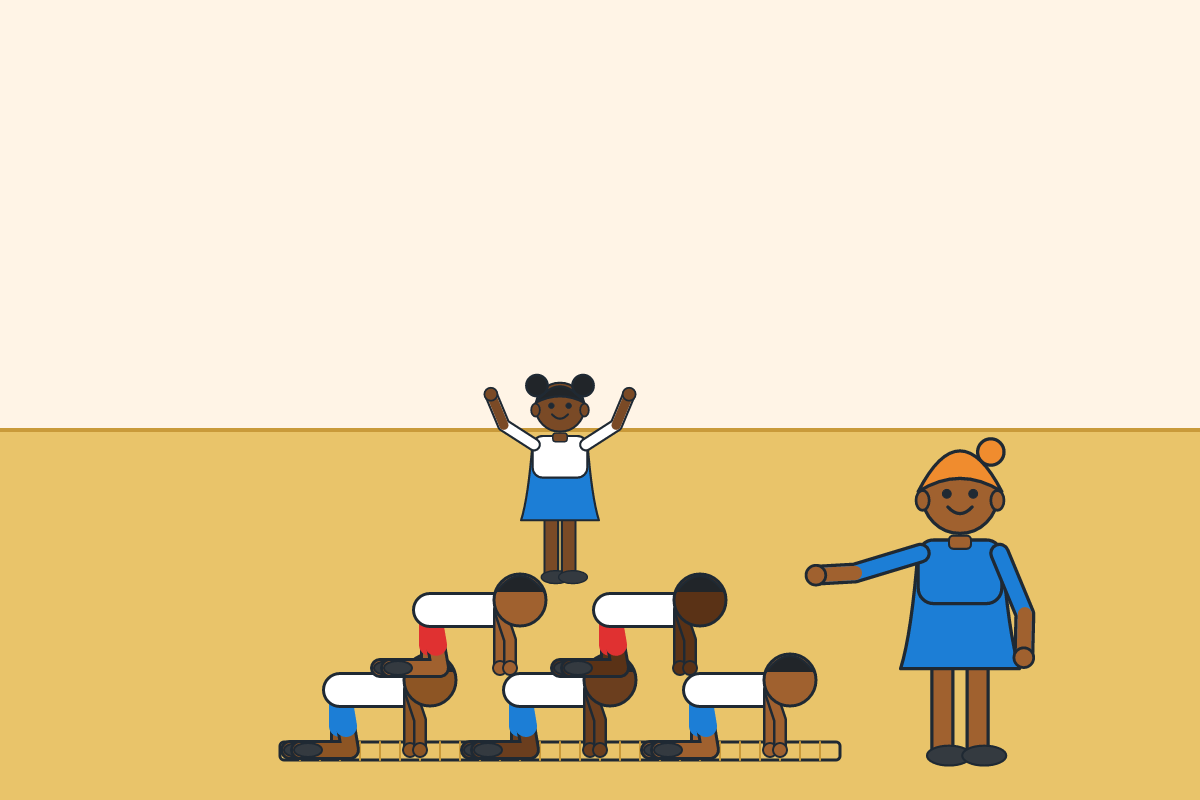
3. Small-Group Pyramid
- Three pupils kneel side by side on hands and knees (the base).
- Two lighter pupils climb gently onto the base, placing knees over hips and hands over shoulders.
- One very light pupil climbs to the top with help from a spotter.
- Hold for three seconds and smile.
- Dismount in reverse order: top first, then middle, then base.
4. Safety Rules
- Always work on a mat or soft grass.
- Remove shoes, watches and jewellery.
- Use spotters (helpers who stand ready to catch).
- Place weight over hips and shoulders, not the lower back.
- Climb and come down slowly; never jump off.
- Stop immediately if someone says "Down!"
New words
- stunt
- A difficult movement that needs skill.
- base
- The people at the bottom who support others.
- spotter
- A helper who keeps performers safe.
- pyramid
- A stunt shaped like a triangle.
- dismount
- To come down from a stunt.
- stability
- Being steady and balanced.
Summary
- A wide base and low centre of gravity improve stability.
- Strong pupils form the base; light pupils go on top.
- Put weight over hips and shoulders, never the lower back.
- Use mats and spotters and dismount carefully.
Class activity: Group Stunt Show
- Practise two partner balances.
- Build a three-level pyramid with a spotter.
- Show your stunts to the class and dismount safely.
You need: Low wooden bench, Beanbag, Woven mat
Exercises
Answer in your exercise book first, then check your answers.
1. Who should form the base of a pyramid?
- A. The strongest pupils
- B. The lightest pupils
- C. The youngest pupils
- D. Anyone tired
Show answer
Answer: The strongest pupilsThey support others.2. Where should weight be placed on a partner's back?
- A. Over hips and shoulders
- B. Middle of the back
- C. On the neck
- D. On the head
Show answer
Answer: Over hips and shouldersThese are strong points.3. A helper who keeps performers safe is a…
- A. spotter
- B. referee
- C. coach
- D. spectator
Show answer
Answer: spotterReady to catch.4. Stunts should be done on mats or soft grass.
- A. True
- B. False
Show answer
Answer: TrueTo prevent injury.5. You should jump off the top of a pyramid.
- A. True
- B. False
Show answer
Answer: FalseClimb down slowly.6. Coming down from a stunt is called a ______.
Show answer
Answer: dismountTop first.7. State three safety rules for balance stunts.
Show answer
Answer: Use mats, use spotters, remove jewellery (or dismount slowly).Any three.8. Why does a wide base make a stunt more stable?
Show answer
Answer: The centre of gravity stays over a larger area, so the group is less likely to tip over.Stability principle.
Homework
- Practise the back-to-back sit with a family member.