Basic 5 · Physical Education · Dynamics
Applying and Receiving Force in Jumping
In this topic you will explain the differences in applying force at take-off and receiving force at landing when jumping for height and for distance.
By the end of these notes you should be able to:
- Explain applying and receiving force
- Compare jumping for height and jumping for distance
- Land safely by absorbing force
What you already know
- Leaping
Copy everything that has a blue line on its left into your notebook. The other parts are for reading.
- Strand
- Movement Concepts
- Sub-strand
- Dynamics
- Indicator
- B5.2.2.2.2 – Explain the differences in applying and receiving force when jumping for height and distance
Introduction
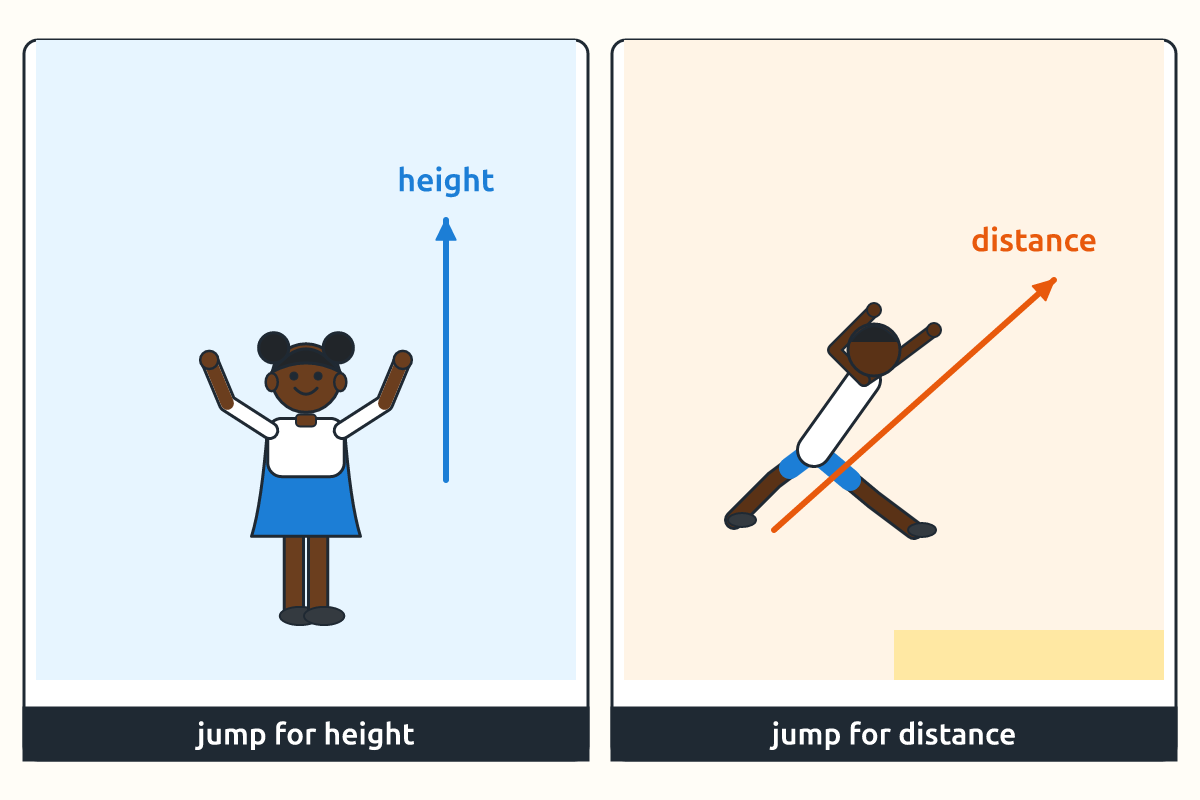
A high jumper and a long jumper both push hard against the ground. But one wants to go up, and the other wants to go far. How they apply force is different.
1. Applying Force (Take-Off)
To jump, you push against the ground with your legs. The ground pushes back and lifts you into the air. The harder you push, the higher or farther you go. Swinging the arms also adds force.
2. Jumping for Height and Distance
| Feature | Jumping for height (high jump, vertical jump) | Jumping for distance (long jump, standing broad jump) |
|---|---|---|
| direction of force | mainly upward | upward and forward (about 45° or lower for running jumps) |
| arm swing | arms swing strongly upward | arms swing forward and upward |
| body position at take-off | upright, knees bend then straighten fast | leaning forward |
| run-up | short, curved (high jump) | long, fast and straight (long jump) |
| landing | on a soft mat or both feet | in a sand pit, feet forward |
3. Receiving Force (Landing)
When you land, the ground pushes back on your body. To land safely, you must absorb this force gradually. Bend your ankles, knees and hips as you land, like a spring, so that the force is spread over a longer time. Land on the balls of your feet first, then roll to the heels. Keep your feet shoulder-width apart for balance.
- Land on both feet where possible.
- Bend ankles, knees and hips ("give" on landing).
- Keep arms forward for balance.
- Land on soft surfaces: sand pit, grass or mat.
Common mistake: Landing with straight legs sends all the force to your joints and can cause injury.
4. Practice
- Vertical jump: stand by a wall, reach up and mark; then jump and mark again. Measure the difference.
- Standing broad jump: stand behind a line, swing arms and jump forward; measure to the back of the heels.
- Compare which arm and body actions gave the best results.
New words
- force
- A push or pull.
- take-off
- The moment of pushing off the ground.
- landing
- Coming back to the ground.
- absorb
- To soak up or reduce.
- vertical jump
- Jumping straight up.
- broad jump
- Jumping forward for distance.
Summary
- Pushing against the ground applies force for take-off.
- Height jumps push upward; distance jumps push up and forward.
- Bend ankles, knees and hips to absorb force on landing.
- Land on soft surfaces to prevent injury.
Class activity: Jump Lab
- Measure each member's vertical jump and standing broad jump.
- Record results in a table.
- Discuss how arm swing and bending affected results.
You need: Plastic-bottle cones, Rope, Sticks of chalk
Exercises
Answer in your exercise book first, then check your answers.
1. A push or pull is a…
- A. force
- B. jump
- C. landing
- D. mat
Show answer
Answer: forceForce moves objects.2. For a long jump, force is applied…
- A. upward and forward
- B. only downward
- C. only backward
- D. sideways
Show answer
Answer: upward and forwardTo travel far.3. To absorb force on landing you should…
- A. bend ankles, knees and hips
- B. keep legs straight
- C. land on your head
- D. lock your knees
Show answer
Answer: bend ankles, knees and hipsLike a spring.4. Swinging the arms helps you jump higher.
- A. True
- B. False
Show answer
Answer: TrueIt adds force.5. Landing with straight legs is safest.
- A. True
- B. False
Show answer
Answer: FalseIt can injure joints.6. The moment of pushing off the ground is the ______.
Show answer
Answer: take-offIt applies force.7. State two differences between jumping for height and for distance.
Show answer
Answer: Height: upward force, upright body. Distance: forward force, leaning forward (or run-up differences).Any two.8. Explain why bending the knees on landing reduces injury.
Show answer
Answer: It spreads the force over a longer time, so less force hits the joints at once.Absorbing force.
Homework
- Practise the standing broad jump and record your best distance.