Basic 5 · Mathematics · Fractions
Multiplying Fractions and Whole Numbers
In this topic you will use models to multiply a whole number by a fraction and a fraction by a whole number.
By the end of these notes you should be able to:
- Model a whole number times a fraction
- Find a fraction of a whole number
- Explain why the answers are the same
What you already know
- Mixed numbers
Copy everything that has a blue line on its left into your notebook. The other parts are for reading.
- Strand
- Number
- Sub-strand
- Fractions
- Indicator
- B5.1.3.1.5 – Use models to explain the result of multiplying a whole number by a fraction and a fraction by a whole number
Introduction
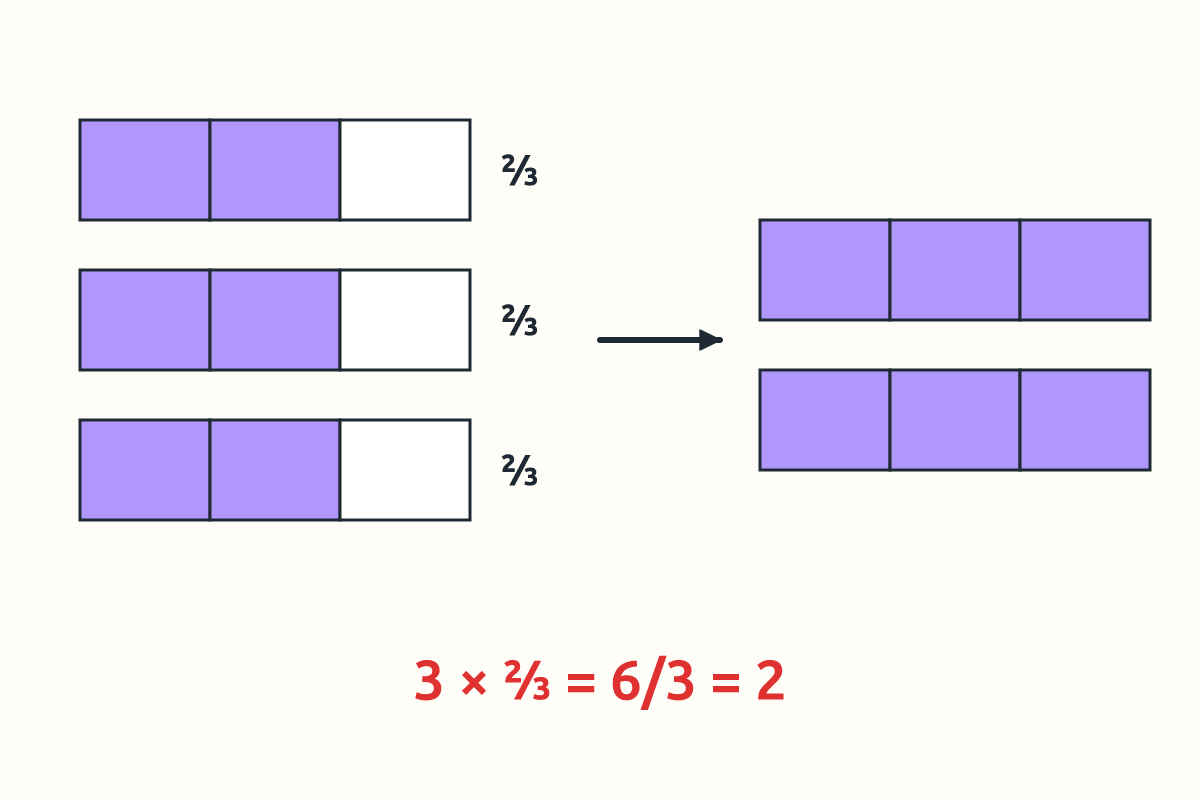
Each child drinks ⅔ of a litre of water a day. How much do 3 children drink? And what is ⅔ of 3 litres? Both questions have the same answer.
1. Whole Number × Fraction
3 × ⅔ means three groups of ⅔.
⅔ + ⅔ + ⅔ = 6/3 = 2
Rule: multiply the whole number by the numerator; keep the denominator.
Example 1
4 × ⅖ = ?
- 4 × 2 = 8
- 8/5 = 1⅗
Answer: 1⅗
2. Fraction of a Whole Number
⅔ of 3 means divide 3 into 3 equal parts and take 2 parts: (3 ÷ 3) × 2 = 2.
Example 2
¾ of 20 = ?
- 20 ÷ 4 = 5 (one quarter)
- 5 × 3 = 15 (three quarters)
Answer: 15
Example 3
⅗ of 45 = ?
- 45 ÷ 5 = 9
- 9 × 3 = 27
Answer: 27
3. Same Answer Either Way
| Fraction × whole | Whole × fraction | Answer |
|---|---|---|
| ⅔ × 3 | 3 × ⅔ | 2 |
| ¾ × 20 | 20 × ¾ | 15 |
Multiplication can be done in any order, so a fraction of a number equals the number times the fraction.
Tip: "Of" means multiply: ¾ of 20 = ¾ × 20.
4. When the Answer Is More Than One
Sometimes the product is an improper fraction. Change it to a mixed number by dividing the numerator by the denominator. For example, 7 × ⅔ = 14/3, and 14 ÷ 3 = 4 remainder 2, so 14/3 = 4⅔. A model shows this clearly: seven bars, each with two thirds shaded, give fourteen thirds, which fill four whole bars and two thirds of another. Notice that multiplying a whole number by a proper fraction always gives an answer smaller than the whole number.
New words
- fraction
- A part of a whole.
- whole number
- A number with no fractional part.
- product
- The answer to a multiplication.
- of
- In fractions, means multiply.
- model
- A drawing or object that shows the idea.
- repeated addition
- Adding the same number again and again.
Summary
- Whole × fraction: multiply by the numerator, keep the denominator.
- Fraction of a number: divide by the denominator, multiply by the numerator.
- ⅔ × 3 = 3 × ⅔; order does not change the product.
- "Of" means multiply.
Class activity: Bottle Top Fractions
- Take 24 bottle tops.
- Find ¼, ⅜ and ⅚ of them by grouping.
- Write a multiplication sentence for each.
You need: Fraction strips cut from old cartons, Bottle tops, Exercise books
Exercises
Answer in your exercise book first, then check your answers.
1. 2 × ⅓ = ?
- A. ⅔
- B. ⅙
- C. ⅓
- D. 1
Show answer
Answer: ⅔2 thirds.2. ⅘ of 30 = ?
- A. 24
- B. 6
- C. 20
- D. 25
Show answer
Answer: 2430 ÷ 5 × 4.3. 5 × ⅜ = ?
- A. 15/8
- B. 5/8
- C. 8/15
- D. 3/40
Show answer
Answer: 15/85 × 3 = 15 eighths.4. "Of" means multiply in fractions.
- A. True
- B. False
Show answer
Answer: True¾ of 20 = ¾ × 20.5. ½ of 18 = 18 × 2
- A. True
- B. False
Show answer
Answer: False½ of 18 = 9.6. ⅓ of 21 = ______
Show answer
Answer: 721 ÷ 3.7. Work out 6 × ¾ and write it as a mixed number.
Show answer
Answer: 18/4 = 4½6 × 3 = 18 quarters.8. A farmer has 120 chickens. ⅖ are cocks and the rest are hens. How many hens are there?
Show answer
Answer: 72 hens⅖ of 120 = 48; 120 − 48 = 72.
Homework
- Find ⅔ of 36, ⅝ of 40 and 7 × ⅗.