Basic 5 · Mathematics · Fractions
Adding and Subtracting Fractions
In this topic you will use equivalent fractions to change fractions to the same denominator so that you can add and subtract them.
By the end of these notes you should be able to:
- Find equivalent fractions
- Find the lowest common denominator (LCD)
- Add and subtract fractions with different denominators
What you already know
- Equivalent fractions and the LCD (Basic 4)
Copy everything that has a blue line on its left into your notebook. The other parts are for reading.
- Strand
- Number
- Sub-strand
- Fractions
- Indicator
- B5.1.3.1.1 – Use the concept of equivalent fractions in changing fractions to the same denominator for addition and subtraction
Introduction
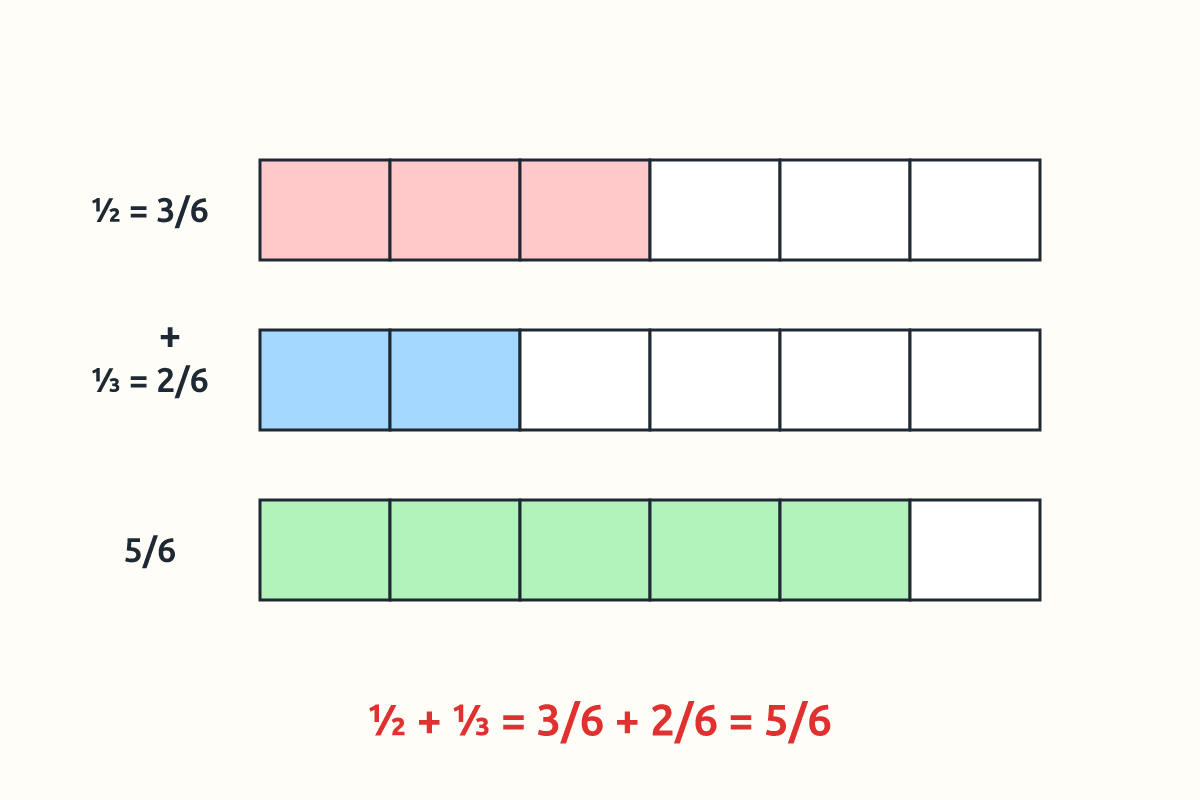
Kofi ate ½ of a pizza and Ama ate ⅓ of the same pizza. What fraction did they eat altogether? We cannot add halves and thirds directly. First we change them to the same kind of part.
1. Like and Unlike Fractions
| Type | Meaning | Example |
|---|---|---|
| like fractions | same denominator | 2/7 and 3/7 |
| unlike fractions | different denominators | ½ and ⅓ |
To add like fractions, add the numerators and keep the denominator: 2/7 + 3/7 = 5/7.
2. Adding Unlike Fractions
- Find the LCD (the LCM of the denominators).
- Change each fraction to an equivalent fraction with the LCD.
- Add the numerators.
- Simplify if possible.
Example 1
½ + ⅓ = ?
- LCD of 2 and 3 = 6
- ½ = 3/6 and ⅓ = 2/6
- 3/6 + 2/6 = 5/6
Answer: Kofi and Ama ate 5/6 of the pizza.
3. Subtracting Unlike Fractions
Example 2
¾ − ⅙ = ?
- LCD of 4 and 6 = 12
- ¾ = 9/12 and ⅙ = 2/12
- 9/12 − 2/12 = 7/12
Answer: 7/12
Example 3
⅚ − ⅓ = ?
- LCD = 6
- ⅓ = 2/6
- 5/6 − 2/6 = 3/6 = ½
Answer: ½ (simplified)
Common mistake: Do not add the denominators. ½ + ⅓ is not 2/5.
Why can we not add the denominators? The denominator tells us the size of the parts. Halves are bigger than thirds, so we cannot count them together, just as we cannot add 2 cedis and 3 pesewas to get 5 cedis. When both fractions are written in sixths, every part is the same size and we simply count the parts: three sixths and two sixths make five sixths. The denominator stays 6 because the size of each part does not change.
New words
- like fractions
- Fractions with the same denominator.
- unlike fractions
- Fractions with different denominators.
- equivalent fraction
- A fraction with the same value.
- LCD
- Lowest common denominator.
- simplify
- To divide numerator and denominator by a common factor.
- numerator
- The top number of a fraction.
Summary
- Like fractions can be added by adding the numerators.
- Unlike fractions need a common denominator first.
- The LCD is the LCM of the denominators.
- Never add or subtract the denominators.
Class activity: Fraction Strip Sums
- Use fraction strips cut from old cartons.
- Show ½ + ¼ and ⅔ − ½ with the strips.
- Check your answers by calculation.
You need: Fraction strips cut from old cartons, Bottle tops, Exercise books
Exercises
Answer in your exercise book first, then check your answers.
1. 3/8 + 2/8 = ?
- A. 5/8
- B. 5/16
- C. 1/8
- D. 6/8
Show answer
Answer: 5/8Add the numerators.2. ½ + ¼ = ?
- A. ¾
- B. 2/6
- C. ⅔
- D. 2/4
Show answer
Answer: ¾2/4 + 1/4 = 3/4.3. What is the LCD of ⅖ and ⅓?
- A. 15
- B. 5
- C. 8
- D. 30
Show answer
Answer: 15LCM of 5 and 3.4. ⅔ and 4/6 are equivalent.
- A. True
- B. False
Show answer
Answer: TrueMultiply top and bottom by 2.5. ¼ + ¼ = 2/8
- A. True
- B. False
Show answer
Answer: False¼ + ¼ = 2/4 = ½.6. 7/9 − 4/9 = ______
Show answer
Answer: 3/9 (or ⅓)Subtract the numerators.7. Work out ⅔ + ¼.
Show answer
Answer: 11/128/12 + 3/12.8. A tank is ⅞ full. ⅜ of the tank is used. Then ½ of the tank is refilled. How full is it now?
Show answer
Answer: 1 (full)⅞ − ⅜ = 4/8; 4/8 + 4/8 = 1.
Homework
- Work out ⅗ + 3/10 and ⅚ − ¼. Show the LCD each time.