Basic 5 · Ghanaian Language · Songs, Reading Texts and Short Stories
Cradle Songs and Reading a Narrative
In this topic you will sing cradle songs (lullabies) with the correct rhythm, discuss why they are important, and read a short narrative and answer questions on it.
By the end of these notes you should be able to:
- Sing a cradle song with the correct rhythm
- Explain the importance of cradle songs
- Read a narrative and answer questions on it
What you already know
- Songs of traditional occupations (Basic 4)
Copy everything that has a blue line on its left into your notebook. The other parts are for reading.
- Strand
- Oral Language/Extensive Reading
- Sub-strand
- Songs, Reading Texts and Short Stories
- Indicator
- B5.1.1.1.1 – 2 Sing cradle songs/lullaby with the correct rhythms and discuss importance of songs and read and answer questions on the narratives/passage read
Introduction
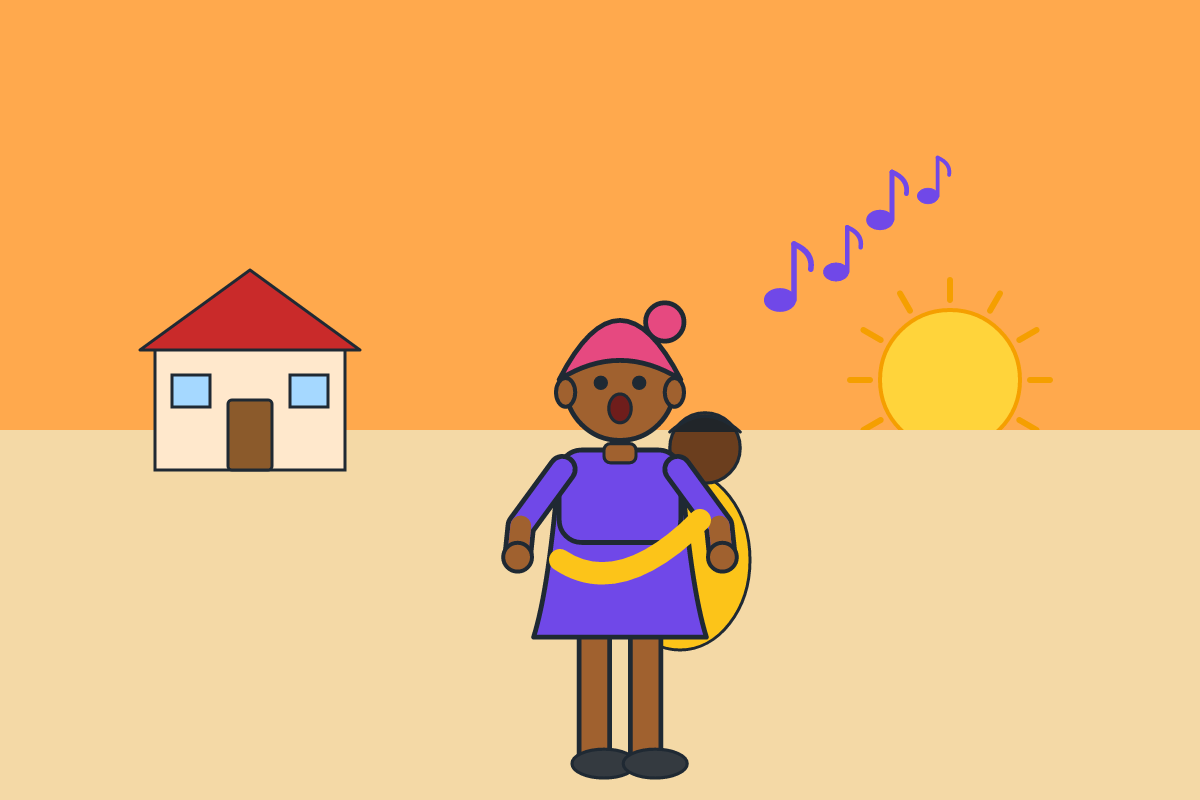
In every Ghanaian home, mothers, grandmothers and older sisters sing softly to babies to calm them and help them sleep. These gentle songs are called cradle songs or lullabies.
1. What Is a Cradle Song?
Cradle song (lullaby): A soft, slow song sung to a baby to calm it or put it to sleep.
Cradle songs have a slow, gentle, rocking rhythm that matches the movement of a mother swaying the baby on her back or in her arms. The words are simple and often repeated. Many praise the baby, promise that mother will return, or tell the baby not to cry.
2. Example (English Version)
Hush, my baby, do not cry,
Mother has gone to the farm nearby,
She will bring you sweet ripe corn,
Sleep, my baby, newly born.
| Feature | Example |
|---|---|
| slow, rocking rhythm | sung while swaying gently |
| repetition | "my baby" is repeated |
| rhyme | cry / nearby; corn / born |
| comfort | "Mother will bring you sweet ripe corn" |
3. Importance of Cradle Songs
- They calm babies and help them sleep.
- They build love between the baby and the caregiver.
- They teach babies the sounds and rhythm of their language early.
- They pass on culture, values and family history.
- They comfort babies when the mother is away.
4. Reading a Narrative
Read this short passage aloud. Then read it in your Ghanaian language with your teacher.
"Every evening, Grandma Adwoa tied little Kofi on her back and sang to him. Her voice was soft and low. Kofi's eyes grew heavy as she swayed from side to side. One day Grandma was ill, and Kofi would not stop crying. His big sister Esi remembered Grandma's song. She tied Kofi on her back and sang it softly. Slowly, Kofi stopped crying and fell asleep. Grandma smiled from her bed and said, 'Now the song belongs to you too.'"
| Question | Answer |
|---|---|
| Who sang to Kofi every evening? | Grandma Adwoa |
| Why did Kofi cry one day? | Grandma was ill and could not sing to him |
| How did Esi help? | She sang Grandma's song while carrying Kofi |
| What did Grandma mean by "the song belongs to you too"? | Esi had learnt the song and could pass it on |
Tip: Sing cradle songs in your Ghanaian language and clap the rhythm gently as you sing.
New words
- cradle song
- A soft song to put a baby to sleep.
- lullaby
- Another name for a cradle song.
- rhythm
- The pattern of beats in a song.
- repetition
- Saying or singing something again.
- narrative
- A story or account of events.
- caregiver
- A person who looks after a child.
Summary
- Cradle songs are soft, slow songs for babies.
- They have a rocking rhythm, repetition and simple words.
- They calm babies and pass on language and culture.
- A narrative should be read carefully to answer questions.
Class activity: Lullaby Circle
- Each member sings a cradle song in your Ghanaian language.
- Clap the rhythm softly together.
- Explain the meaning of one song to the class.
You need: Locally made song or poem cards, Local drum, Gourd shaker
Exercises
Answer in your exercise book first, then check your answers.
1. A cradle song is sung to…
- A. a baby
- B. a soldier
- C. a footballer
- D. a farmer
Show answer
Answer: a babyTo calm it.2. The rhythm of a cradle song is usually…
- A. slow and rocking
- B. fast and loud
- C. harsh
- D. without beat
Show answer
Answer: slow and rockingIt matches swaying.3. In the passage, who sang when Grandma was ill?
- A. Esi
- B. Kofi
- C. Grandma
- D. A neighbour
Show answer
Answer: EsiHis big sister.4. Cradle songs help babies sleep.
- A. True
- B. False
Show answer
Answer: TrueThey calm them.5. Cradle songs do not teach anything.
- A. True
- B. False
Show answer
Answer: FalseThey teach language and culture.6. Another name for a cradle song is a ______.
Show answer
Answer: lullabyBoth mean the same.7. State three importances of cradle songs.
Show answer
Answer: Calm babies, build love, teach language (or pass on culture).Any three.8. What lesson does the passage teach?
Show answer
Answer: Songs and traditions should be learnt and passed on to younger people.Continuity of culture.
Homework
- Ask a mother or grandmother to teach you a cradle song in your Ghanaian language. Write it down and its meaning.