Basic 5 · Ghanaian Language · Penmanship
Full Stop, Comma and Colon
In this topic you will recognise and use the full stop, the comma and the colon correctly in writing.
By the end of these notes you should be able to:
- Identify the full stop, comma and colon
- State the uses of each mark
- Use them correctly in sentences
What you already know
- Punctuation (Basic 4)
Copy everything that has a blue line on its left into your notebook. The other parts are for reading.
- Strand
- Writing
- Sub-strand
- Penmanship
- Indicator
- B5.3.1.1.1-3 – Recognize the use of full stops comma and colon
Introduction
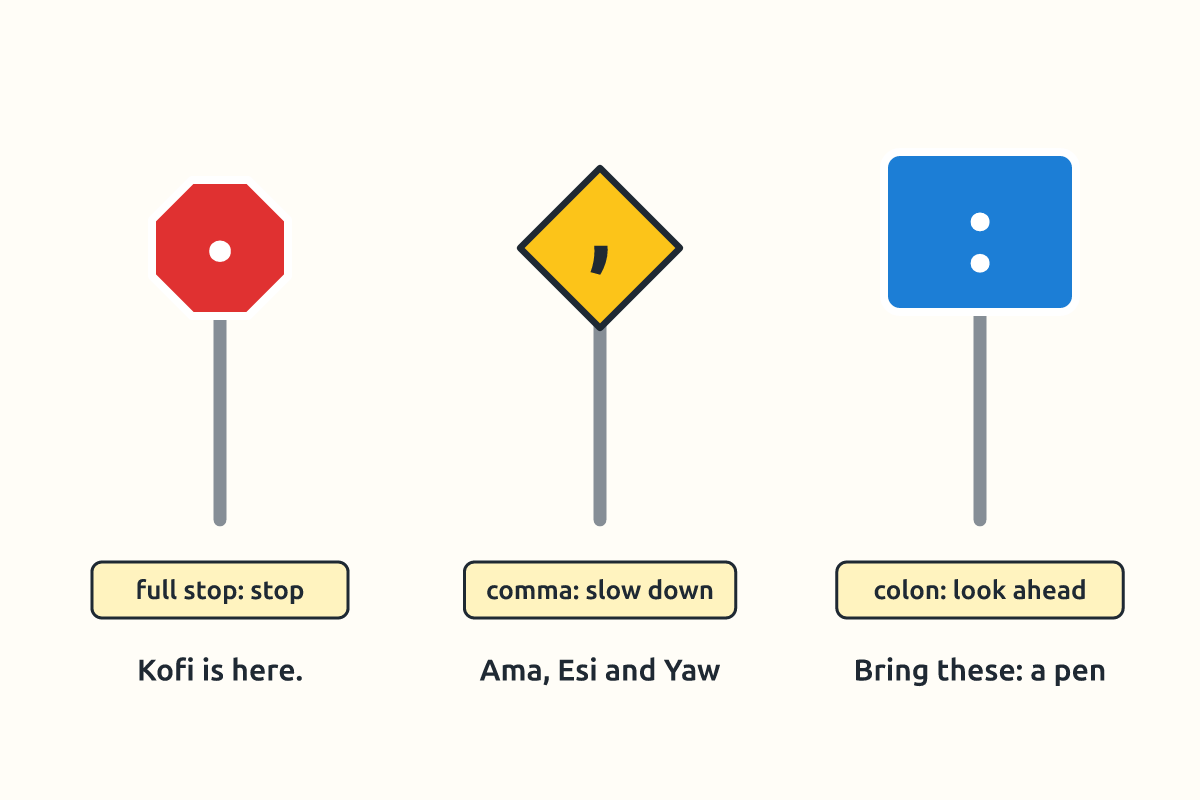
Punctuation marks are like road signs for readers. They tell us where to stop, where to pause and what is coming next. Without them, writing is confusing.
1. The Full Stop (.)
A full stop marks the end of a statement. It tells the reader to stop. It is also used after some abbreviations.
Example: Kofi went to the farm.
2. The Comma (,)
| Use | Example |
|---|---|
| to separate items in a list | We bought yam, plantain, cassava and pepper. |
| after an introductory word or phrase | Yesterday, it rained heavily. |
| before the name of the person spoken to | Ama, come here. |
| to separate parts of a long sentence | When the bell rang, the pupils lined up. |
| in direct speech | Mother said, "Sweep the compound." |
3. The Colon (:)
| Use | Example |
|---|---|
| to introduce a list | Bring these items: a cutlass, a hoe and a basket. |
| to introduce an explanation | We stayed at home: the road was flooded. |
| in time | The meeting starts at 9:30. |
| before a speaker's words in a play | Kofi: Where are you going? |
4. Practice
Example
Punctuate: "my mother sells kenkey fish and pepper at the market"
- Begin with a capital letter: My
- Separate the list with commas: kenkey, fish and pepper
- End with a full stop.
Answer: My mother sells kenkey, fish and pepper at the market.
Example
Punctuate: "you need three things for school pencil eraser and ruler"
- Capital letter: You
- Colon before the list: school:
- Commas in the list and a full stop at the end.
Answer: You need three things for school: a pencil, an eraser and a ruler.
These marks are used in the same way in most Ghanaian languages. Practise writing sentences in your Ghanaian language with each mark.
New words
- punctuation
- Marks that make writing clear.
- full stop
- A mark (.) that ends a statement.
- comma
- A mark (,) that shows a short pause.
- colon
- A mark (:) that introduces a list or explanation.
- statement
- A sentence that gives information.
- abbreviation
- A shortened form of a word.
Summary
- A full stop ends a statement.
- A comma separates items in a list and shows a pause.
- A colon introduces a list, an explanation or speech in a play.
- Correct punctuation makes writing clear.
Class activity: Punctuation Repair
- Your teacher gives sentences in your Ghanaian language without punctuation.
- Add full stops, commas and colons.
- Check your answers with another pair.
You need: Locally made punctuation cards, Sentence strips about local life, Exercise books, Pencils
Exercises
Answer in your exercise book first, then check your answers.
1. Which mark ends a statement?
- A. Full stop
- B. Comma
- C. Colon
- D. Question mark
Show answer
Answer: Full stopIt means stop.2. Which mark introduces a list?
- A. Colon
- B. Full stop
- C. Comma only
- D. Question mark
Show answer
Answer: Colone.g. items: a, b and c.3. Which sentence uses commas correctly?
- A. We bought yam, plantain and pepper.
- B. We, bought yam plantain and pepper.
- C. We bought, yam plantain, and pepper
- D. We bought yam plantain and, pepper.
Show answer
Answer: We bought yam, plantain and pepper.Commas separate list items.4. A comma shows a short pause.
- A. True
- B. False
Show answer
Answer: TrueShorter than a full stop.5. A colon is used at the end of every sentence.
- A. True
- B. False
Show answer
Answer: FalseA full stop is.6. In time, we write 9 ______ 30 using a colon.
Show answer
Answer: :9:30.7. Punctuate: "bring the following a bucket a broom and a cloth"
Show answer
Answer: Bring the following: a bucket, a broom and a cloth.Colon and commas.8. Give two uses of the comma with examples.
Show answer
Answer: Separating list items (yam, plantain and pepper); after an introductory word (Yesterday, it rained).Any two.
Homework
- Write five sentences in your Ghanaian language using full stops, commas and colons.