Basic 5 · Ghanaian Language · Creative and Free Writing
Creating a Story About Our Environment
In this topic you will create and write an original story that relates to your environment.
By the end of these notes you should be able to:
- Generate ideas from your environment
- Plan a story using a story map
- Write an original story with a clear message
What you already know
- Narrative writing
Copy everything that has a blue line on its left into your notebook. The other parts are for reading.
- Strand
- Composition Writing
- Sub-strand
- Creative and Free Writing
- Indicator
- B5.4.2.1.1-3 – Create a story that relates to their environment
Introduction
Your surroundings are full of stories: the farm, the river, the market, the lorry station and the school compound. Good writers use what they see around them to create interesting stories.
1. Getting Ideas from the Environment
| Place | Possible story |
|---|---|
| river | a child who saves a friend from drowning; a river polluted by galamsey |
| farm | a farmer who discovers a clever way to scare birds |
| market | a lost child who finds her way home |
| school | a new pupil who becomes a class hero |
| festival | a drummer who loses his drum before the durbar |
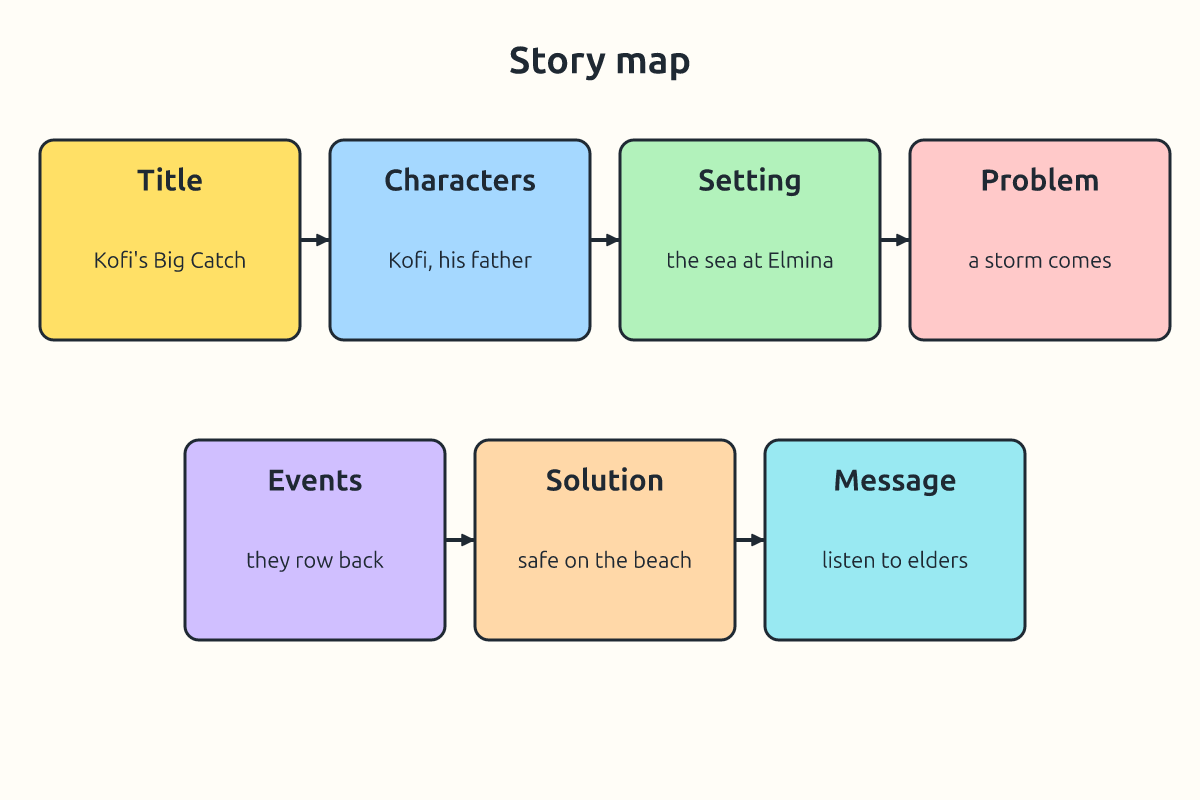
2. Planning with a Story Map
| Part | Questions | Example |
|---|---|---|
| title | What will I call my story? | "The Brave Fisher Girl" |
| characters | Who is in the story? | Akosua, her brother Kwesi, fishermen |
| setting | Where and when? | a fishing village near Elmina, early morning |
| problem | What goes wrong? | Kwesi's canoe overturns in rough waves |
| events | What happens next? | Akosua runs to call the fishermen and throws a rope |
| solution | How is it solved? | The fishermen pull Kwesi to safety |
| message | What is the lesson? | Quick thinking and courage save lives |
3. Writing the Story
- Start with an interesting opening sentence to catch the reader's attention.
- Describe the setting using the senses: sights, sounds and smells.
- Use dialogue to bring characters to life.
- Arrange events in order using linking words such as first, then, suddenly, finally.
- End with a clear solution and message.
- Give your story a title.
4. Editing
After writing, read your story again. Check spelling, punctuation and tone marks if your language uses them. Make sure the events are in order and the message is clear. Then write a neat final copy.
Tip: Write the story in your Ghanaian language. Use proverbs to make your story richer.
New words
- original
- New and created by you.
- story map
- A plan showing the parts of a story.
- environment
- The surroundings in which we live.
- opening
- The first sentence or part of a story.
- linking words
- Words that connect events, such as then and finally.
- edit
- To check and correct writing.
Summary
- Use your environment for story ideas.
- Plan with a story map: characters, setting, problem, events, solution and message.
- Write with a strong opening, description, dialogue and linking words.
- Edit your story before writing the final copy.
Class activity: Environment Stories
- Choose a place in your community.
- Plan a story using a story map.
- Write and illustrate it in your Ghanaian language.
You need: Printed photographs of a local market or festival, Locally made story-planning cards, Exercise books, Pencils
Exercises
Answer in your exercise book first, then check your answers.
1. A plan showing the parts of a story is a…
- A. story map
- B. dictionary
- C. timetable
- D. register
Show answer
Answer: story mapIt helps planning.2. Which is a linking word?
- A. Suddenly
- B. Market
- C. River
- D. Blue
Show answer
Answer: SuddenlyIt connects events.3. What goes wrong in a story is the…
- A. problem
- B. title
- C. setting
- D. message
Show answer
Answer: problemIt creates interest.4. You can get story ideas from your environment.
- A. True
- B. False
Show answer
Answer: TrueFarms, markets, rivers.5. You should not edit your story.
- A. True
- B. False
Show answer
Answer: FalseEditing improves writing.6. Checking and correcting writing is to ______.
Show answer
Answer: editBefore the final copy.7. Name four parts of a story map.
Show answer
Answer: Characters, setting, problem and solution (or title, events, message).Any four.8. Why is it good to describe the setting using the senses?
Show answer
Answer: It helps readers imagine the place clearly and makes the story more interesting.Vivid writing.
Homework
- Complete your environment story and read it to your family.