Basic 5 · Creative Arts · Appreciating and Appraising
Guidelines for Appreciating Performing Arts
In this topic you will develop guidelines for appreciating and appraising your own and others' performances that reflect African history and culture.
By the end of these notes you should be able to:
- Identify what to look for in a performance
- Use guidelines to appraise music, dance and drama
- Give and receive helpful feedback
What you already know
- Guidelines for appreciating visual art
Copy everything that has a blue line on its left into your notebook. The other parts are for reading.
- Strand
- Performing Arts
- Sub-strand
- Appreciating and Appraising
- Indicator
- B5.2.4.6.1 – Develop guidelines for appreciating and appraising own and others’ performing artworks that reflect the history and culture of the African people
Introduction
After a school cultural show, teachers and pupils often discuss which item was the best. To be fair, we need clear guidelines for judging performances.
1. What to Look For
| Area | Questions |
|---|---|
| content | Is the theme clear? Does it reflect African culture or history? |
| skill | Are the singing, dancing, drumming or acting done well? Are they in rhythm? |
| expression | Do performers show feeling through face, voice and body? |
| costume and props | Are they suitable and neat? |
| teamwork | Do performers work together and keep time? |
| audience contact | Do performers face and engage the audience? |
| message | What did the audience learn? |
2. Appraising Music
Listen for the melody (tune), rhythm (beat pattern), tempo (speed), dynamics (loud and soft) and harmony (voices or instruments sounding together). Check that words are clear and the singers are in tune.
3. Appraising Dance
Watch the movements, gestures, facial expressions, formations and use of space. In many Ghanaian dances, gestures carry meaning. In Adowa, for example, dancers use hand and body gestures to express ideas such as sorrow, gratitude, praise or bravery. Check whether the dancers move with the drums.
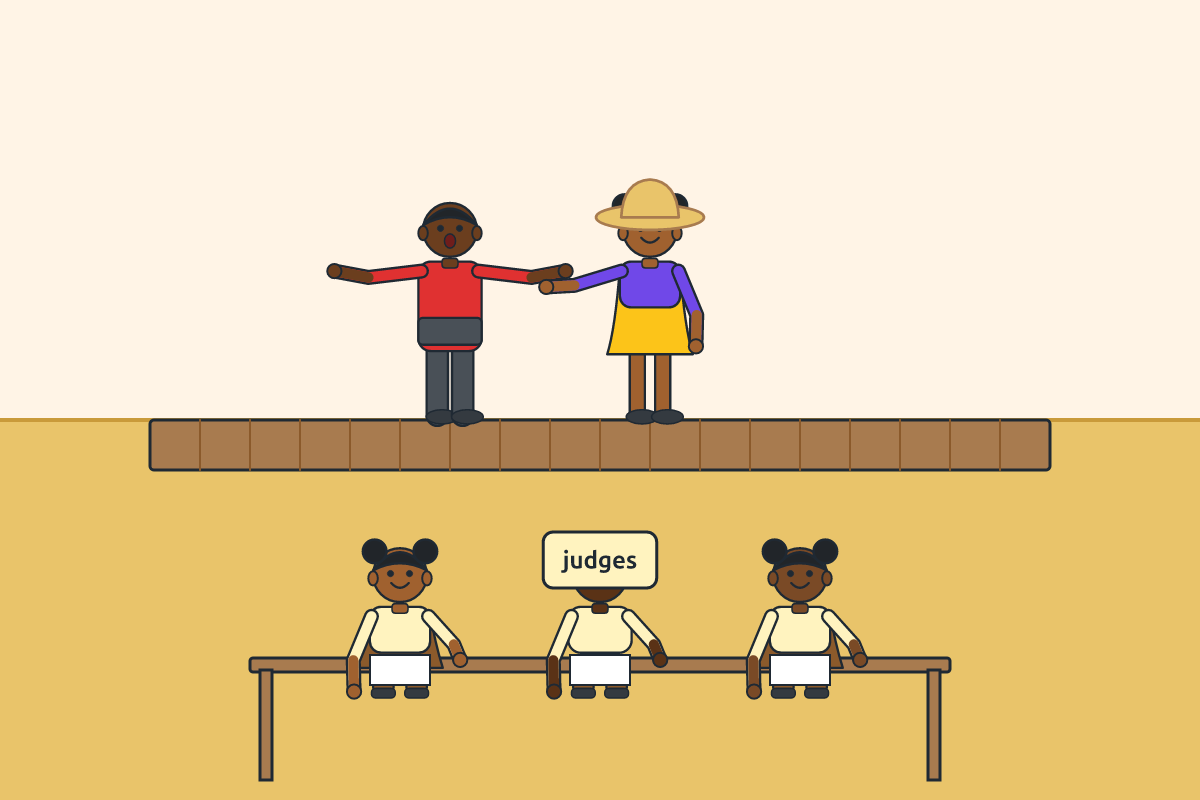
4. Appraising Drama
Look at how well actors speak (loud, clear, with feeling), how they move on stage, whether the story has a clear beginning, middle and end, and whether the costumes and props suit the setting.
| Criteria | Marks |
|---|---|
| theme and message | 5 |
| skill and technique | 5 |
| expression | 5 |
| costume and props | 5 |
| teamwork | 5 |
| Total | 25 |
5. Giving Feedback
Use the "two stars and a wish" method: give two things the performers did well and one wish for improvement. For example: "Your drumming was in time and your costumes were colourful. I wish the actors spoke more loudly."
New words
- melody
- The tune of a song.
- rhythm
- The pattern of beats.
- tempo
- The speed of music.
- dynamics
- How loud or soft music is.
- expression
- Showing feeling in a performance.
- criteria
- Standards used for judging.
Summary
- Use clear criteria: content, skill, expression, costume, teamwork and message.
- Listen for melody, rhythm, tempo and dynamics in music.
- Watch movements and gestures in dance; voice and story in drama.
- Give feedback using "two stars and a wish".
Class activity: Score the Show
- Watch a performance by another group.
- Score it using the score sheet.
- Give "two stars and a wish" feedback.
You need: Locally made drum, Gourd shaker, Kente cloth sample
Exercises
Answer in your exercise book first, then check your answers.
1. The speed of music is its…
- A. tempo
- B. melody
- C. rhythm
- D. dynamics
Show answer
Answer: tempoFast or slow.2. "Two stars and a wish" means…
- A. two good points and one improvement
- B. two prizes
- C. two songs
- D. two dances
Show answer
Answer: two good points and one improvementHelpful feedback.3. How loud or soft music is, is called…
- A. dynamics
- B. tempo
- C. harmony
- D. costume
Show answer
Answer: dynamicsLoud and soft.4. Teamwork is important in group performances.
- A. True
- B. False
Show answer
Answer: TruePerformers must work together.5. Expression is not important in drama.
- A. True
- B. False
Show answer
Answer: FalseActors must show feeling.6. Standards used for judging are called ______.
Show answer
Answer: criteriaSingular: criterion.7. State three things to look for when appraising a dance.
Show answer
Answer: Movements, gestures and formations (or rhythm with drums, expression, costume).Any three.8. Why should performances be judged with a score sheet?
Show answer
Answer: It makes judging fair and clear because everyone uses the same criteria.Fairness.
Homework
- Watch a performance on TV or at an event and write "two stars and a wish" about it.