Basic 4 · Science · Living and Non-Living Things
Life Processes in Animals
In this topic you will study how animals carry out life processes such as feeding, breathing, moving and reproducing.
By the end of these notes you should be able to:
- Describe how different animals feed
- Describe how animals breathe and move
- Describe how animals reproduce
What you already know
- Classifying animals
Copy everything that has a blue line on its left into your notebook. The other parts are for reading.
- Strand
- Diversity of matter
- Sub-strand
- Living and Non-Living Things
- Indicator
- B4.1.1.1.2 – Know life processes of animals
Introduction
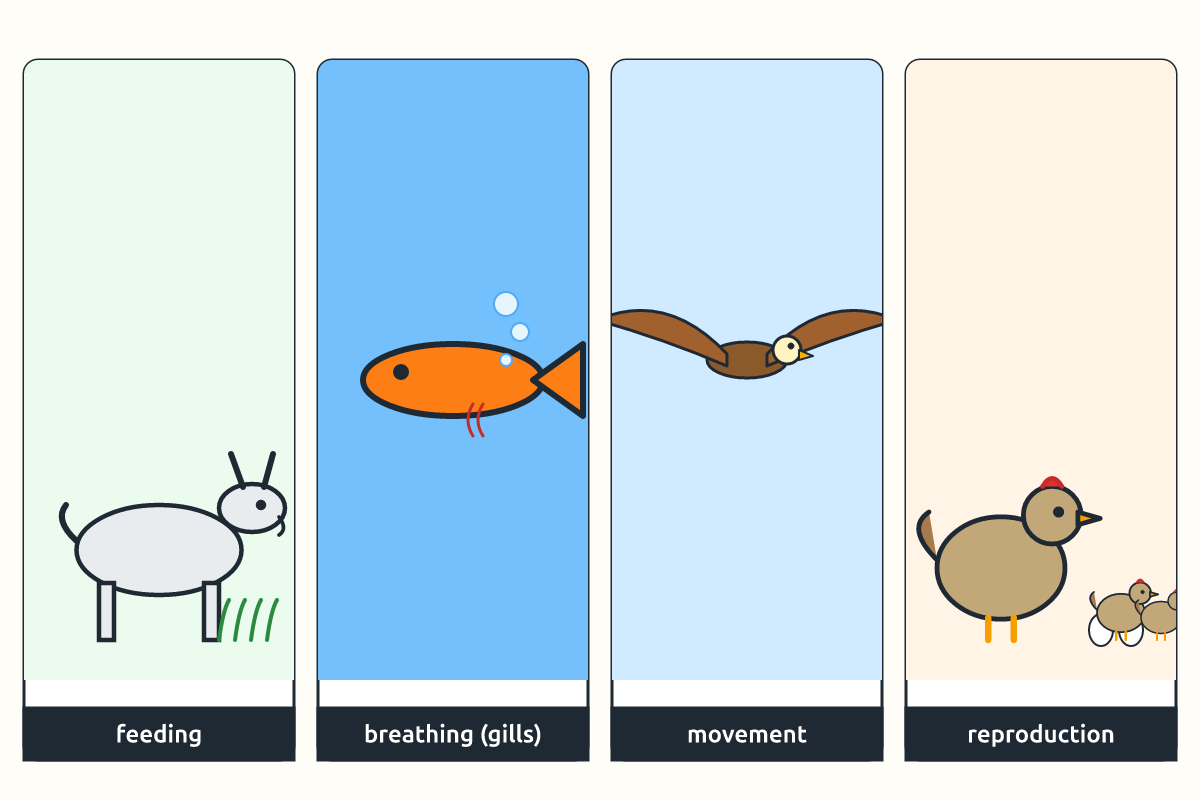
A goat eats grass. A lion eats meat. A fish breathes in water. A bird flies. Animals carry out life processes in different ways.
1. Feeding
| Type | Food | Examples |
|---|---|---|
| herbivore | plants only | goat, cow, grasshopper |
| carnivore | other animals | lion, hawk, snake |
| omnivore | plants and animals | human, hen, pig |
2. Breathing
| Organ | Animals |
|---|---|
| lungs | mammals, birds, reptiles |
| gills | fish, tadpoles |
| tiny holes (spiracles) | insects |
3. Moving
- legs: walking, running and hopping (goat, frog)
- wings: flying (birds, bats, insects)
- fins: swimming (fish)
- sliding the body: snakes and snails
4. Reproducing
- laying eggs: birds, most reptiles, insects, fish
- giving birth to live young: most mammals
New words
- herbivore
- An animal that eats only plants.
- carnivore
- An animal that eats other animals.
- omnivore
- An animal that eats plants and animals.
- gills
- Organs fish use to breathe in water.
- reproduce
- To produce young ones.
- organ
- A body part that does a special job.
Summary
- Herbivores eat plants; carnivores eat animals; omnivores eat both.
- Mammals, birds and reptiles breathe with lungs; fish use gills.
- Animals move with legs, wings, fins or by sliding.
- Animals reproduce by laying eggs or giving birth to live young.
Class activity: Life Process Cards
- Use the photographs of local animals.
- For each animal, write how it feeds, breathes, moves and reproduces.
- Present one animal to the class.
You need: Printed photographs of local animals, Feathers, Snail shells
Exercises
Answer in your exercise book first, then check your answers.
1. Which animal is a herbivore?
- A. Cow
- B. Lion
- C. Hawk
- D. Snake
Show answer
Answer: CowCows eat grass.2. How do fish breathe?
- A. With gills
- B. With lungs
- C. Through feathers
- D. Through the skin only
Show answer
Answer: With gillsGills take oxygen from water.3. Which animal is an omnivore?
- A. Human
- B. Goat
- C. Lion
- D. Grasshopper
Show answer
Answer: HumanHumans eat plants and animals.4. Birds reproduce by laying eggs.
- A. True
- B. False
Show answer
Answer: TrueAll birds lay eggs.5. Snakes move using legs.
- A. True
- B. False
Show answer
Answer: FalseSnakes slide their bodies.6. An animal that eats other animals is a ______.
Show answer
Answer: carnivoreThat is a carnivore.7. Give one example each of a herbivore, a carnivore and an omnivore.
Show answer
Answer: E.g. goat, lion, human.They differ in diet.8. Why does a fish die when taken out of water?
Show answer
Answer: Its gills can only take oxygen from water, not from air.Fish breathe with gills.
Homework
- Observe a hen or goat at home. Write how it feeds, moves and breathes.