Basic 4 · History · Major Historical Locations
Cape Coast Castle
In this topic you will describe the history of Cape Coast Castle.
By the end of these notes you should be able to:
- Describe the history of Cape Coast Castle
- Explain its role in the slave trade
- Explain why it is a World Heritage Site
What you already know
- Historical places in Ghana (Basic 2)
Copy everything that has a blue line on its left into your notebook. The other parts are for reading.
- Strand
- My country Ghana
- Sub-strand
- Major Historical Locations
- Indicator
- B4.1.4.1.1 – Describe the history of Ghana's major historical locations
Introduction
Cape Coast Castle stands white and tall by the sea. Inside are dark dungeons where enslaved Africans were kept before being shipped across the Atlantic Ocean.
1. History of the Castle
| Year | Event |
|---|---|
| 1653 | the Swedes built a trading fort here |
| 1664 | the British captured it and later enlarged it |
| 1664–1877 | it was the British headquarters on the Gold Coast |
| 1877 | the capital moved to Accra |
2. The Slave Trade
- Enslaved Africans were held in crowded, dark dungeons.
- They passed through the "Door of No Return" to ships.
- Many died on the journey to the Americas.
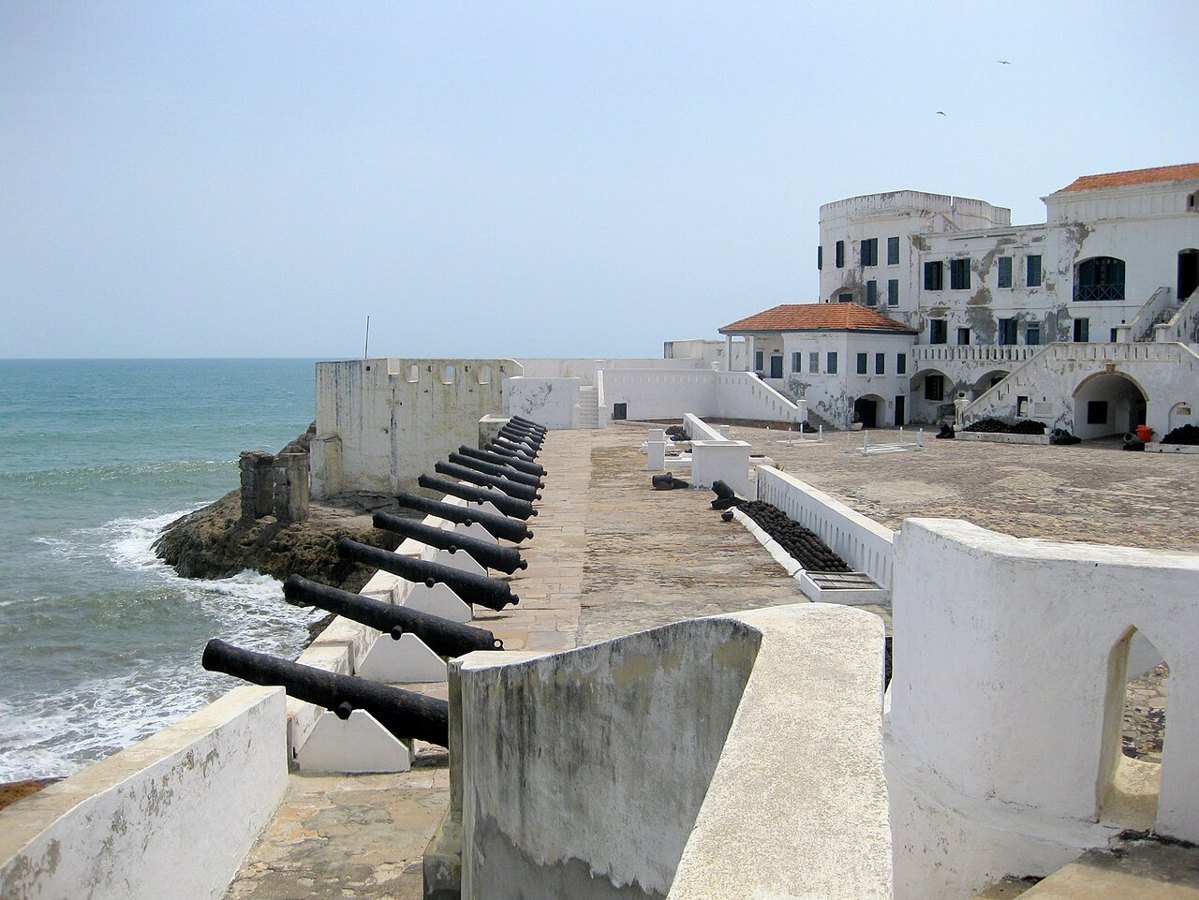
3. A World Heritage Site
UNESCO lists Ghana's forts and castles, including Cape Coast Castle, as a World Heritage Site. Visitors come to remember the victims of the slave trade.
New words
- castle
- A large fortified building.
- dungeon
- A dark underground prison.
- slave trade
- The buying and selling of people.
- Door of No Return
- The exit enslaved people passed through to ships.
- UNESCO
- The UN agency that protects world heritage.
- heritage
- Something valuable passed down from the past.
Summary
- Cape Coast Castle was built by the Swedes in 1653 and taken by the British.
- It was the British headquarters until 1877.
- Enslaved Africans were kept in its dungeons.
- It is a UNESCO World Heritage Site.
Class activity: Castle Visit (Virtual)
- Look at photographs of Cape Coast Castle.
- Describe the dungeons and the Door of No Return.
- Discuss why we must remember the slave trade.
You need: Ghana map, Printed photographs of major Ghanaian historical sites, Locally made site-name cards
Exercises
Answer in your exercise book first, then check your answers.
1. Where is Cape Coast Castle?
- A. Cape Coast
- B. Kumasi
- C. Tamale
- D. Ho
Show answer
Answer: Cape CoastIt is in the Central Region.2. Who first built a fort at Cape Coast?
- A. The Swedes
- B. The Portuguese
- C. The Dutch
- D. The Danes
Show answer
Answer: The SwedesIn 1653.3. Until when was Cape Coast the British headquarters?
- A. 1877
- B. 1957
- C. 1653
- D. 1901
Show answer
Answer: 1877The capital moved to Accra.4. Enslaved Africans were kept in the castle dungeons.
- A. True
- B. False
Show answer
Answer: TrueBefore being shipped.5. Cape Coast Castle was built in 1957.
- A. True
- B. False
Show answer
Answer: FalseIt was built in the 1600s.6. A dark underground prison is a ______.
Show answer
Answer: dungeonThe castle has dungeons.7. Explain the "Door of No Return".
Show answer
Answer: The exit through which enslaved Africans were taken to ships, never to return home.It symbolises loss.8. Why is it important to preserve Cape Coast Castle?
Show answer
Answer: To remember the victims of the slave trade and teach future generations.It is a place of memory.
Homework
- Write three facts about Cape Coast Castle.