Basic 4 · Ghanaian Language · Reading
Reading Long Stories Aloud
In this topic you will read longer stories aloud correctly and with expression.
By the end of these notes you should be able to:
- Read long stories aloud correctly
- Use punctuation to guide pauses and tone
- Summarise a long story
What you already know
- Reading aloud with correct pronunciation and tone
Copy everything that has a blue line on its left into your notebook. The other parts are for reading.
- Strand
- Extensive Reading
- Sub-strand
- Reading
- Indicator
- B4.6.1.1.1 – Read long stories aloud correctly
Introduction
Reading a long story aloud takes practice. You must keep your place, read correctly and keep listeners interested.
1. A Story to Read (English example)
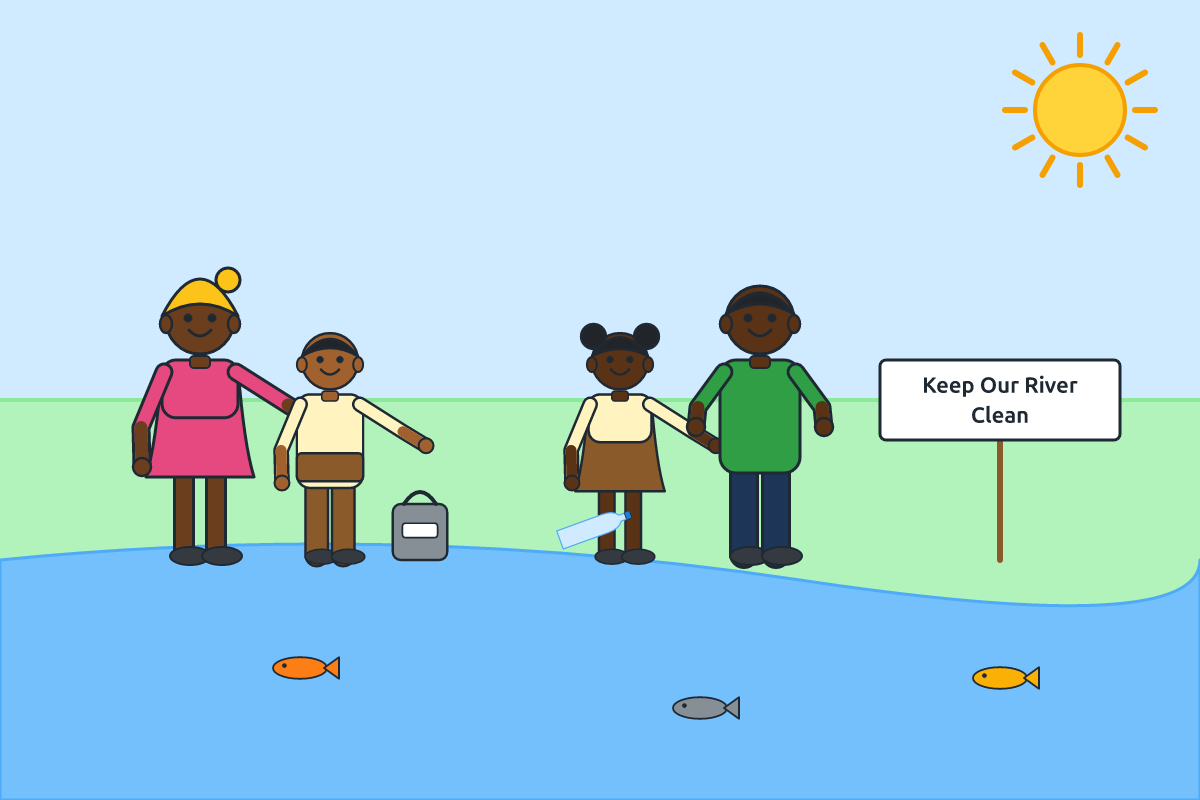
"Abena's family lived near a river. One morning, she saw that the river was brown and full of rubbish. 'Who did this?' she asked her father. 'People threw rubbish into the river,' he replied. Abena told her friends at school. On Saturday, the children and their parents cleaned the river bank. They put up a sign: Keep Our River Clean. Soon, the water became clear again, and the fish returned."
2. Reading Tips
| Tip | Why |
|---|---|
| read silently first | understand the story |
| use a pointer | keep your place |
| pause at punctuation | listeners follow the meaning |
| change your voice for dialogue | make characters come alive |
| look up sometimes | connect with listeners |
3. Summarising
Summary: Abena saw that the river was dirty, and she and her community cleaned it until the fish returned.
New words
- summarise
- To give the main points briefly.
- dialogue
- Words spoken by characters.
- pointer
- A stick used to follow words.
- expression
- Showing feeling with your voice.
- community
- People living in the same area.
- correctly
- Without mistakes.
Summary
- Read long stories silently first, then aloud.
- Use a pointer and pause at punctuation.
- Change your voice for dialogue.
- Summarise the story in a few sentences.
Class activity: Read-Aloud Relay
- Take turns reading parts of a long story in your Ghanaian language.
- Listen for correct pronunciation and pauses.
- Summarise the story together.
You need: Ghanaian-language storybook, Locally made sentence cards, Pointer stick
Exercises
Answer in your exercise book first, then check your answers.
1. What was wrong with the river?
- A. It was brown and full of rubbish
- B. It was dry
- C. It was frozen
- D. It was too deep
Show answer
Answer: It was brown and full of rubbishThe story says so.2. What did the children do on Saturday?
- A. Cleaned the river bank
- B. Went to the zoo
- C. Played football
- D. Slept
Show answer
Answer: Cleaned the river bankWith their parents.3. Giving the main points briefly is…
- A. Summarising
- B. Copying
- C. Spelling
- D. Drawing
Show answer
Answer: SummarisingThat is summarising.4. The fish returned when the water became clear.
- A. True
- B. False
Show answer
Answer: TrueThe story says so.5. Abena threw rubbish into the river.
- A. True
- B. False
Show answer
Answer: FalseOther people did; Abena helped clean it.6. Words spoken by characters are ______.
Show answer
Answer: dialogueDialogue makes stories lively.7. Summarise the story in one sentence.
Show answer
Answer: Abena and her community cleaned the dirty river and the fish returned.Main points only.8. What lesson does the story teach?
Show answer
Answer: We should keep our rivers clean and work together to solve problems.Community action works.
Homework
- Read a long story aloud to your family and summarise it.